
AlterEgo–an extraordinary invention from MIT’s Media Lab, tries to close that gap between the swift silence of thinking and the actions we take in the world.
By Kaviya Sneha
There is something quietly fascinating about the idea that thought travels faster than light. When we speak, we are limited by the physics of sound: the vibrations of our vocal cords, the movement of air, and the time it takes for words to reach another person. But in our minds, ideas flash and flow with a speed no machine has yet matched. AlterEgo, an extraordinary invention from MIT’s Media Lab, tries to close that gap between the swift silence of thinking and the actions we take in the world.
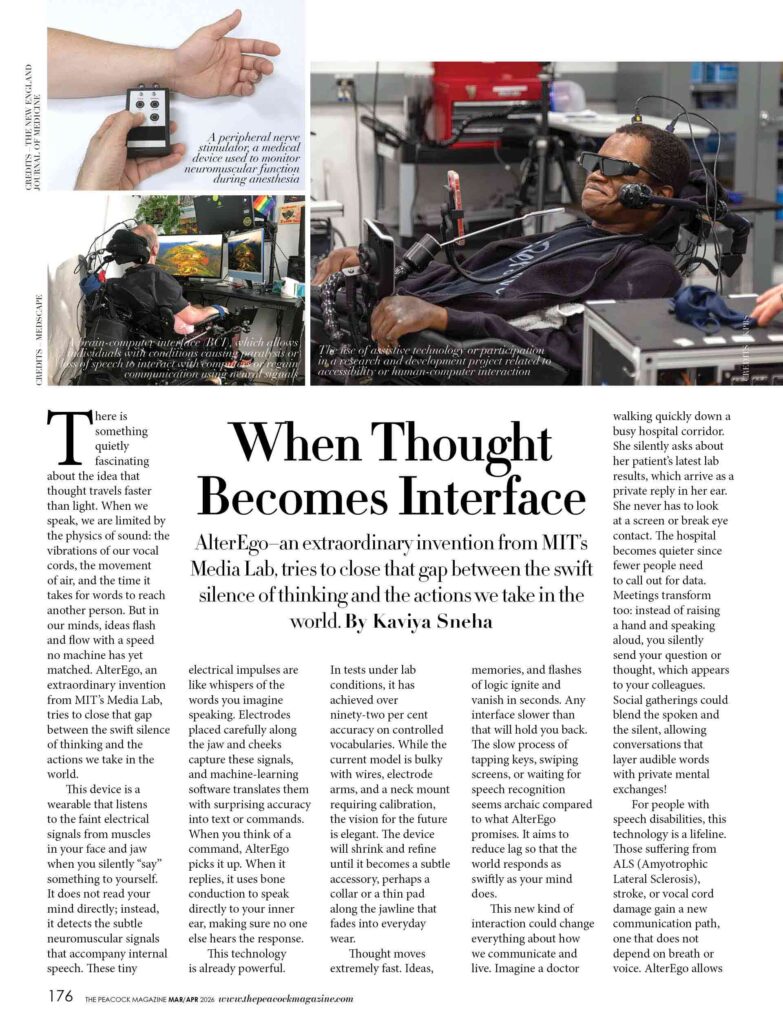
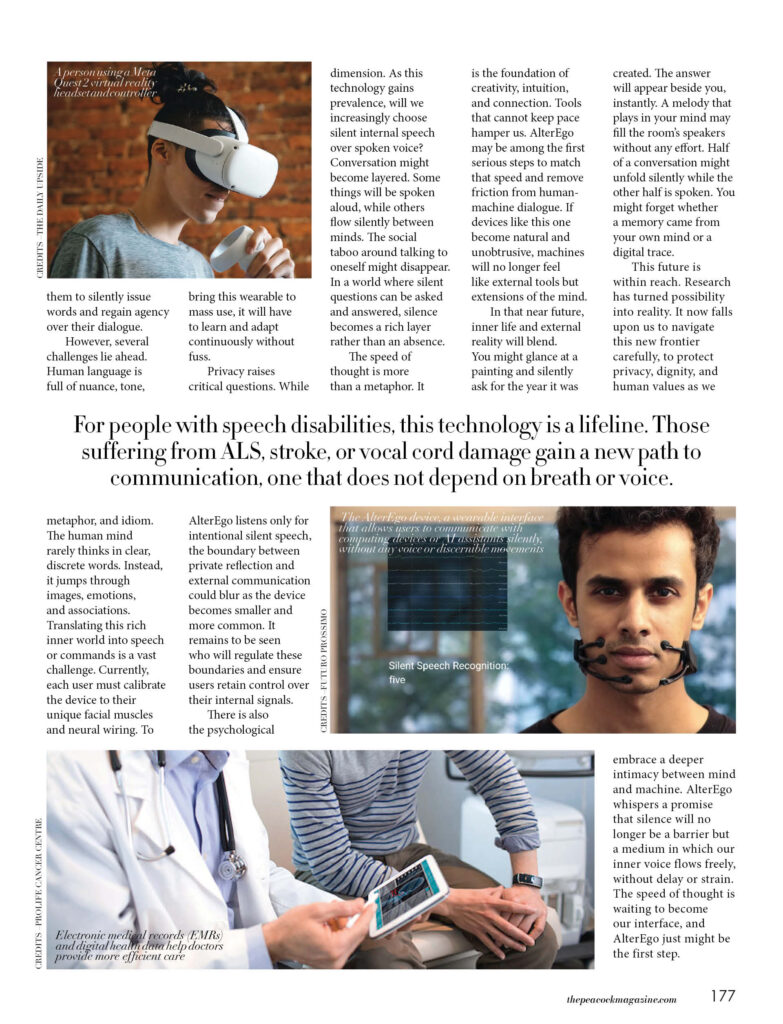
This device is a wearable that listens to the faint electrical signals from muscles in your face and jaw when you silently “say” something to yourself. It does not read your mind directly; instead, it detects the subtle neuromuscular signals that accompany internal speech. These tiny electrical impulses are like whispers of the words you imagine speaking. Electrodes placed carefully along the jaw and cheeks capture these signals, and machine-learning software translates them with surprising accuracy into text or commands. When you think of a command, AlterEgo picks it up. When it replies, it uses bone conduction to speak directly to your inner ear, making sure no one else hears the response.
This technology is already powerful. In tests under lab conditions, it has achieved over ninety-two per cent accuracy on controlled vocabularies. While the current model is bulky with wires, electrode arms, and a neck mount requiring calibration, the vision for the future is elegant. The device will shrink and refine until it becomes a subtle accessory, perhaps a collar or a thin pad along the jawline that fades into everyday wear.
Thought moves extremely fast. Ideas, memories, and flashes of logic ignite and vanish in seconds. Any interface slower than that will hold you back. The slow process of tapping keys, swiping screens, or waiting for speech recognition seems archaic compared to what AlterEgo promises. It aims to reduce lag so that the world responds as swiftly as your mind does.
This new kind of interaction could change everything about how we communicate and live. Imagine a doctor walking quickly down a busy hospital corridor. She silently asks about her patient’s latest lab results, which arrive as a private reply in her ear. She never has to look at a screen or break eye contact. The hospital becomes quieter since fewer people need to call out for data. Meetings transform too: instead of raising a hand and speaking aloud, you silently send your question or thought, which appears to your colleagues. Social gatherings could blend the spoken and the silent, allowing conversations that layer audible words with private mental exchanges!
For people with speech disabilities, this technology is a lifeline. Those suffering from ALS (Amyotrophic Lateral Sclerosis), stroke, or vocal cord damage gain a new communication path, one that does not depend on breath or voice. AlterEgo allows them to silently issue words and regain agency over their dialogue.
However, several challenges lie ahead. Human language is full of nuance, tone, metaphor, and idiom. The human mind rarely thinks in clear, discrete words. Instead, it jumps through images, emotions, and associations. Translating this rich inner world into speech or commands is a vast challenge. Currently, each user must calibrate the device to their unique facial muscles and neural wiring. To bring this wearable to mass use, it will have to learn and adapt continuously without fuss.
Privacy raises critical questions. While AlterEgo listens only for intentional silent speech, the boundary between private reflection and external communication could blur as the device becomes smaller and more common. It remains to be seen who will regulate these boundaries and ensure users retain control over their internal signals.
There is also the psychological dimension. As this technology gains prevalence, will we increasingly choose silent internal speech over spoken voice? Conversation might become layered. Some things will be spoken aloud, while others flow silently between minds. The social taboo around talking to oneself might disappear. In a world where silent questions can be asked and answered, silence becomes a rich layer rather than an absence.
The speed of thought is more than a metaphor. It is the foundation of creativity, intuition, and connection. Tools that cannot keep pace hamper us. AlterEgo may be among the first serious steps to match that speed and remove friction from human-machine dialogue. If devices like this one become natural and unobtrusive, machines will no longer feel like external tools but extensions of the mind.
In that near future, inner life and external reality will blend. You might glance at a painting and silently ask for the year it was created. The answer will appear beside you, instantly. A melody that plays in your mind may fill the room’s speakers without any effort. Half of a conversation might unfold silently while the other half is spoken. You might forget whether a memory came from your own mind or a digital trace.
This future is within reach. Research has turned possibility into reality. It now falls upon us to navigate this new frontier carefully, to protect privacy, dignity, and human values as we embrace a deeper intimacy between mind and machine. AlterEgo whispers a promise that silence will no longer be a barrier but a medium in which our inner voice flows freely, without delay or strain. The speed of thought is waiting to become our interface, and AlterEgo just might be the first step.