
The Peacock Magazine looks at the trend evolution over decades.
By Manish Mishra
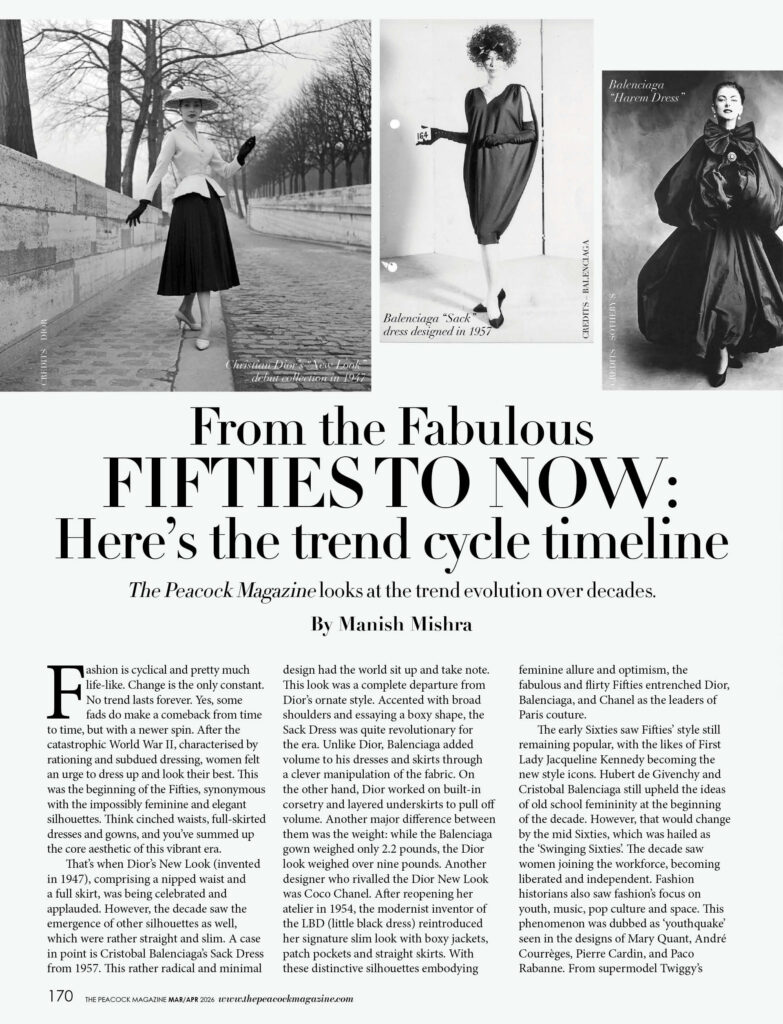
Fashion is cyclical and pretty much life-like. Change is the only constant. No trend lasts forever. Yes, some fads do make a comeback from time to time, but with a newer spin. After the catastrophic World War II, characterised by rationing and subdued dressing, women felt an urge to dress up and look their best. This was the beginning of the Fifties, synonymous with the impossibly feminine and elegant silhouettes. Think cinched waists, full-skirted dresses and gowns, and you’ve summed up the core aesthetic of this vibrant era.
That’s when Dior’s New Look (invented in 1947), comprising a nipped waist and a full skirt, was being celebrated and applauded. However, the decade saw the emergence of other silhouettes as well, which were rather straight and slim. A case in point is Cristobal Balenciaga’s Sack Dress from 1957. This rather radical and minimal design had the world sit up and take note. This look was a complete departure from Dior’s ornate style. Accented with broad shoulders and essaying a boxy shape, the Sack Dress was quite revolutionary for the era. Unlike Dior, Balenciaga added volume to his dresses and skirts through a clever manipulation of the fabric. On the other hand, Dior worked on built-in corsetry and layered underskirts to pull off volume. Another major difference between them was the weight: while the Balenciaga gown weighed only 2.2 pounds, the Dior look weighed over nine pounds. Another designer who rivalled the Dior New Look was Coco Chanel. After reopening her atelier in 1954, the modernist inventor of the LBD (little black dress) reintroduced her signature slim look with boxy jackets, patch pockets and straight skirts. With these distinctive silhouettes embodying feminine allure and optimism, the fabulous and flirty Fifties entrenched Dior, Balenciaga, and Chanel as the leaders of Paris couture.
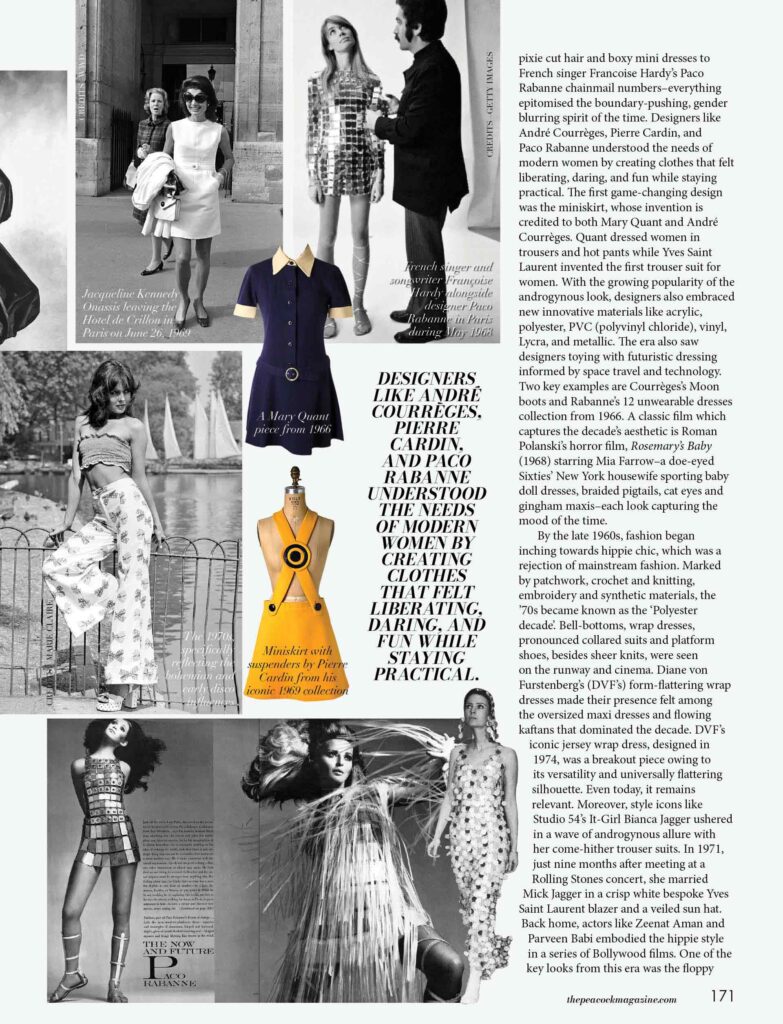
The early Sixties saw Fifties’ style still remaining popular, with the likes of First Lady Jacqueline Kennedy becoming the new style icons. Hubert de Givenchy and Cristobal Balenciaga still upheld the ideas of old school femininity at the beginning of the decade. However, that would change by the mid Sixties, which was hailed as the ‘Swinging Sixties’. The decade saw women joining the workforce, becoming liberated and independent. Fashion historians also saw fashion’s focus on youth, music, pop culture and space. This phenomenon was dubbed as ‘youthquake’ seen in the designs of Mary Quant, André Courrèges, Pierre Cardin, and Paco Rabanne. From supermodel Twiggy’s pixie cut hair and boxy mini dresses to French singer Francoise Hardy’s Paco Rabanne chainmail numbers–everything epitomised the boundary-pushing, gender blurring spirit of the time. Designers like André Courrèges, Pierre Cardin, and Paco Rabanne understood the needs of modern women by creating clothes that felt liberating, daring, and fun while staying practical. The first game-changing design was the miniskirt, whose invention is credited to both Mary Quant and André Courrèges. Quant dressed women in trousers and hot pants while Yves Saint Laurent invented the first trouser suit for women. With the growing popularity of the androgynous look, designers also embraced new innovative materials like acrylic, polyester, PVC (polyvinyl chloride), vinyl, Lycra, and metallic. The era also saw designers toying with futuristic dressing informed by space travel and technology. Two key examples are Courrèges’s Moon boots and Rabanne’s 12 unwearable dresses collection from 1966. A classic film which captures the decade’s aesthetic is Roman Polanski’s horror film, Rosemary’s Baby (1968) starring Mia Farrow–a doe-eyed Sixties’ New York housewife sporting baby doll dresses, braided pigtails, cat eyes and gingham maxis–each look capturing the mood of the time.
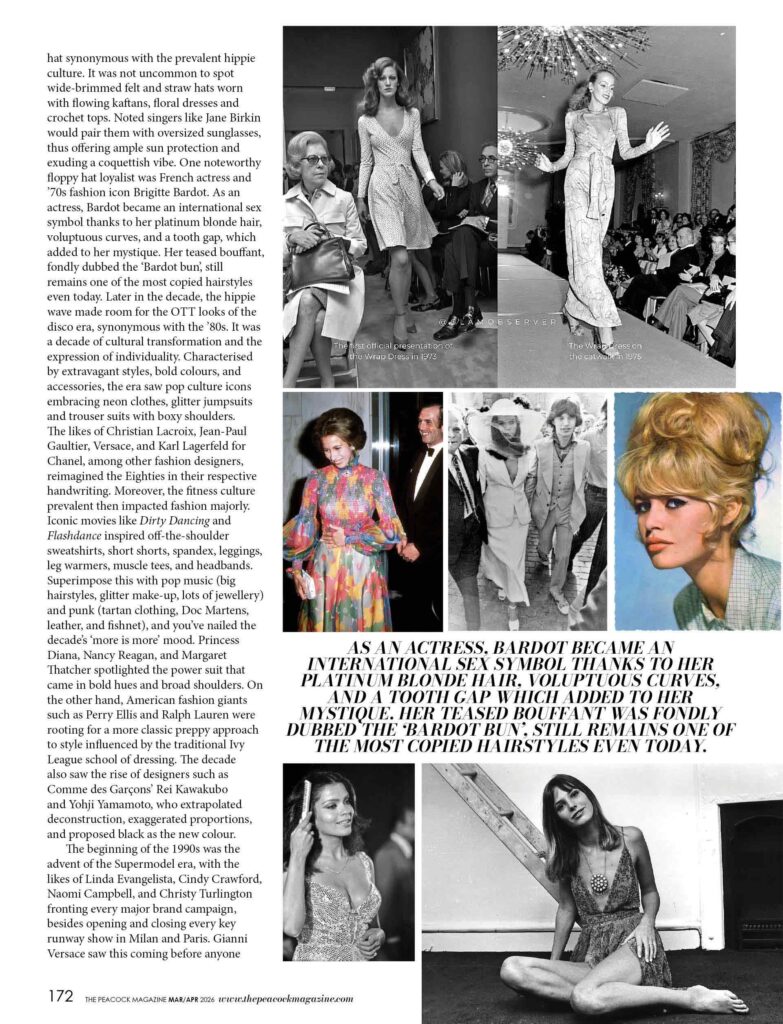
By the late 1960s, fashion began inching towards hippie chic, which was a rejection of mainstream fashion. Marked by patchwork, crochet and knitting, embroidery and synthetic materials, the ’70s became known as the ‘Polyester decade’. Bell-bottoms, wrap dresses, pronounced collared suits and platform shoes, besides sheer knits, were seen on the runway and cinema. Diane von Furstenberg’s (DVF’s) form-flattering wrap dresses made their presence felt among the oversized maxi dresses and flowing kaftans that dominated the decade. DVF’s iconic jersey wrap dress, designed in 1974, was a breakout piece owing to its versatility and universally flattering silhouette. Even today, it remains relevant. Moreover, style icons like Studio 54’s It-Girl Bianca Jagger ushered in a wave of androgynous allure with her come-hither trouser suits. In 1971, just nine months after meeting at a Rolling Stones concert, she married Mick Jagger in a crisp white bespoke Yves Saint Laurent blazer and a veiled sun hat. Back home, actors like Zeenat Aman and Parveen Babi embodied the hippie style in a series of Bollywood films. One of the key looks from this era was the floppy hat synonymous with the prevalent hippie culture. It was not uncommon to spot wide-brimmed felt and straw hats worn with flowing kaftans, floral dresses and crochet tops. Noted singers like Jane Birkin would pair them with oversized sunglasses, thus offering ample sun protection and exuding a coquettish vibe. One noteworthy floppy hat loyalist was French actress and ’70s fashion icon Brigitte Bardot. As an actress, Bardot became an international sex symbol thanks to her platinum blonde hair, voluptuous curves, and a tooth gap, which added to her mystique. Her teased bouffant, fondly dubbed the ‘Bardot bun’, still remains one of the most copied hairstyles even today. Later in the decade, the hippie wave made room for the OTT looks of the disco era, synonymous with the ’80s. It was a decade of cultural transformation and the expression of individuality. Characterised by extravagant styles, bold colours, and accessories, the era saw pop culture icons embracing neon clothes, glitter jumpsuits and trouser suits with boxy shoulders. The likes of Christian Lacroix, Jean-Paul Gaultier, Versace, and Karl Lagerfeld for Chanel, among other fashion designers, reimagined the Eighties in their respective handwriting. Moreover, the fitness culture prevalent then impacted fashion majorly. Iconic movies like Dirty Dancing and Flashdance inspired off-the-shoulder sweatshirts, short shorts, spandex, leggings, leg warmers, muscle tees, and headbands. Superimpose this with pop music (big hairstyles, glitter make-up, lots of jewellery) and punk (tartan clothing, Doc Martens, leather, and fishnet), and you’ve nailed the decade’s ‘more is more’ mood. Princess Diana, Nancy Reagan, and Margaret Thatcher spotlighted the power suit that came in bold hues and broad shoulders. On the other hand, American fashion giants such as Perry Ellis and Ralph Lauren were rooting for a more classic preppy approach to style influenced by the traditional Ivy League school of dressing. The decade also saw the rise of designers such as Comme des Garçons’ Rei Kawakubo and Yohji Yamamoto, who extrapolated deconstruction, exaggerated proportions, and proposed black as the new colour.
The beginning of the 1990s was the advent of the Supermodel era, with the likes of Linda Evangelista, Cindy Crawford, Naomi Campbell, and Christy Turlington fronting every major brand campaign, besides opening and closing every key runway show in Milan and Paris. Gianni Versace saw this coming before anyone else.
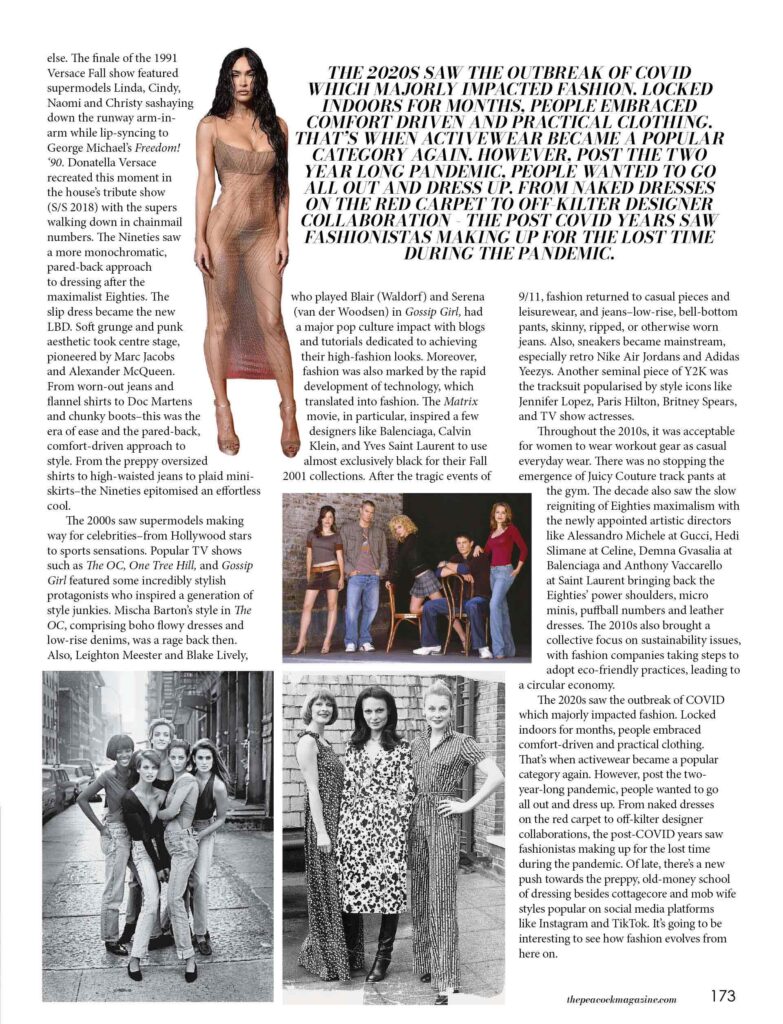
The finale of the 1991 Versace Fall show featured supermodels Linda, Cindy, Naomi and Christy sashaying down the runway arm-in-arm while lip-syncing to George Michael’s Freedom! ’90. Donatella Versace recreated this moment in the house’s tribute show (S/S 2018) with the supers walking down in chainmail numbers. The Nineties saw a more monochromatic, pared-back approach to dressing after the maximalist Eighties. The slip dress became the new LBD. Soft grunge and punk aesthetic took centre stage, pioneered by Marc Jacobs and Alexander McQueen. From worn-out jeans and flannel shirts to Doc Martens and chunky boots–this was the era of ease and the pared-back, comfort-driven approach to style. From the preppy oversized shirts to high-waisted jeans to plaid mini-skirts–the Nineties epitomised an effortless cool.
The 2000s saw supermodels making way for celebrities–from Hollywood stars to sports sensations. Popular TV shows such as The OC, One Tree Hill, and Gossip Girl featured some incredibly stylish protagonists who inspired a generation of style junkies. Mischa Barton’s style in The OC, comprising boho flowy dresses and low-rise denims, was a rage back then. Also, Leighton Meester and Blake Lively, who played Blair (Waldorf) and Serena (van der Woodsen) in Gossip Girl, had a major pop culture impact with blogs and tutorials dedicated to achieving their high-fashion looks. Moreover, fashion was also marked by the rapid development of technology, which translated into fashion. The Matrix movie, in particular, inspired a few designers like Balenciaga, Calvin Klein, and Yves Saint Laurent to use almost exclusively black for their Fall 2001 collections. After the tragic events of 9/11, fashion returned to casual pieces and leisurewear, and jeans–low-rise, bell-bottom pants, skinny, ripped, or otherwise worn jeans. Also, sneakers became mainstream, especially retro Nike Air Jordans and Adidas Yeezys. Another seminal piece of Y2K was the tracksuit popularised by style icons like Jennifer Lopez, Paris Hilton, Britney Spears, and TV show actresses.
Throughout the 2010s, it was acceptable for women to wear workout gear as casual everyday wear. There was no stopping the emergence of Juicy Couture track pants at the gym. The decade also saw the slow reigniting of Eighties maximalism with the newly appointed artistic directors like Alessandro Michele at Gucci, Hedi Slimane at Celine, Demna Gvasalia at Balenciaga and Anthony Vaccarello at Saint Laurent bringing back the Eighties’ power shoulders, micro minis, puffball numbers and leather dresses. The 2010s also brought a collective focus on sustainability issues, with fashion companies taking steps to adopt eco-friendly practices, leading to a circular economy.
The 2020s saw the outbreak of COVID which majorly impacted fashion. Locked indoors for months, people embraced comfort-driven and practical clothing. That’s when activewear became a popular category again. However, post the two-year-long pandemic, people wanted to go all out and dress up. From naked dresses on the red carpet to off-kilter designer collaborations, the post-COVID years saw fashionistas making up for the lost time during the pandemic. Of late, there’s a new push towards the preppy, old-money school of dressing besides cottagecore and mob wife styles popular on social media platforms like Instagram and TikTok. It’s going to be interesting to see how fashion evolves from here on.