
CREDITS – All images sourced from Divyak D’Souza’s team
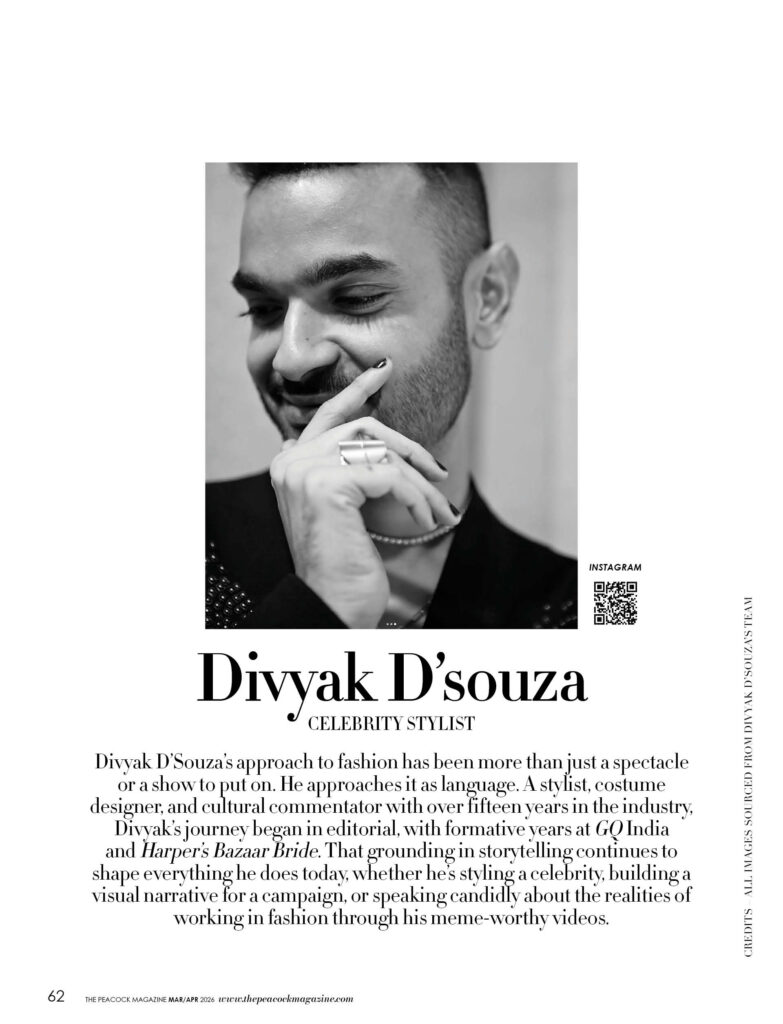
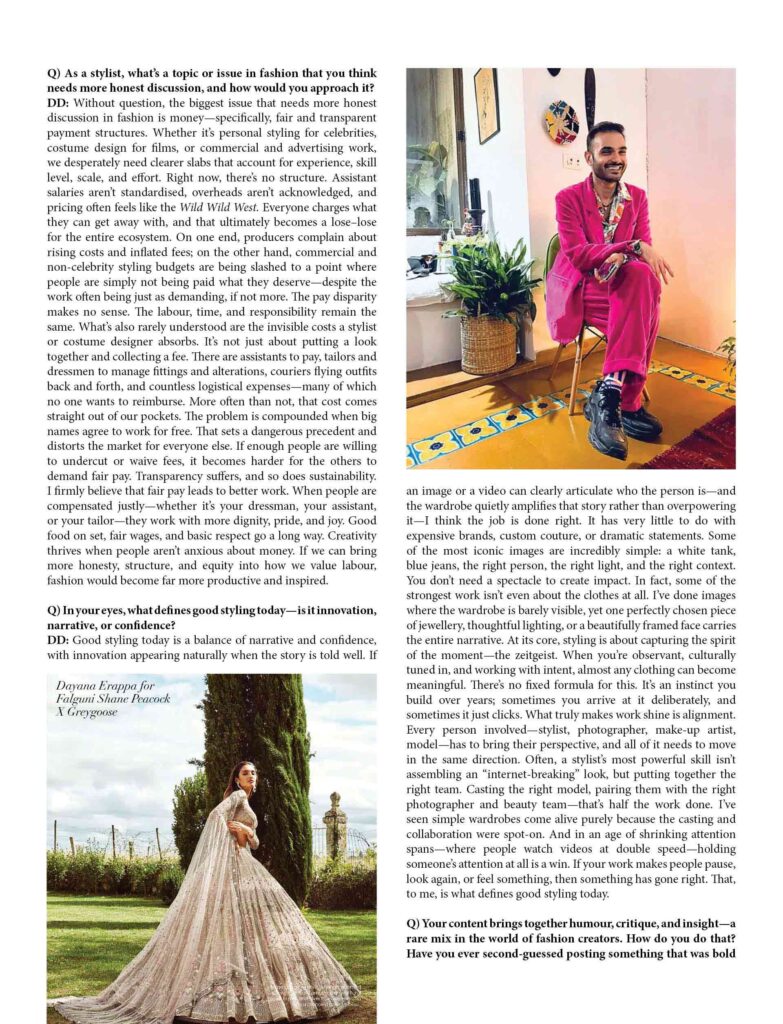
Divyak D’Souza’s approach to fashion has been more than just a spectacle or a show to put on. He approaches it as language. A stylist, costume designer, and cultural commentator with over fifteen years in the industry, Divyak’s journey began in editorial, with formative years at GQ India and Harper’s Bazaar Bride. That grounding in storytelling continues to shape everything he does today, whether he’s styling a celebrity, building a visual narrative for a campaign, or speaking candidly about the realities of working in fashion through his meme-worthy videos.
What sets Divyak apart is his refusal to romanticise the industry. He is as interested in structure, fairness, and process as he is in aesthetics. For him, great styling does not come anywhere close to chasing trends or “breaking the internet”—it’s about understanding people, context, and timing. Minimal when needed, expressive when the story demands it–his work prioritises alignment with the client and clarity over excess.
Beyond clothes, Divyak has become a sharp, self-aware voice online—using humour, critique, and cultural observation to start conversations the industry often avoids. There’s wit, yes, but also intention: to make fashion feel more honest, more human, and less performative.
In this interview, Divyak speaks openly about creativity, collaboration, money, power, humour, and why fashion, at its best, is really about storytelling. Read on for a refreshingly grounded conversation with someone who sees fashion for what it truly is—and isn’t afraid to say it out loud.
Q) How did your journey into styling begin, and what were some of your earliest influences that shaped your aesthetic?
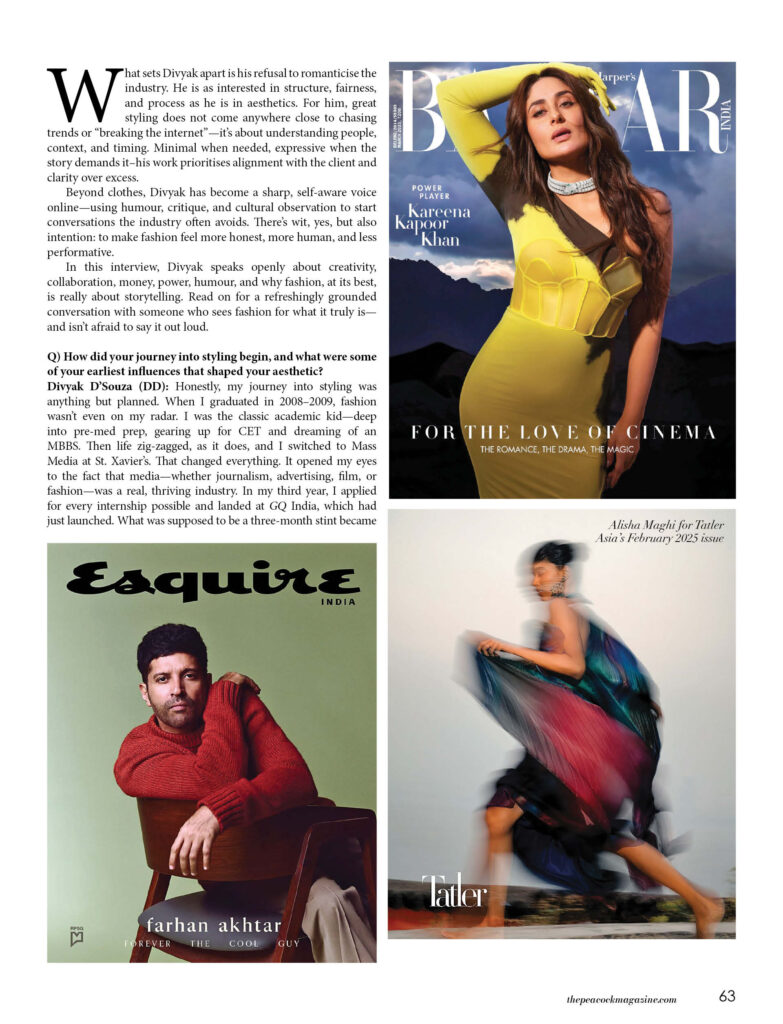
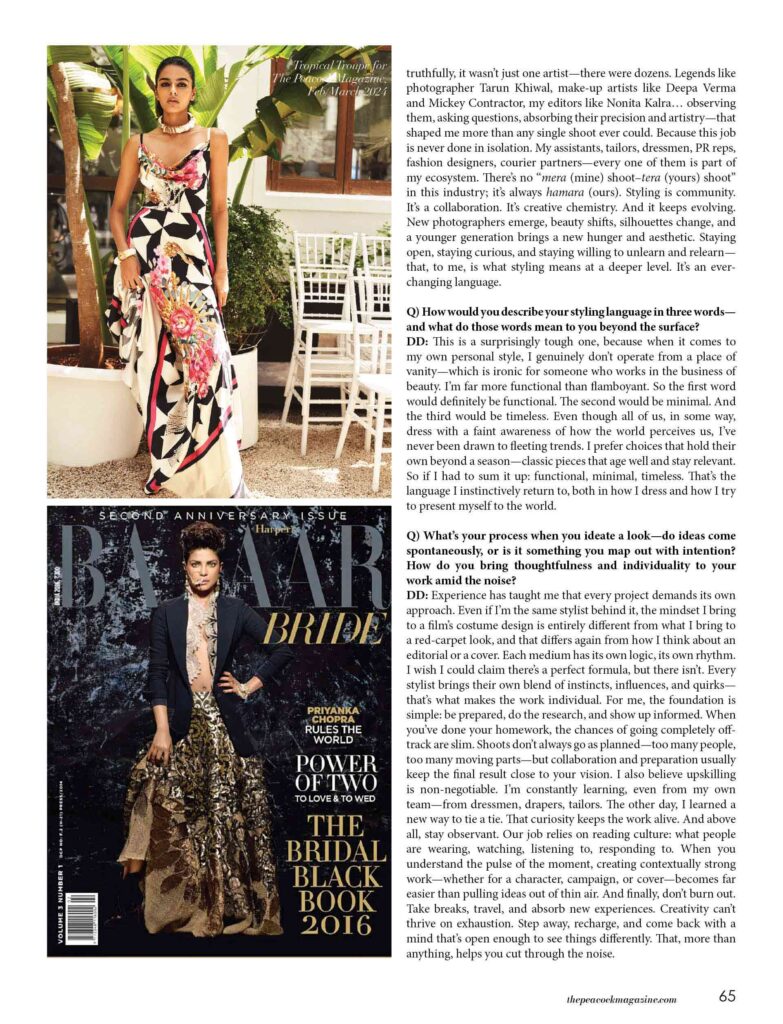
Divyak D’Souza (DD): Honestly, my journey into styling was anything but planned. When I graduated in 2008–2009, fashion wasn’t even on my radar. I was the classic academic kid—deep into pre-med prep, gearing up for CET and dreaming of an MBBS. Then life zig-zagged, as it does, and I switched to Mass Media at St. Xavier’s. That changed everything. It opened my eyes to the fact that media—whether journalism, advertising, film, or fashion—was a real, thriving industry. In my third year, I applied for every internship possible and landed at GQ India, which had just launched. What was supposed to be a three-month stint became my gateway into a world that was glamorous, disciplined, creatively charged, and extraordinarily inspiring. I was assisting the bookings editor—coordinating shoots, managing logistics, working with top photographers, models, and talent during what I’d call the golden era of Indian editorial. That exposure made me realise that fashion could be a serious, structured profession—something my Type-A brain actually vibed with. For the next eight years, editorial became my fashion school: GQ, L’Officiel, Femina, and finally Harper’s Bazaar Bride. I learned everything—production, retail realities, budgets, timelines, the business behind beauty, and the art behind execution. In 2016, I shifted to freelancing. I didn’t have a grand plan—I just knew Bombay was expensive, I have expensive taste, and I needed to earn well. Since then, my work has evolved with the industry: the rise of Instagram, digital covers, campaign styling, celebrity dressing, hosting, branded events, and the wonderfully unpredictable mix that defines my career today. Hosting entered my life in the most accidental way. One day, right in the middle of COVID, Discovery called about hosting the Indian edition of an international Say Yes to the Dress franchise. It felt like a natural extension of what I already did—styling real brides, just with cameras rolling—so I said yes. The show was unscripted and completely real, which meant I simply had to be myself and do my job on-screen. That opportunity opened the gates to many others: hosting Vogue Forces of Fashion, interviewing Anna Wintour, and anchoring branded events for Tira, H&M, and more. Before I knew it, hosting became a full-fledged vertical in my career. I joke that I’m just blessed with the gift of the gab, and thankfully, people seem happy to pay me to talk. It turned out to be one of the most unexpected—and rewarding—pivots in my journey. I work with artists I deeply respect—Kareena Kapoor Khan, Tabu, and Farhan Akhtar—and I enjoy the blend of advertising, red carpet work, and hosting gigs that now form my universe. If there’s one thing I’ve learned, it’s that you’re never done learning. I like staying dynamic. I like that no two days look the same. And yes, I believe in passion—but I also believe in commerce. Creativity is great, but the rent isn’t going to pay itself. That’s been my path so far: unplanned, organic, and always driven by the simple truth that the work must be worth the life you want to live.
Q) Was there a moment or project where you realised—this is the kind of styling I want to be known for? And, what does styling mean to you on a deeper level?
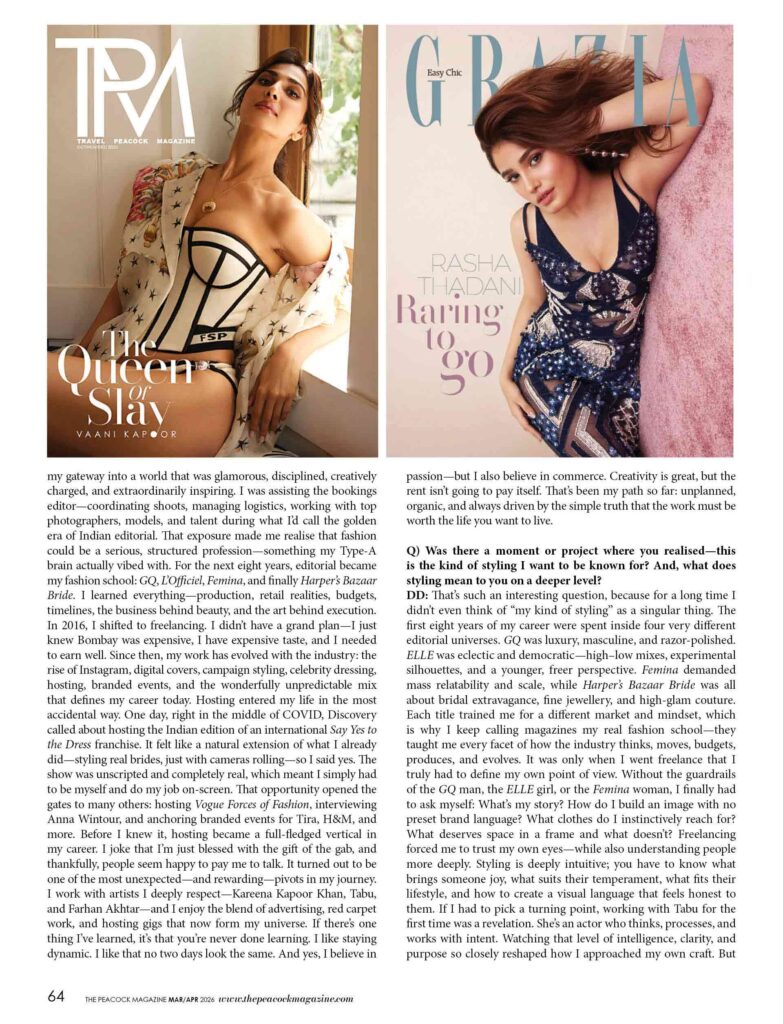
DD: That’s such an interesting question, because for a long time I didn’t even think of “my kind of styling” as a singular thing. The first eight years of my career were spent inside four very different editorial universes. GQ was luxury, masculine, and razor-polished. ELLE was eclectic and democratic—high–low mixes, experimental silhouettes, and a younger, freer perspective. Femina demanded mass relatability and scale, while Harper’s Bazaar Bride was all about bridal extravagance, fine jewellery, and high-glam couture. Each title trained me for a different market and mindset, which is why I keep calling magazines my real fashion school—they taught me every facet of how the industry thinks, moves, budgets, produces, and evolves. It was only when I went freelance that I truly had to define my own point of view. Without the guardrails of the GQ man, the ELLE girl, or the Femina woman, I finally had to ask myself: What’s my story? How do I build an image with no preset brand language? What clothes do I instinctively reach for? What deserves space in a frame and what doesn’t? Freelancing forced me to trust my own eyes—while also understanding people more deeply. Styling is deeply intuitive; you have to know what brings someone joy, what suits their temperament, what fits their lifestyle, and how to create a visual language that feels honest to them. If I had to pick a turning point, working with Tabu for the first time was a revelation. She’s an actor who thinks, processes, and works with intent. Watching that level of intelligence, clarity, and purpose so closely reshaped how I approached my own craft. But truthfully, it wasn’t just one artist—there were dozens. Legends like photographer Tarun Khiwal, make-up artists like Deepa Verma and Mickey Contractor, my editors like Nonita Kalra… observing them, asking questions, absorbing their precision and artistry—that shaped me more than any single shoot ever could. Because this job is never done in isolation. My assistants, tailors, dressmen, PR reps, fashion designers, courier partners—every one of them is part of my ecosystem. There’s no “mera (mine) shoot–tera (yours) shoot” in this industry; it’s always hamara (ours). Styling is community. It’s a collaboration. It’s creative chemistry. And it keeps evolving. New photographers emerge, beauty shifts, silhouettes change, and a younger generation brings a new hunger and aesthetic. Staying open, staying curious, and staying willing to unlearn and relearn—that, to me, is what styling means at a deeper level. It’s an ever-changing language.
Q) How would you describe your styling language in three words—and what do those words mean to you beyond the surface?
DD: This is a surprisingly tough one, because when it comes to my own personal style, I genuinely don’t operate from a place of vanity—which is ironic for someone who works in the business of beauty. I’m far more functional than flamboyant. So the first word would definitely be functional. The second would be minimal. And the third would be timeless. Even though all of us, in some way, dress with a faint awareness of how the world perceives us, I’ve never been drawn to fleeting trends. I prefer choices that hold their own beyond a season—classic pieces that age well and stay relevant. So if I had to sum it up: functional, minimal, timeless. That’s the language I instinctively return to, both in how I dress and how I try to present myself to the world.
Q) What’s your process when you ideate a look—do ideas come spontaneously, or is it something you map out with intention? How do you bring thoughtfulness and individuality to your work amid the noise?
DD: Experience has taught me that every project demands its own approach. Even if I’m the same stylist behind it, the mindset I bring to a film’s costume design is entirely different from what I bring to a red-carpet look, and that differs again from how I think about an editorial or a cover. Each medium has its own logic, its own rhythm. I wish I could claim there’s a perfect formula, but there isn’t. Every stylist brings their own blend of instincts, influences, and quirks—that’s what makes the work individual. For me, the foundation is simple: be prepared, do the research, and show up informed. When you’ve done your homework, the chances of going completely off-track are slim. Shoots don’t always go as planned—too many people, too many moving parts—but collaboration and preparation usually keep the final result close to your vision. I also believe upskilling is non-negotiable. I’m constantly learning, even from my own team—from dressmen, drapers, tailors. The other day, I learned a new way to tie a tie. That curiosity keeps the work alive. And above all, stay observant. Our job relies on reading culture: what people are wearing, watching, listening to, responding to. When you understand the pulse of the moment, creating contextually strong work—whether for a character, campaign, or cover—becomes far easier than pulling ideas out of thin air. And finally, don’t burn out. Take breaks, travel, and absorb new experiences. Creativity can’t thrive on exhaustion. Step away, recharge, and come back with a mind that’s open enough to see things differently. That, more than anything, helps you cut through the noise.
Q) As a stylist, what’s a topic or issue in fashion that you think needs more honest discussion, and how would you approach it?
DD: Without question, the biggest issue that needs more honest discussion in fashion is money—specifically, fair and transparent payment structures. Whether it’s personal styling for celebrities, costume design for films, or commercial and advertising work, we desperately need clearer slabs that account for experience, skill level, scale, and effort. Right now, there’s no structure. Assistant salaries aren’t standardised, overheads aren’t acknowledged, and pricing often feels like the Wild Wild West. Everyone charges what they can get away with, and that ultimately becomes a lose–lose for the entire ecosystem. On one end, producers complain about rising costs and inflated fees; on the other hand, commercial and non-celebrity styling budgets are being slashed to a point where people are simply not being paid what they deserve—despite the work often being just as demanding, if not more. The pay disparity makes no sense. The labour, time, and responsibility remain the same. What’s also rarely understood are the invisible costs a stylist or costume designer absorbs. It’s not just about putting a look together and collecting a fee. There are assistants to pay, tailors and dressmen to manage fittings and alterations, couriers flying outfits back and forth, and countless logistical expenses—many of which no one wants to reimburse. More often than not, that cost comes straight out of our pockets. The problem is compounded when big names agree to work for free. That sets a dangerous precedent and distorts the market for everyone else. If enough people are willing to undercut or waive fees, it becomes harder for the others to demand fair pay. Transparency suffers, and so does sustainability. I firmly believe that fair pay leads to better work. When people are compensated justly—whether it’s your dressman, your assistant, or your tailor—they work with more dignity, pride, and joy. Good food on set, fair wages, and basic respect go a long way. Creativity thrives when people aren’t anxious about money. If we can bring more honesty, structure, and equity into how we value labour, fashion would become far more productive and inspired.
Q) In your eyes, what defines good styling today—is it innovation, narrative, or confidence?
DD: Good styling today is a balance of narrative and confidence, with innovation appearing naturally when the story is told well. If an image or a video can clearly articulate who the person is—and the wardrobe quietly amplifies that story rather than overpowering it—I think the job is done right. It has very little to do with expensive brands, custom couture, or dramatic statements. Some of the most iconic images are incredibly simple: a white tank, blue jeans, the right person, the right light, and the right context. You don’t need a spectacle to create impact. In fact, some of the strongest work isn’t even about the clothes at all. I’ve done images where the wardrobe is barely visible, yet one perfectly chosen piece of jewellery, thoughtful lighting, or a beautifully framed face carries the entire narrative. At its core, styling is about capturing the spirit of the moment—the zeitgeist. When you’re observant, culturally tuned in, and working with intent, almost any clothing can become meaningful. There’s no fixed formula for this. It’s an instinct you build over years; sometimes you arrive at it deliberately, and sometimes it just clicks. What truly makes work shine is alignment. Every person involved—stylist, photographer, make-up artist, model—has to bring their perspective, and all of it needs to move in the same direction. Often, a stylist’s most powerful skill isn’t assembling an “internet-breaking” look, but putting together the right team. Casting the right model, pairing them with the right photographer and beauty team—that’s half the work done. I’ve seen simple wardrobes come alive purely because the casting and collaboration were spot-on. And in an age of shrinking attention spans—where people watch videos at double speed—holding someone’s attention at all is a win. If your work makes people pause, look again, or feel something, then something has gone right. That, to me, is what defines good styling today.
Q) Your content brings together humour, critique, and insight—a rare mix in the world of fashion creators. How do you do that? Have you ever second-guessed posting something that was bold or opinionated—and what makes you hit “share” anyway?
DD: Honestly, a lot of my joy comes from what I unapologetically call trash-watching and cringe-watching. I don’t hide from it—my Instagram algorithm is the truest test of who I am. It’s a heady mix of visually arresting, beautiful things and absolute nonsense. And I think oscillating between those two extremes is important, because irony is one of the only sane responses to the times we live in. We’re surrounded by conflict, climate anxiety, disasters, and a relentless news cycle. One headline is enough to spike your cortisol for the day. So I genuinely believe learning to laugh—especially in awkward or heavy situations—is a form of emotional intelligence. I read somewhere (or maybe saw a meme) that people who can laugh under stress are better at processing complexity. They’ve already done the mental gymnastics and arrived at a lighter place, which is actually healthier for the brain. That idea really stuck with me and became a bit of a life philosophy: if I can laugh at the tragedy, I can move through it without being paralysed by it. That same logic applies to the memes and videos I make. I’ll sit through hours of deeply cringey celebrity interviews—mismatched answers, out-of-context soundbites—and enjoy the challenge of editing them into something funny while still making a point. Humour has this incredible ability to deliver uncomfortable truths without making people defensive. Hans-hans ke bada sach bol dena is powerful. That’s why memes work so well for this generation—they open up dialogue without feeling preachy. Some of my posts about pay disparity, styling politics, freebies, or industry behaviour have sparked real conversations. Actors, producers, stylists—people across the board have engaged, reacted, and even disagreed. And that, for me, means it’s working. It’s making people pause and think. I also genuinely love the process. Editing could very easily have been my second career. The rhythm of cuts, the cadence of dialogue, the music—it’s deeply satisfying. Engagement, virality, numbers… honestly, I don’t care much. I’m not getting hired off a meme. This is a purely non-academic pursuit. My only real benchmark is: if my WhatsApp group laughs, it’s going up. That said, I do think before I post. I never want to be malicious, cruel, or personal in my digs. Even when I’m using a celebrity clip, the joke is never about them—it’s about a larger idea or pattern. Kindness is a non-negotiable filter for me. You can be sharp without being mean. If I can make a point, make someone laugh, and still keep my conscience clean, that’s when I hit “share”.
Q) Finally, what’s next for you—are there projects or directions you’re excited to explore beyond what people already know you for?
DD: I have very simple life goals, honestly. One hand for good food, the other for receiving the cheque. Everything I want sits somewhere between those two things. By good food, I really mean a good life—being able to travel well, see the world, immerse myself in art and culture, and enjoy beautiful things without constantly worrying about survival. I’m also very clear-eyed about the fact that none of this comes free. A certain lifestyle has a very real price tag attached to it, and I’m not romantic about that. So what I’m consciously working towards is balance. Making space to grow as a person, nurture friendships, stay connected to family, travel, and feed the mind with experiences beyond work—while also building a strong body of work, earning well, and sustaining the life I want. That equation never fully resolves, but being aware of it is half the job. Beyond that, I’m fairly esoteric in how I make decisions. I follow instinct. If something feels right at the moment, I go for it. Even if only 60 per cent of my gut says yes—if there’s a chance I’ll learn, grow, or evolve—I’ll take the leap. Fear is a terrible creative advisor. So, just take that leap!