
By Kaviya Sneha
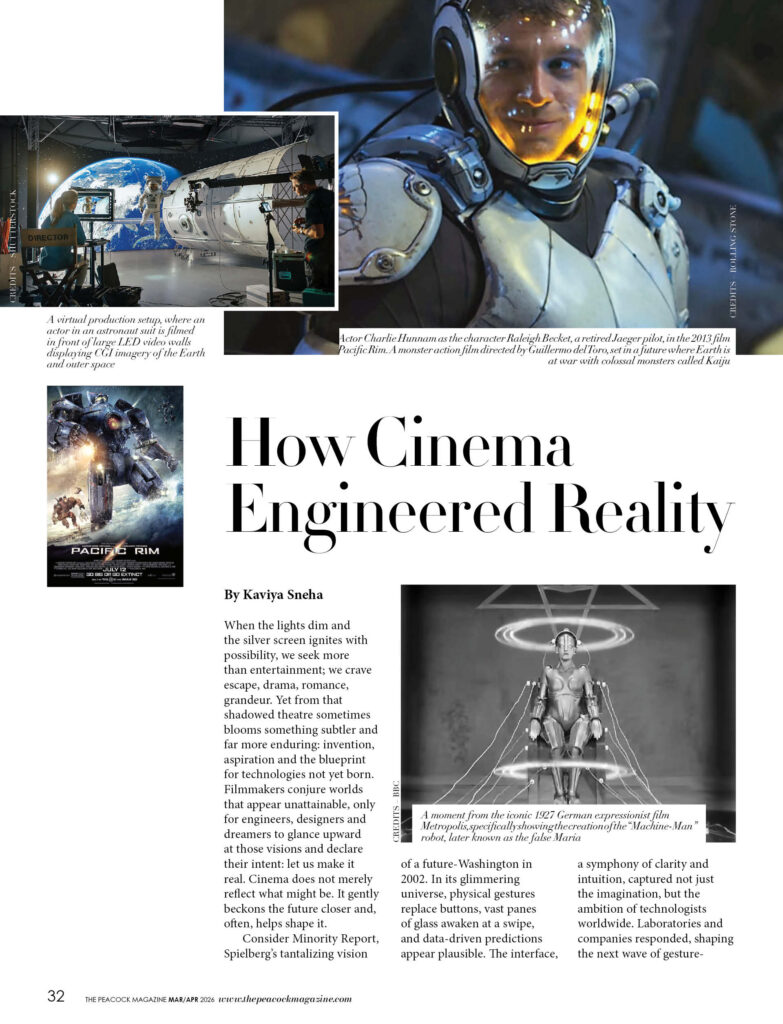
When the lights dim and the silver screen ignites with possibility, we seek more than entertainment; we crave escape, drama, romance, grandeur. Yet from that shadowed theatre sometimes blooms something subtler and far more enduring: invention, aspiration and the blueprint for technologies not yet born. Filmmakers conjure worlds that appear unattainable, only for engineers, designers and dreamers to glance upward at those visions and declare their intent: let us make it real. Cinema does not merely reflect what might be. It gently beckons the future closer and, often, helps shape it.
Consider Minority Report, Spielberg’s tantalising vision of a future Washington, made in 2002. In its glimmering universe, physical gestures replace buttons, vast panes of glass awaken at a swipe, and data-driven predictions appear plausible. The interface, a symphony of clarity and intuition, captured not just the imagination but the ambition of technologists worldwide. Laboratories and companies responded, shaping the next wave of gesture-based devices. That on-screen fiction pressed ethical and technological questions into view, questioning prediction, surveillance and privacy. Today, as researchers probe predictive policing and data analytics, traces of that cinematic moment remain evident in their pursuits.
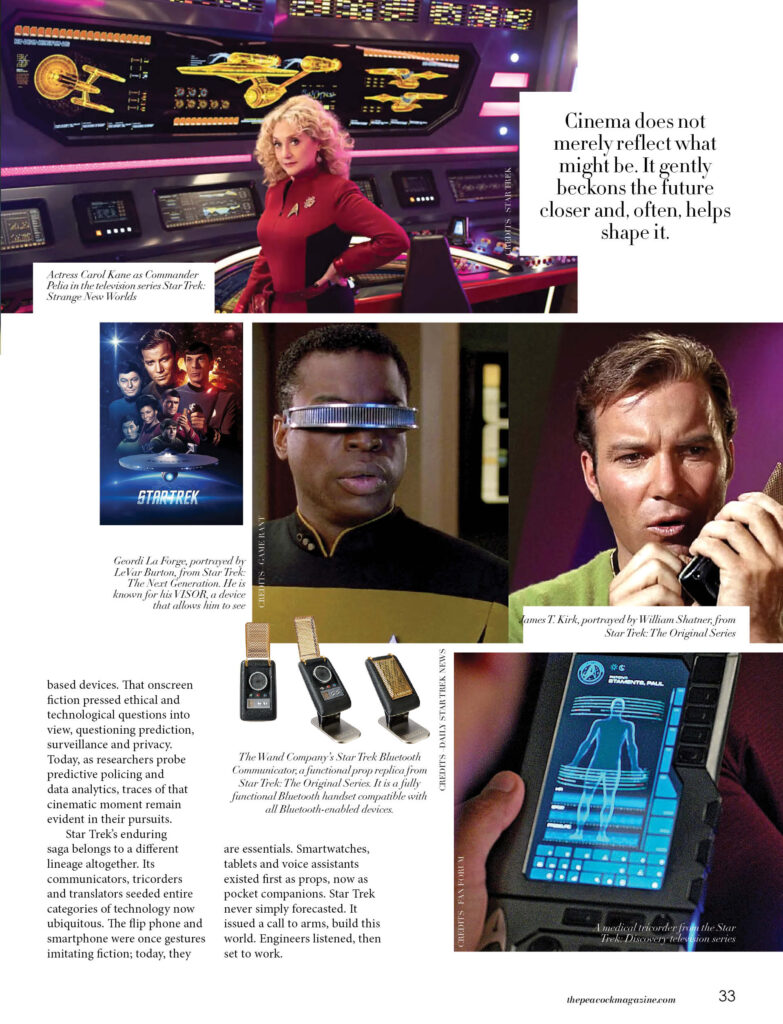
Star Trek‘s enduring saga belongs to a different lineage altogether. Its communicators, tricorders and translators seeded entire categories of technology now ubiquitous. The flip phone and smartphone were once gestures imitating fiction; today, they are essentials. Smartwatches, tablets and voice assistants existed first as props, now as pocket companions. Star Trek never simply forecasted. It issued a call to arms, build this world. Engineers listened, then set to work.
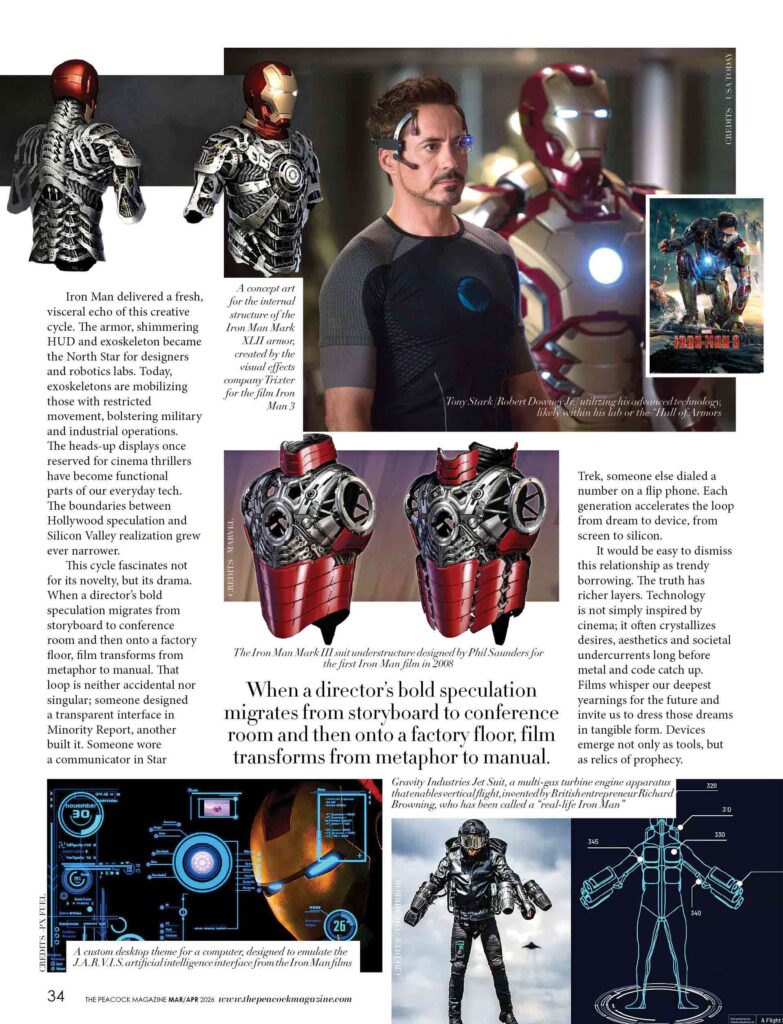
Iron Man delivered a fresh, visceral echo of this creative cycle. The armour, shimmering HUD and exoskeleton became the North Star for designers and robotic labs. Today, exoskeletons are mobilising those with restricted movement, bolstering military and industrial operations. The heads-up displays once reserved for cinema thrillers have become functional parts of our everyday tech. The boundaries between Hollywood speculation and Silicon Valley realisation grew ever narrower.
This cycle fascinates not only for its novelty, but also for its drama. When a director’s bold speculation migrates from storyboard to conference room and then onto a factory floor, the film transforms from metaphor to manual. That loop is neither accidental nor singular; someone designed a transparent interface in Minority Report, another built it. Someone wore a communicator in Star Trek, someone else dialled a number on a flip phone. Each generation accelerates the loop from dream to device, from screen to silicon.
It would be easy to dismiss this relationship as trendy borrowing. The truth has richer layers. Technology is not simply inspired by cinema; it often crystallises desires, aesthetics and societal undercurrents long before metal and code catch up. Films whisper our deepest yearnings for the future and invite us to dress those dreams in tangible form. Devices emerge not only as tools, but as relics of prophecy.
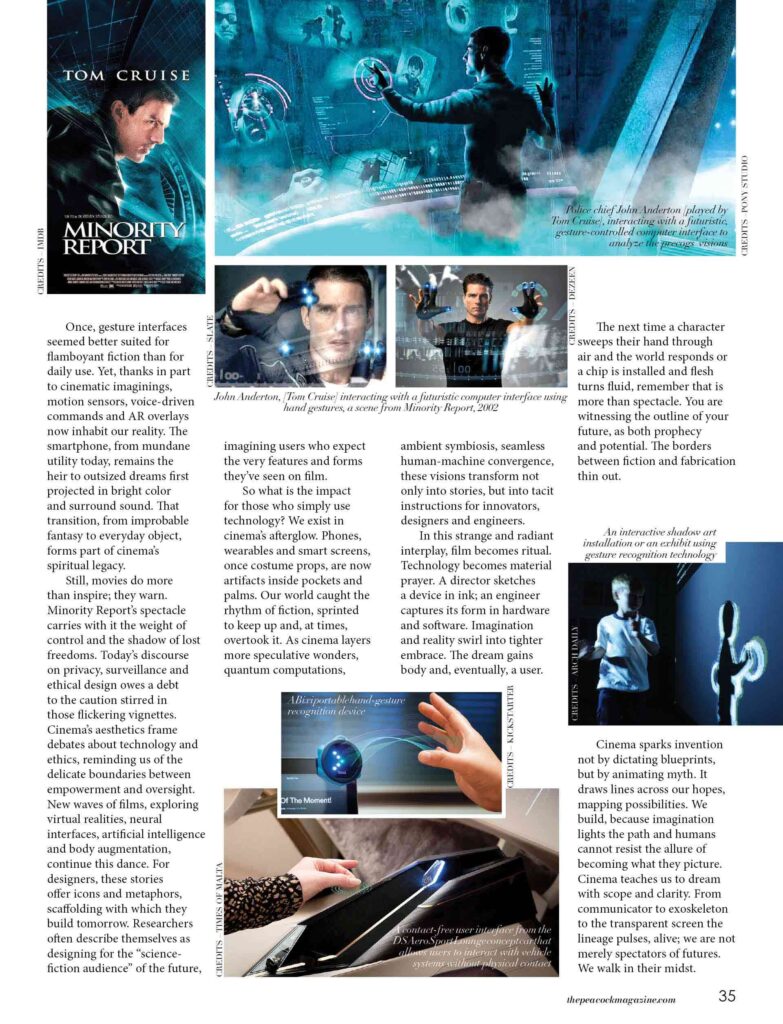
Once, gesture interfaces seemed better suited for flamboyant fiction than for daily use. Yet, thanks in part to cinematic imaginings, motion sensors, voice-driven commands and AR overlays now inhabit our reality. The smartphone, from mundane utility today, remains the heir to outsized dreams first projected in bright colour and surround sound. That transition, from improbable fantasy to everyday object, forms part of cinema’s spiritual legacy.
Still, movies do more than inspire; they warn. Minority Report’s spectacle carries with it the weight of control and the shadow of lost freedoms. Today’s discourse on privacy, surveillance and ethical design owes a debt to the caution stirred in those flickering vignettes. Cinema’s aesthetics frame debates about technology and ethics, reminding us of the delicate boundaries between empowerment and oversight. New waves of films, exploring virtual realities, neural interfaces, artificial intelligence and body augmentation, continue this dance. For designers, these stories offer icons and metaphors, scaffolding with which they build tomorrow. Researchers often describe themselves as designing for the “science-fiction audience” of the future, imagining users who expect the very features and forms they’ve seen on film.
So what is the impact on those who simply use technology? We exist in cinema’s afterglow. Phones, hi-tech electronic wearables and smart screens, once costume props, are now artefacts inside pockets and palms. Our world caught the rhythm of fiction, sprinted to keep up and, at times, overtook it. As cinema layers more speculative wonders, quantum computations, ambient symbiosis, seamless human-machine convergence, these visions transform not only into stories, but into tacit instructions for innovators, designers and engineers.
In this strange and radiant interplay, film becomes ritual. Technology becomes material prayer. A director sketches a device in ink; an engineer captures its form in hardware and software. Imagination and reality swirl into a tighter embrace. The dream gains body and, eventually, a user.
The next time a character sweeps their hand through the air and the world responds, or a chip is installed, and flesh turns fluid, remember that it is more than spectacle. You are witnessing the outline of your future, as both prophecy and potential. The borders between fiction and fabrication thin out.
Cinema sparks invention not by dictating blueprints, but by animating myth. It draws lines across our hopes, mapping possibilities. We build because imagination lights the path, and humans cannot resist the allure of becoming what they picture. Cinema teaches us to dream with scope and clarity. From communicator to exoskeleton to the transparent screen, the lineage pulses, alive; we are not merely spectators of futures. We walk in their midst.