
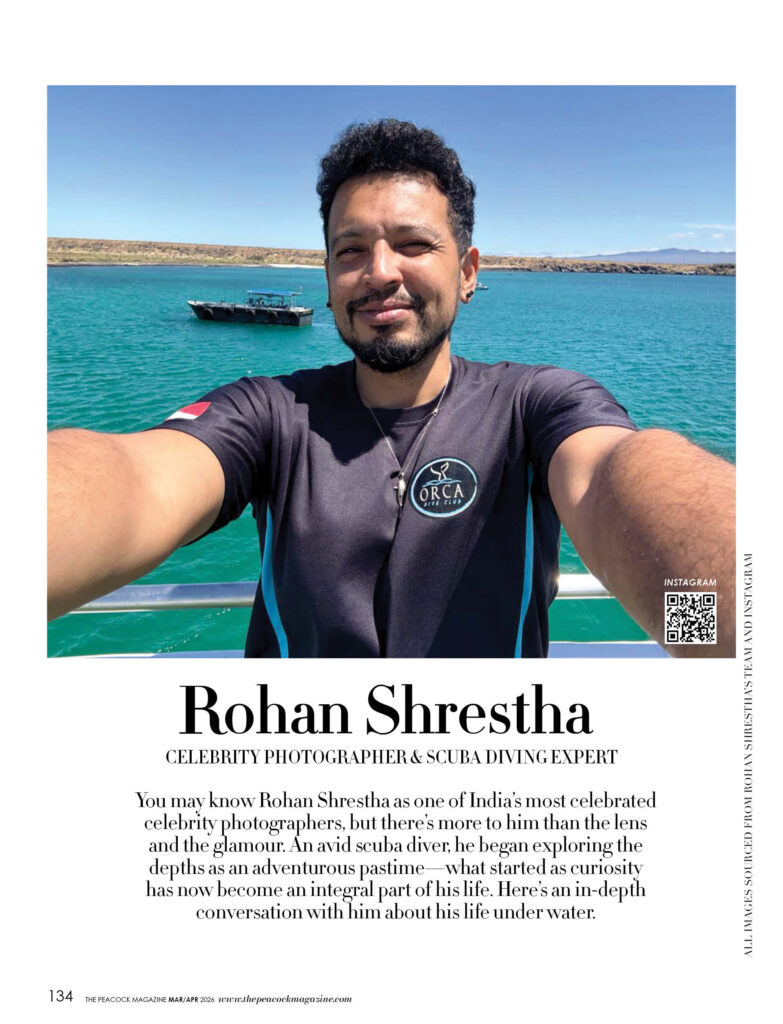
CREDITS – All images sourced from Rohan Shrestha’s team and Instagram
You may know Rohan Shrestha as one of India’s most celebrated celebrity photographers, but there’s more to him than the lens and the glamour. An avid scuba diver, he began exploring the depths as an adventurous pastime—what started as curiosity has now become an integral part of his life. Here’s an in-depth conversation with him about his life underwater.
Q) How did your passion for scuba-diving begin—was it a single experience that sparked it or a gradual curiosity about the ocean?
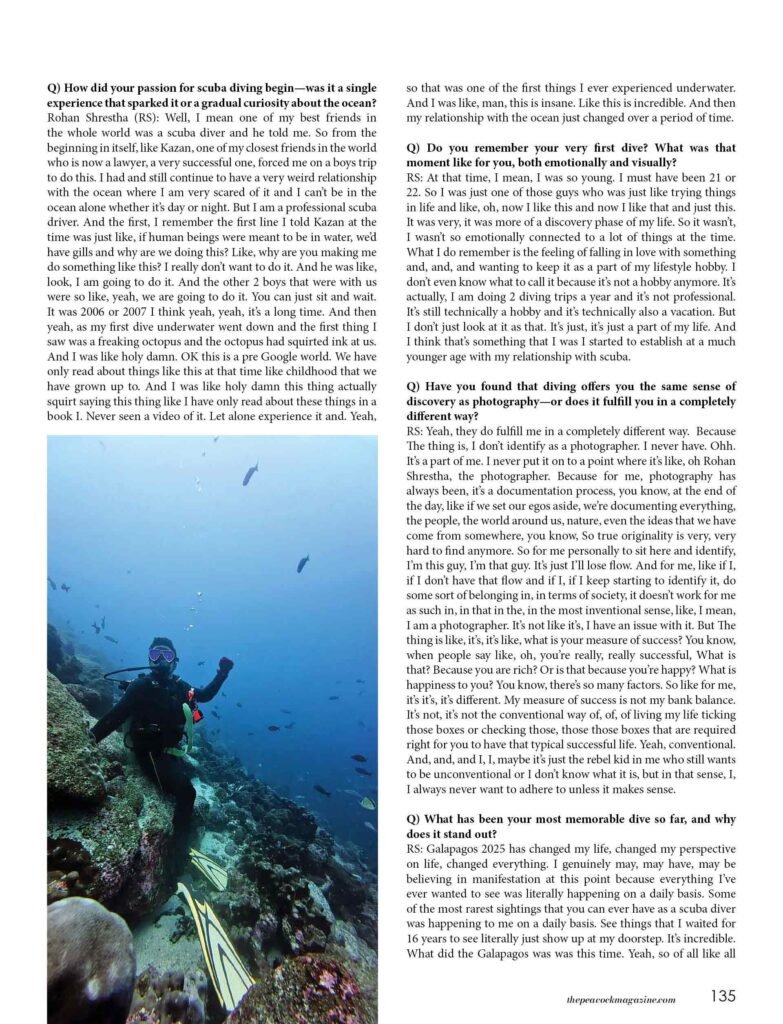
Rohan Shrestha (RS): One of my closest friends in the world was a scuba diver, and he’s the one who planted the idea in my head. From the very beginning—Kazan, one of my best friends, now a very successful lawyer—basically forced me on a boys’ trip to try scuba-diving. I’ve always had a strange relationship with the ocean. I’m genuinely scared of it and still can’t be in the water alone, day or night. Ironically, I’m a professional scuba diver now. I remember the very first thing I said to Kazan: If human beings were meant to be in the water, we’d have gills. Why are you making me do this? I truly didn’t want to. But he was determined, and the other two guys on the trip were all in. They told me I could either dive or just sit and wait. This was back in 2006 or 2007—long before Google and endless videos. On my very first dive, the first thing I saw underwater was an octopus, and it squirted ink at us. I was stunned. These were things I had only read about in books growing up. I’d never seen a video of it, let alone experienced it in real life. That moment completely blew my mind. It was insane. Incredible. And over time, my entire relationship with the ocean began to change.
Q) Do you remember your very first dive? What was that moment like for you, both emotionally and visually?
RS: At the time, I was very young—maybe 21 or 22. I was in that phase of life where you’re trying everything, figuring out what you like, what you don’t, and just discovering yourself. It was a period of exploration, not one where I was deeply or emotionally attached to anything. What I do remember clearly is the feeling of falling in love with something and wanting to make it a part of my life. I don’t even know what to call it anymore—it’s not just a hobby. I still do about two diving trips a year, so technically it’s a hobby, and technically it’s also a vacation. But I don’t see it that way. It’s simply become a part of who I am. And I think that connection—my relationship with scuba—was something I began to establish at a much younger age.
Q) Have you found that diving offers you the same sense of discovery as photography—or does it fulfil you in a completely different way?
RS: Yes, they fulfil me in a completely different way. The thing is, I’ve never identified myself as a photographer—and I still don’t. Photography is a part of me, but I’ve never wanted to turn it into a label, like Rohan Shrestha, the photographer. For me, photography has always been a process of documentation. At the end of the day, if we put our egos aside, we’re all documenting something—people, the world around us, nature. Even our ideas come from somewhere else. True originality is incredibly rare now. So sitting here and trying to define myself as this or that just disrupts my flow. And if I lose that flow—if I start attaching myself to fixed identities or societal labels—it simply doesn’t work for me in a conventional sense. It’s not that I have a problem saying I’m a photographer. I don’t. But that’s not the point. The real question is: how do you measure success? Is it money? Is it happiness? And what does happiness even mean? There are so many variables. For me, success isn’t my bank balance, and it’s definitely not ticking off the usual boxes of what a “successful life” is supposed to look like. Maybe it’s the rebel in me that still wants to remain unconventional—I don’t know. But I’ve never been someone who wants to conform–unless it truly makes sense to me.
Q) What has been your most memorable dive so far, and why does it stand out?
RS: Galápagos 2025 changed my life. It changed my perspective on life—everything. I might actually believe in manifestation now, because everything I had ever wanted to see was unfolding almost daily. Some of the rarest sightings a scuba diver can experience were happening to me again and again. Things I had waited sixteen years to see were literally showing up right in front of me! It was unbelievable! What the Galápagos was for me this time—after all these years of diving—was simply the best. And it’s not even close. I’ve had individual dives in different parts of the world that were unforgettable, but this wasn’t just a moment or two. This was an entire trip. If I had to list my top-five dives of all time, at least three of them would come from this Galápagos experience.
Q) Diving often brings you face-to-face with nature’s unpredictability. How do you handle those moments of uncertainty or challenge underwater?
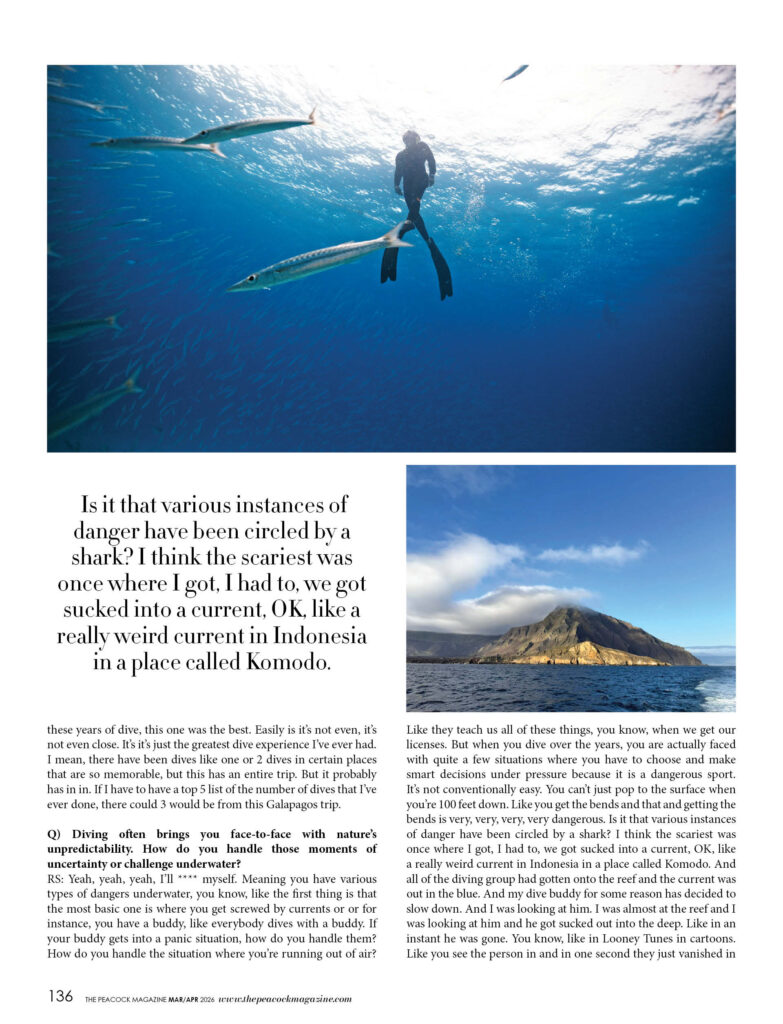
RS: Yeah—diving can genuinely scare the hell out of you. There are so many kinds of danger underwater. The most basic is getting caught in currents. Then there’s diving with a buddy—everyone dives with one—and if your buddy panics, you have to know how to handle that. What if someone is running out of air? These are all things we’re trained for when we get our licenses, but real diving is different. Over the years, you’ve faced situations where you have to make fast, intelligent decisions under pressure. It is a dangerous sport. You can’t just shoot up to the surface from 100 feet down—you’ll get the bends, which is extremely dangerous. I’ve been surrounded by sharks before, and yes, that’s intense. But the scariest moment for me happened in Komodo, Indonesia. We got caught in a strange current. The rest of the group managed to grab onto the reef, but the current was pulling us out into the blue. My buddy, for some reason, slowed down. I was almost at the reef when I looked back—and in a split second, he was gone. Literally gone. Like a cartoon moment where someone just vanishes. My dive guide looked at me and signed, You have to go with your buddy. And I’m thinking, you want me to swim into that current? But it was the right thing to do. So I went in, not knowing where it would take me, just to find him. We had to abort the dive. When we surfaced, the current had dragged us nearly a kilometre and a half away. We waited for the boat to find us. I found my buddy—he was panicking underwater. He was a new diver and had no idea what had just happened. Situations like that are terrifying. Then there are the other moments—the “cool” scary ones. I’ve surfaced through a swarm of jellyfish because I ran out of air and had no choice but to get stung. And then there’s what happened in the Galápagos. I came face to face with a wild mother orca—about 13 to 15 feet long. That is the apex predator of the ocean. If you think great white sharks are dangerous, orcas eat great white sharks. They’re incredibly intelligent and unpredictable underwater.
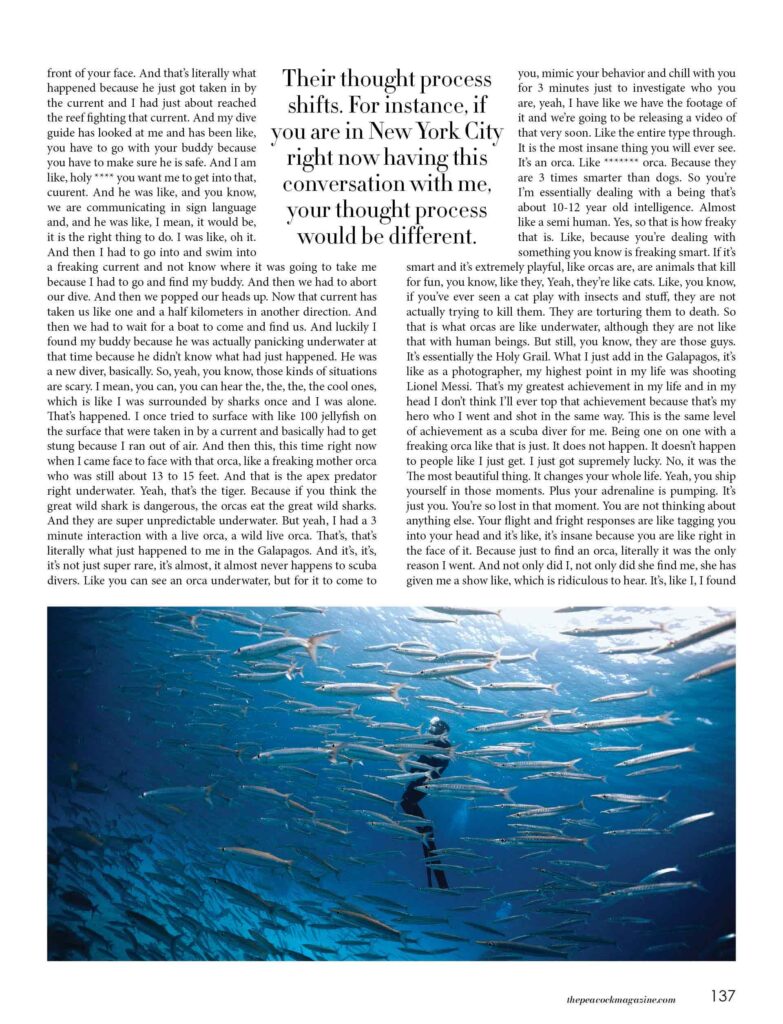
I had a three-minute interaction with her. Three minutes! A wild orca came to me, mimicked my movements, and just… stayed. That almost never happens to scuba divers. Seeing one is rare enough. Having one approach you, study you, and engage with you is almost unheard of. We have the footage, and we’ll be releasing the full video soon—it’s unbelievable. Orcas are estimated to be three times smarter than dogs. You’re essentially dealing with an intelligence similar to a 10–12-year-old human. That’s what makes it so intense. They’re playful, highly intelligent animals—and yes, they’re known to kill for sport, much like cats do. Not with humans, but still—you’re very aware of what you’re facing. For me, this was the holy grail. As a photographer, the peak moment of my life was shooting Lionel Messi. That’s my hero, and I don’t think I’ll ever top that professionally. This experience was the scuba equivalent of that. Being one-on-one with a wild orca like that simply doesn’t happen. I didn’t earn it—I just got unimaginably lucky. It was one of the most beautiful moments of my life. It changes you. Your adrenaline is through the roof, your fight-or-flight instincts are firing, and yet you’re completely present. You’re not thinking about anything else. You’re just there, face to face with something extraordinary. I went to the Galápagos for one reason—to find an orca. Instead, she found me. And she gave me a show. It sounds ridiculous even saying it out loud. It felt like Free Willy or something. She swam upright, mimicking us, trying to understand us. A 13-foot whale standing vertically in the water to study human beings. That’s when it hits you: the ocean is the most beautiful thing on this planet—and we barely begin to understand it…
Q) Has scuba-diving changed the way you view our planet, especially in terms of conservation and sustainability?
RS: Health-wise—when I did my second diving licence in Malaysia, the institute didn’t serve seafood at all. Their philosophy was simple: fish are our friends—why would you eat them? That’s what we dive for. I haven’t eaten seafood since 2009. And I’m Goan, so you can imagine what kind of sacrifice that is. My family still thinks I’m crazy. But for me, it just didn’t feel right. And it wasn’t only about conservation. For nearly eight years, I carried a bucket to bathe and refused to use a shower. Small choices like that make you far more aware of your impact. I’m not preaching, and I’m not trying to tell the world how to live. I’m simply doing what I can, so I feel like I’m contributing in some small way—playing a part in preserving something I’m deeply in love with. When you spend that much time underwater, it becomes a world you belong to. Almost as much as the one above the surface.
Q) How do you balance your professional life in photography with the time and energy scuba-diving demands?
RS: Scuba-diving doesn’t actually demand that much from me. I dive twice a year, and during that time, I’m completely disconnected from everyday reality. At this point, I’m an adventurous diver—I’m not heading to the Maldives for a casual dive. I’m searching for places that are raw, untouched, and extraordinary. The kind of places that take effort to reach. Sometimes that means four or five flights just to get to one location. For example, to dive in Chuuk Lagoon, I had to go Bombay–Singapore, Singapore–Tokyo, Tokyo–Guam, Guam–Chuuk. All of that just to shoot specific things underwater. But that’s the beauty of this part of my life—it takes me to places you’d never go to otherwise. Most people haven’t even heard of them. Chuuk is in the Federated States of Micronesia, made up of tiny islands that are still incredibly untouched. It’s one of the most beautiful places you’ll ever see. Eventually, you start asking yourself bigger questions: what does balance mean to you? What does success look like? For me, it’s this—the ability to see the world. The planet has so much to offer, and I’ve barely scratched the surface. But I’m taking steps towards it, because I don’t know how much time I have. And if I’m in a position to do this, why wouldn’t I? Not doing it would feel like a disservice to myself. There was a period of about four years when I didn’t dive—between 2018 and 2021. COVID played a part, but things just kept going wrong. I booked a trip and then broke my shoulder. And the kind of diving I do requires booking at least a year in advance—you can’t just show up. I’m part of a diving club we started in 2010. It’s grown into a community of around 200–300 members. The club plans the trips, and it’s first-come, first-served. Sometimes you find out that someone you dived with eight years ago is joining the same trip. You reconnect with the most unexpected people—Indians from completely different walks of life—and then spend eight or nine days together on a boat, cut off from work and mostly without phone reception. You’ll have everyone on board—from an ex–L’Oréal CEO to an actor, a banker, a lawyer, and then me, this random photographer. On land, our perspectives on life couldn’t be more different. But underwater, none of that matters. The only conversation is, Did you see that whale? How big do you think it was? That’s the magic of it. It brings together the most unlikely group of people through one shared obsession.
Q) What’s next on your diving bucket list—is it a dream location, a new certification, or an adventure you haven’t yet experienced?
RS: The deep south of the Maldives. That’s the next pursuit. Now that I’ve seen an orca, a whale shark, a mola mola, and dolphins in the Galápagos, I’ve essentially ticked off most things from my bucket list. So naturally, my mind has moved on to tiger sharks. And the place for that is the Maldives—specifically, the deep southern atolls. There’s an island down there known for its tiger shark population, and I’m determined to do that this year, ideally before it ends. They’re all around that area. There’s even a chance of encountering a bull shark, which is considered the most dangerous shark in the world. If that happens too, that’s pretty much the ultimate scuba-diving bucket list spot for me. At that point, I might actually retire from diving and take up trekking instead. For divers, these sightings are badges of honour. Being able to write whale shark in your logbook is a big deal. When divers meet, the first question is always, Where have you dived? What have you seen underwater? And when you say, I spent three and a half minutes with an orca, you basically get abused—in the best way possible. It’s the ultimate flex. I’m fairly certain I’ll see tiger sharks. I’ll be going with my camera, though honestly, I don’t even need it. Tiger sharks are the final obsession. Sharks, in general, have always been it for me.