
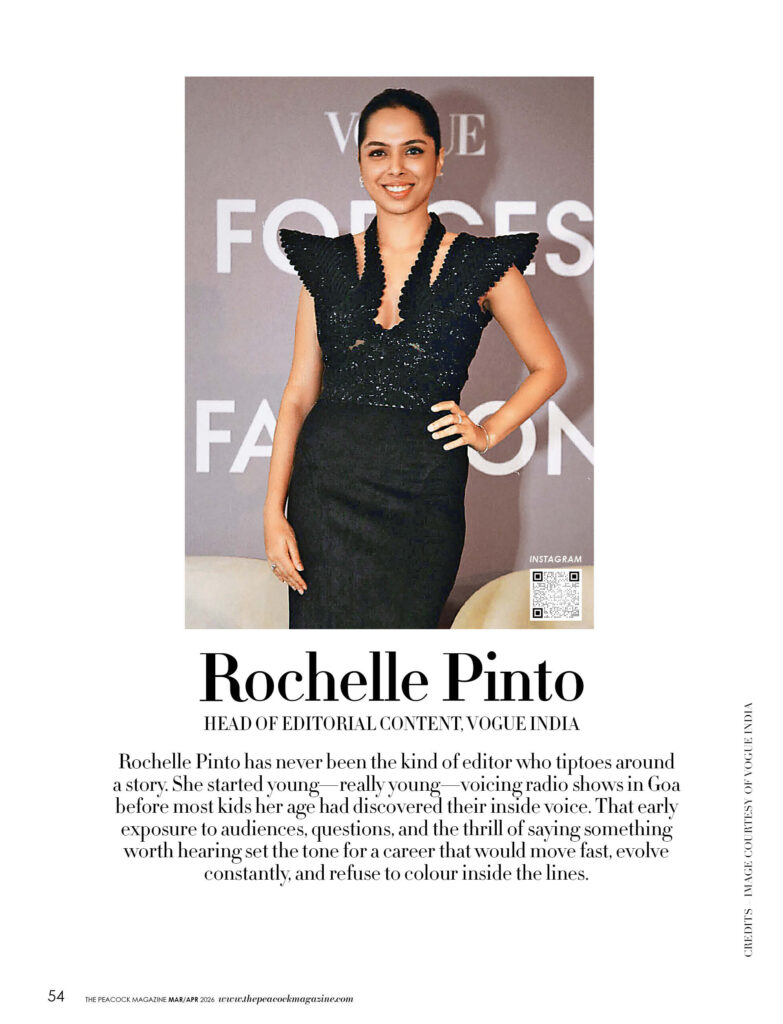
CREDITS – Image courtesy of Vogue India
Rochelle Pinto has never been the kind of editor who tiptoes around a story. She started young—really young—voicing radio shows in Goa before most kids her age had discovered their inside voice. That early exposure to audiences, questions, and the thrill of saying something worth hearing set the tone for a career that would move fast, evolve constantly, and refuse to colour inside the lines.
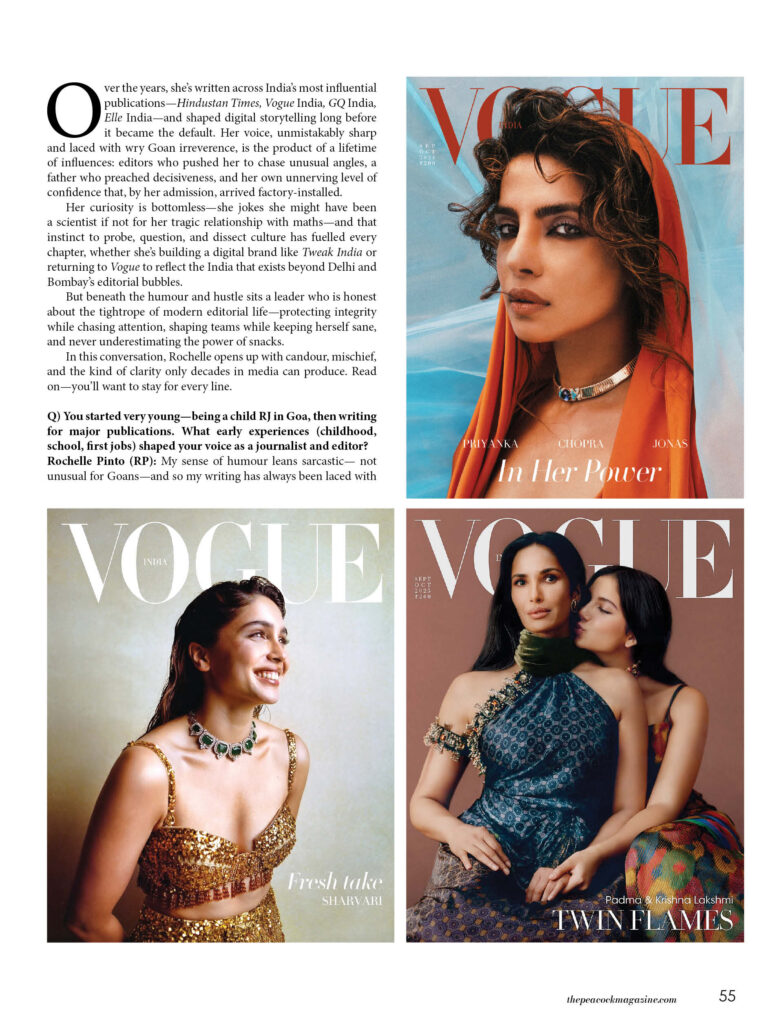
Over the years, she’s written across India’s most influential publications—Hindustan Times, Vogue India, GQ India, Elle India—and shaped digital storytelling long before it became the default. Her voice, unmistakably sharp and laced with wry Goan irreverence, is the product of a lifetime of influences: editors who pushed her to chase unusual angles, a father who preached decisiveness, and her own unnerving level of confidence that, by her admission, arrived factory-installed.
Her curiosity is bottomless—she jokes she might have been a scientist if not for her tragic relationship with maths—and that instinct to probe, question, and dissect culture has fuelled every chapter, whether she’s building a digital brand like Tweak India or returning to Vogue to reflect the India that exists beyond Delhi and Bombay’s editorial bubbles.
But beneath the humour and hustle sits a leader who is honest about the tightrope of modern editorial life—protecting integrity while chasing attention, shaping teams while keeping herself sane, and never underestimating the power of snacks.
In this conversation, Rochelle opens up with candour, mischief, and the kind of clarity only decades in media can produce. Read on—you’ll want to stay for every line.
Q) You started very young—being a child RJ in Goa, then writing for major publications. What early experiences (childhood, school, first jobs) shaped your voice as a journalist and editor?
Rochelle Pinto (RP): My sense of humour leans sarcastic— not unusual for Goans—and so my writing has always been laced with irreverence. Then, each editor I’ve had the privilege of working under further helped hone that voice. Khalid Mohammed showed me the importance of painting pictures with words, Mayank Shekhar forced me to find the story no one else was writing, Sita Wadhwani taught me to get to the point quickly, and Twinkle Khanna gave me the freedom to be weird. My father always says that “indecision causes accidents”, a perspective that he and Anna Wintour have in common. So from them, I learnt to think on my feet and act quickly instead of being paralysed by ‘what ifs’. Somehow, this khichdi of influences has resulted in what some may diagnose as a ‘voice’.
Q) What drew you into journalism in the first place, and how did you land your first significant break?
RP: Limitless curiosity. I could have been a scientist if not for the fact that I am terrible at maths.
Q) As one of the youngest columnists in Hindustan Times, how did you navigate pressure, expectations, or imposter syndrome early on?
RP: Luckily for me, I was born with an unfounded and unnatural sense of confidence. The medical community is yet to find a cure for this disease. As a result, from a young age, I have often found myself in influential positions I had no right or training to be in. And that’s when I discovered that almost no one has any idea what they are doing. So any traces of imposter syndrome that might have leapt over the Great Wall of Confidence were immediately squashed.
Q) You’ve worked in both print and digital (for example, Vogue India, GQ India, Elle India) — which of your early digital projects pushed you to question the old rules of storytelling?
RP: There are no rules to storytelling except this: Don’t be boring. I hope I haven’t broken that one yet.
Q) Founding Tweak India (Twinkle Khanna’s venture) seems like a defining chapter. What did you set out to do with Tweak in terms of format, audience, values, and what surprised you most about building a digital brand in the Indian context?
RP: Working under a leader with a strong ethical compass who was willing to walk away from lucrative deals if they didn’t align with her values— that’s rarer than getting a reservation at Papa’s. With Tweak, we set out to prove that you could build a media company without a poisonous work culture. That women weren’t unifaceted creatures, and we could juggle seemingly paradoxical interests within the same mindspace. That people still wanted to… read. What surprised me was how much our readers trusted us, how they would share their personal lives and secrets with us. Our DMs were popping, let me tell you.
Q) When you took on roles like digital editor for GQ India and ELLE India, what was your mandate? Did you ever face resistance pushing digital innovation within what were historically print-first institutions, and how did you deal with that?
RP: You just get on with the job, really. I’m a doer, not a dweller, and the best way to convince people is with results. So grow a thick skin, keep your eyes on the goalpost (because it tends to move) and waste little to no time trying to please everyone.
Q) How do you decide which platform (print, digital, video, social, live events, etc.) is best suited for a story idea? How has that decision process changed over the years?
RP: The Internet is the place for lean-in content— trendy, quick, deliberately provocative but not always nuanced. Print is lean-back–you take time to savour what you’re tasting. Hopefully, the stories we bring to life can straddle both these worlds.
Q) In a media world that is constantly being disrupted (algorithms, attention spans, new platforms), how have you maintained editorial integrity while also chasing reach/revenue? Any trade-offs you regret or are proud of navigating well?
RP: Editorial integrity is the underpinning of everything we do. I tell my team, our first duty is to the reader. Don’t lie to them. It’s really that simple.
Q) From a leadership standpoint: how do you build and nurture teams—both in terms of talent (writers, editors, creatives) and culture—in fast-moving, high-expectation environments?
RP: This is probably the hardest part about being a leader today, and I am still learning and failing every day. People in leadership positions now have to be a blend of friend, therapist, firefighter, educator, inventor and mama bear, while also keeping a tight lid on their own emotions. As you can imagine, this level of gymnastics might make even Simone Biles throw in the towel. I have found that being honest with your team about your expectations and, equally, your limitations, is helpful. Oh, and don’t forget to laugh at yourself. It’s a survival skill.
Q) Returning to Vogue India—“where it all began,” as you’ve said—you’ve spoken about reflecting the zeitgeist, championing new talent, and inclusive media. What “gaps” in Vogue India’s past or present are you most determined to fill?
RP: We just want to make sure that we are representing the whole of India, not just the bubbles of Delhi and Bombay, and that we are able to surprise the reader with what is ‘in Vogue’. Thankfully, I have a vibrant, talented team from many different parts of India, so it makes my mission infinitely easier.
Q) Looking back at your career so far, what are the biggest lessons you wish someone had told you much earlier? What would you do differently, knowing what you now know?
RP: I’m quite sure even if someone had told me, I would have needed to experience it myself to really get it. One thing I figured out early on is that other women are not my enemies. If anything, they are the only ones who know what it really takes for one of us to be successful in a patriarchal society, so surround yourself with smart, unafraid women who will have your back and, equally, set you straight. What I learnt belatedly is to always have snacks handy. Never underestimate the wrath of the 4 pm hunger pangs. Left unattended, they could lead to some pretty bad decisions.
Q) What have been your most satisfying editorial or creative projects to date? And which ones fell short of what you had hoped, and what did you learn from those misfires?
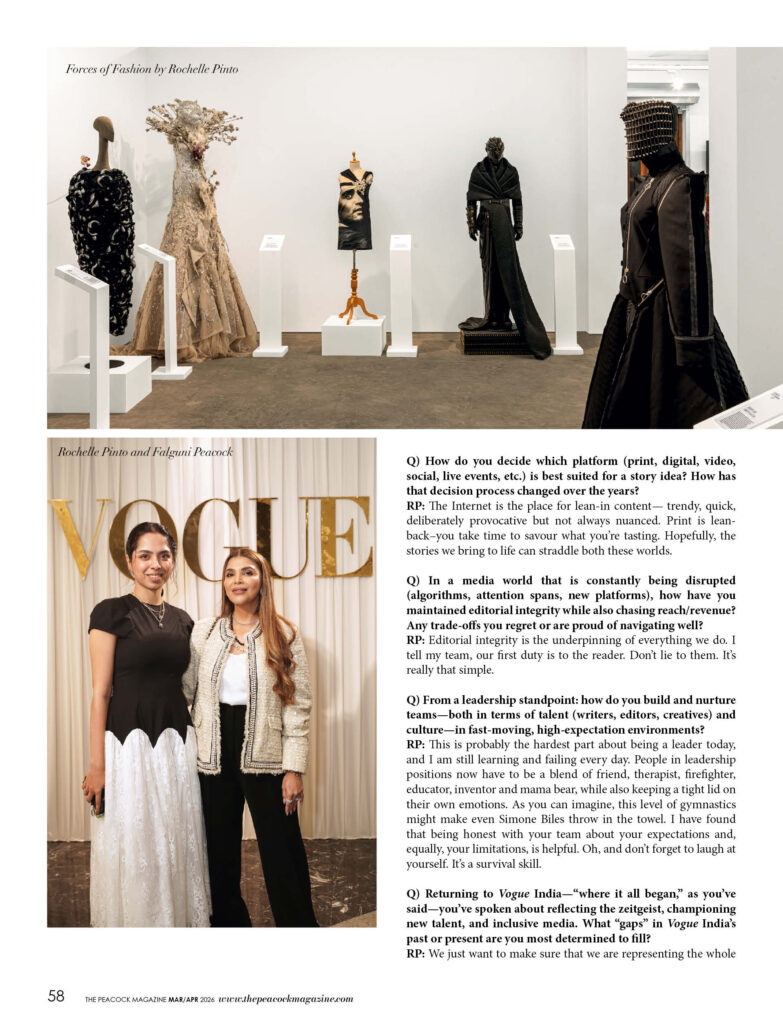
RP: I am so grateful for our Forces of Fashion Exhibit and how we’ve been able to engage with young folks and people outside the ordinary ambit of Vogue. It makes my heart full to see the crowds line up to experience the heights of creativity our designers are able to conjure into reality.
Q) On a personal note: as someone who has “grown up” with media transformations, how do you stay creatively inspired and renew your energy—what keeps you going despite the demands, deadlines, and disruption?
RP: Limitless curiosity. What got me here keeps me here.