
CREDITS – All images sourced from Avarna Jain’s team
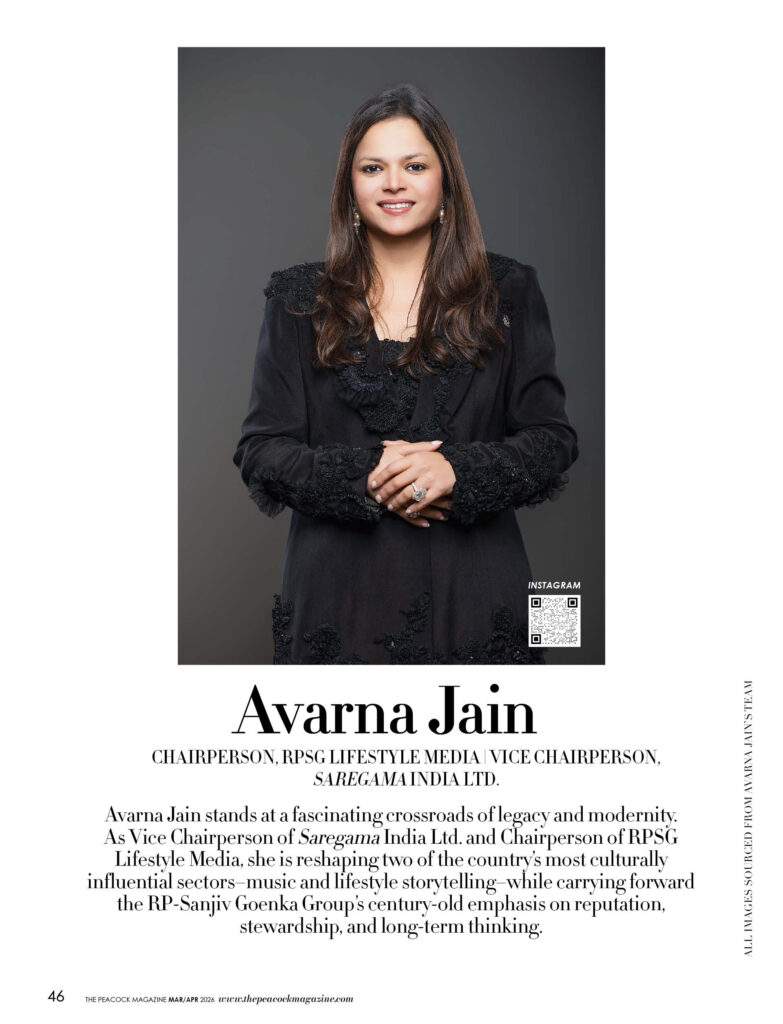
Avarna Jain stands at a fascinating crossroads of legacy and modernity. As Vice Chairperson of Saregama India Ltd. and Chairperson of RPSG Lifestyle Media, she is reshaping two of the country’s most culturally influential sectors–music and lifestyle storytelling–while carrying forward the RP-Sanjiv Goenka Group’s century-old emphasis on reputation, stewardship, and long-term thinking.
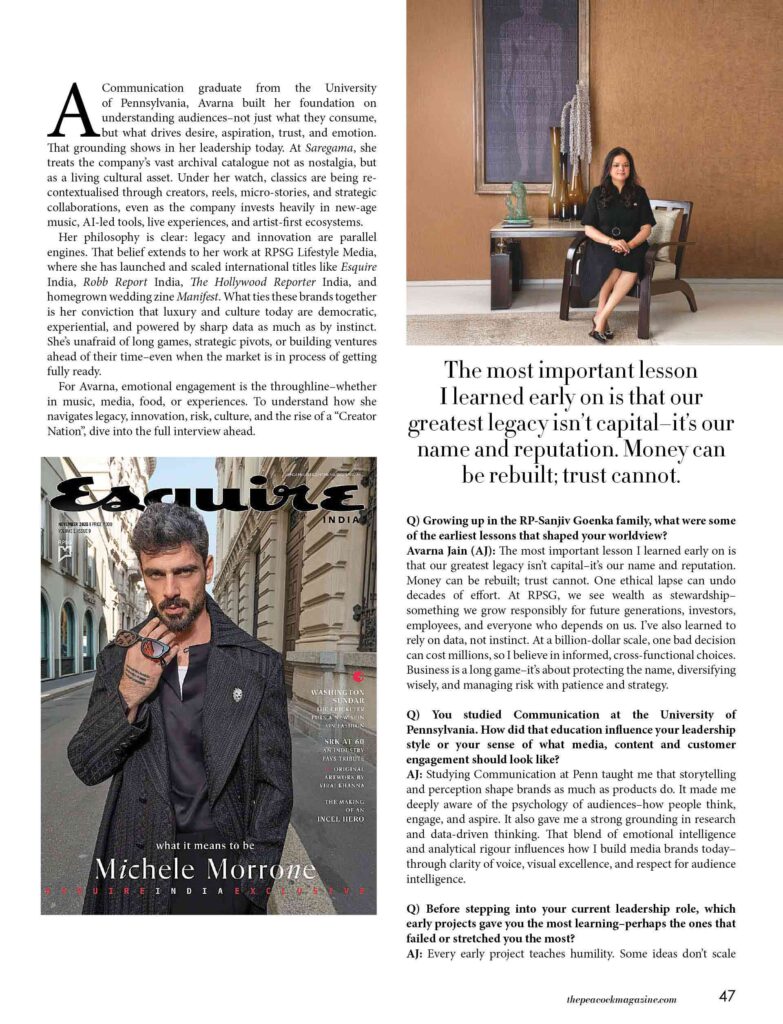
A Communication graduate from the University of Pennsylvania, Avarna built her foundation on understanding audiences–not just what they consume, but what drives desire, aspiration, trust, and emotion. That grounding shows in her leadership today. At Saregama, she treats the company’s vast archival catalogue not as nostalgia, but as a living cultural asset. Under her watch, classics are being re-contextualised through creators, reels, micro-stories, and strategic collaborations, even as the company invests heavily in new-age music, AI-led tools, live experiences, and artist-first ecosystems.
Her philosophy is clear: legacy and innovation are parallel engines. That belief extends to her work at RPSG Lifestyle Media, where she has launched and scaled international titles like Esquire India, Robb Report India, The Hollywood Reporter India, and homegrown wedding zine Manifest. What ties these brands together is her conviction that luxury and culture today are democratic, experiential, and powered by sharp data as much as by instinct. She’s unafraid of long games, strategic pivots, or building ventures ahead of their time–even when the market is in process of getting fully ready.
For Avarna, emotional engagement is the throughline–whether in music, media, food, or experiences. To understand how she navigates legacy, innovation, risk, culture, and the rise of a “Creator Nation”, dive into the full interview ahead.
Q) Growing up in the RP-Sanjiv Goenka family, what were some of the earliest lessons that shaped your worldview?
Avarna Jain (AJ): The most important lesson I learned early on is that our greatest legacy isn’t capital–it’s our name and reputation. Money can be rebuilt; trust cannot. One ethical lapse can undo decades of effort. At RPSG, we see wealth as stewardship–something we grow responsibly for future generations, investors, employees, and everyone who depends on us. I’ve also learned to rely on data, not instinct. At a billion-dollar scale, one bad decision can cost millions, so I believe in informed, cross-functional choices. Business is a long game–it’s about protecting the name, diversifying wisely, and managing risk with patience and strategy.
Q) You studied Communication at the University of Pennsylvania. How did that education influence your leadership style or your sense of what media, content and customer engagement should look like?
AJ: Studying Communication at Penn taught me that storytelling and perception shape brands as much as products do. It made me deeply aware of the psychology of audiences–how people think, engage, and aspire. It also gave me a strong grounding in research and data-driven thinking. That blend of emotional intelligence and analytical rigour influences how I build media brands today–through clarity of voice, visual excellence, and respect for audience intelligence.
Q) Before stepping into your current leadership role, which early projects gave you the most learning–perhaps the ones that failed or stretched you the most?
AJ: Every early project teaches humility. Some ideas don’t scale as expected–especially when consumer behaviour changes faster than infrastructure or technology. What I learned was that timing matters as much as vision, and that setbacks are incredible teachers. They force clarity, resilience, and the discipline to build things that last, not things that trend. An idea too early may not result in a large enough market share. And if an idea is too late and there’s no market share left.
Q) What drew you to sectors as diverse as food, media, and music? Was there a unifying theme behind those choices?
AJ: The common thread is emotional engagement. Whether it’s food, music, or media, all are deeply experiential. Through these sectors, I can connect directly with audiences, understand how they live, and anticipate what they’ll want next. With rising disposable incomes, Indian consumers are aspiring higher. Through Esquire and Robb Report, we’re enabling that aspiration; through Saregama, we’re connecting them to heritage and emotion. It’s one ecosystem of experience, powered by insight.
Q) As Vice Chairperson at Saregama, how do you balance legacy with innovation–especially for younger audiences like Gen Z and Gen Alpha?
AJ: Our archival catalogue is a living asset. We treat it not as nostalgia, but as a bridge between eras. Through collaborations with digital storytellers and influencers, we’re reintroducing classics in new contexts–reels, web series, and micro-dramas. It’s our small way of converting culture to capital. At the same time, we’re investing over ₹1,000 crore in new-age music, AI tools, and live experiences to keep Saregama relevant across generations. Legacy and innovation aren’t opposites–they’re parallel forces in our story.
Q) Carvaan was a contrarian product at launch–a physical retro music player in a streaming era. What was the thinking behind it?
AJ: Carvaan was built on emotion, not tech trends. We saw an audience that felt alienated by apps and wanted something simple, tangible, and nostalgic. It wasn’t just a device–it was memory-made-modern. Its success proved that when you design for feeling, not function, you can create something timeless. As consumption moves digital, we’re ensuring our simplicity and emotional connect stay intact–across both physical and online experiences.
Q) How do you see the role of music in a digital era defined by AI, streaming, and user-generated content?
AJ: Music is now part of culture–it lives in content, creators, and algorithms. We see this as evolution, not disruption. Our classics and new releases find new life across platforms, thanks to smart collaborations and data-led insights. AI helps us understand listener behaviour, personalise curation, and even reimagine songs creatively. With our ecosystem–from FilterCopy and Dice Media to our influencer networks–Saregama is positioned to make music live everywhere the audience is.
Q) With acquisitions like Pocket Aces and launches like Padhanisa, how do you decide when to diversify versus stay core?
AJ: We diversify only when it amplifies our core–music and storytelling. Pocket Aces strengthens our digital reach; Padhanisa extends our music expertise into learning. Both deepen engagement without drifting from who we are. We’re very mindful of our risk thresholds. Every venture must align with our DNA, not dilute it. Innovation should enhance the brand’s strength, not chase trends.
Q) You’ve expanded RPSG Lifestyle Media’s portfolio with Esquire, Robb Report, The Hollywood Reporter India, and Manifest. What’s your broader vision for this group?
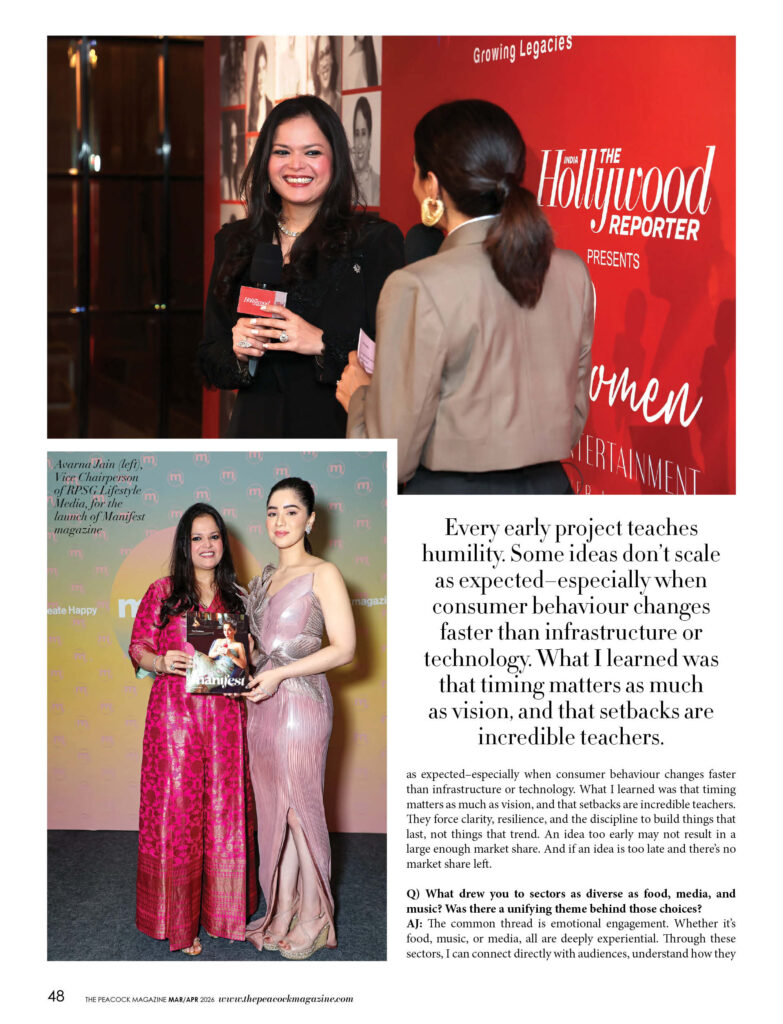
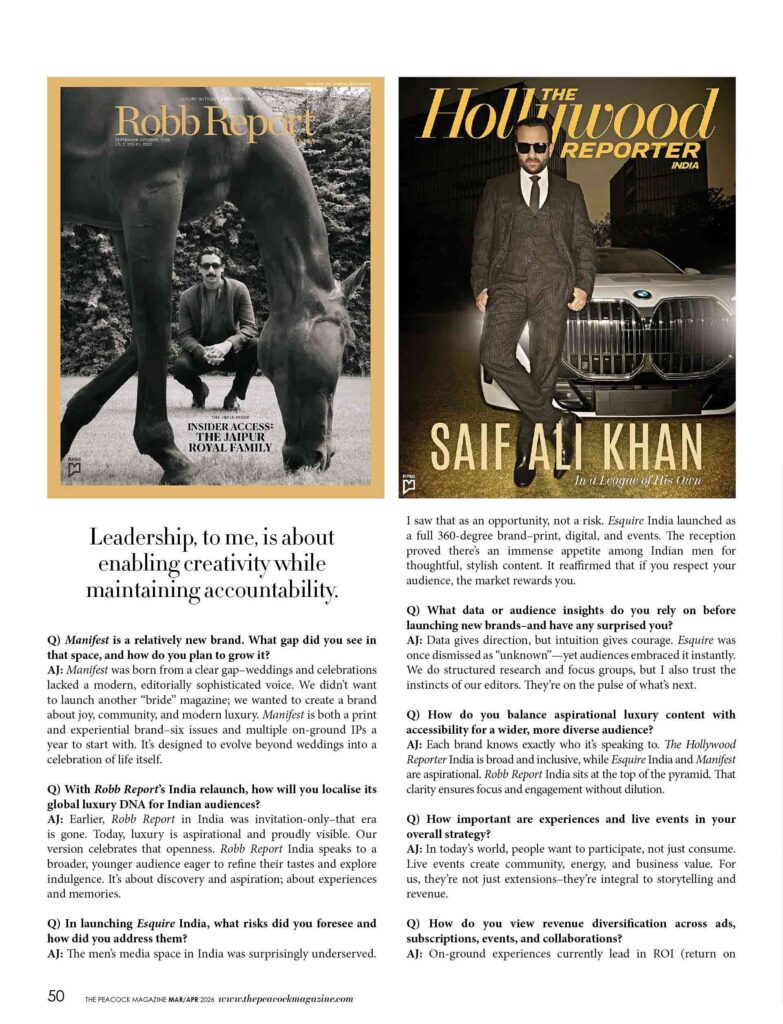
AJ: RPSG Lifestyle Media is built to be the voice of luxury and aspiration in India. Luxury today is democratic–no longer limited to a few. We aim to be the authority that guides how India defines “the good life”. Our brands together form a complete ecosystem: The Hollywood Reporter India captures entertainment and culture, Esquire India redefines modern masculinity, Robb Report India curates high luxury, and Manifest celebrates life through the lens of weddings and occasions.
Q) Manifest is a relatively new brand. What gap did you see in that space, and how do you plan to grow it?
AJ: Manifest was born from a clear gap–weddings and celebrations lacked a modern, editorially sophisticated voice. We didn’t want to launch another “bride” magazine; we wanted to create a brand about joy, community, and modern luxury. Manifest is both a print and experiential brand–six issues and multiple on-ground IPs a year to start with. It’s designed to evolve beyond weddings into a celebration of life itself.
Q) With Robb Report’s India relaunch, how will you localise its global luxury DNA for Indian audiences?
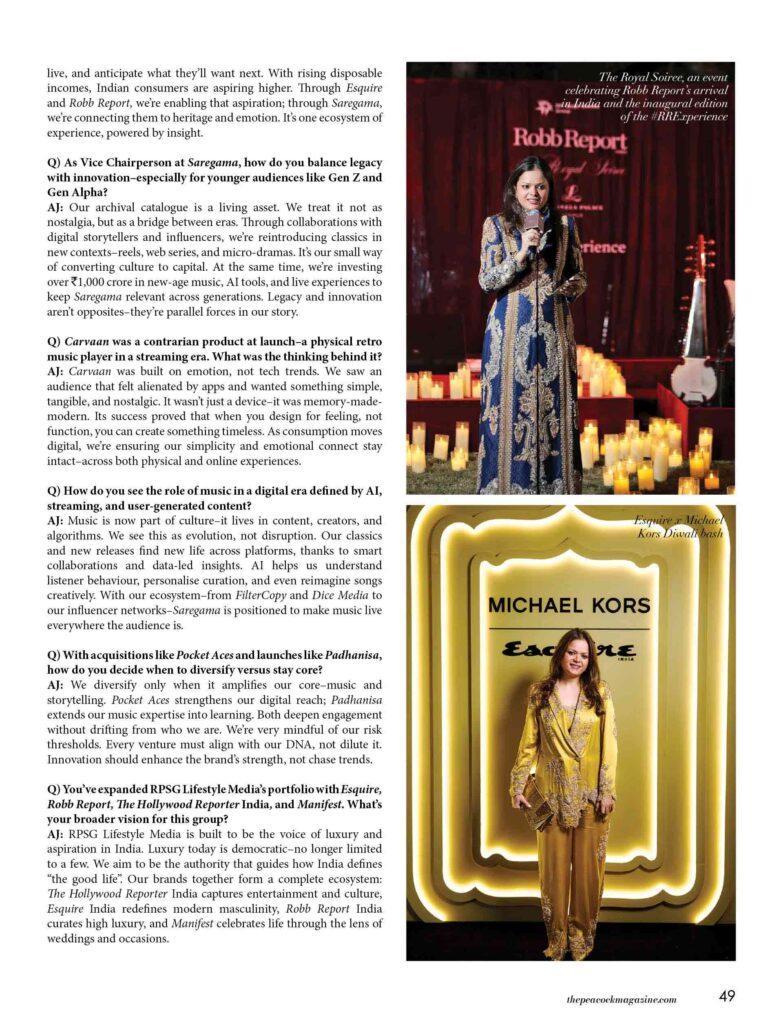
AJ: Earlier, Robb Report in India was invitation-only–that era is gone. Today, luxury is aspirational and proudly visible. Our version celebrates that openness. Robb Report India speaks to a broader, younger audience eager to refine their tastes and explore indulgence. It’s about discovery and aspiration; about experiences and memories.
Q) In launching Esquire India, what risks did you foresee and how did you address them?
AJ: The men’s media space in India was surprisingly underserved. I saw that as an opportunity, not a risk. Esquire India launched as a full 360-degree brand–print, digital, and events. The reception proved there’s an immense appetite among Indian men for thoughtful, stylish content. It reaffirmed that if you respect your audience, the market rewards you.
Q) What data or audience insights do you rely on before launching new brands–and have any surprised you?
AJ: Data gives direction, but intuition gives courage. Esquire was once dismissed as “unknown”—yet audiences embraced it instantly. We do structured research and focus groups, but I also trust the instincts of our editors. They’re on the pulse of what’s next.
Q) How do you balance aspirational luxury content with accessibility for a wider, more diverse audience?
AJ: Each brand knows exactly who it’s speaking to. The Hollywood Reporter India is broad and inclusive, while Esquire India and Manifest are aspirational. Robb Report India sits at the top of the pyramid. That clarity ensures focus and engagement without dilution.
Q) How important are experiences and live events in your overall strategy?
AJ: In today’s world, people want to participate, not just consume. Live events create community, energy, and business value. For us, they’re not just extensions–they’re integral to storytelling and revenue.
Q) How do you view revenue diversification across ads, subscriptions, events, and collaborations?
AJ: On-ground experiences currently lead in ROI (return on investment)–brands value real engagement. But digital campaigns are catching up fast, and print is enjoying a global revival. At RPSG Lifestyle Media, we’ve proven that print can be luxurious, collectible, and commercially viable. We’ve revived the space and plan to keep redefining it.
Q) As someone managing multiple large initiatives, what are your leadership principles?
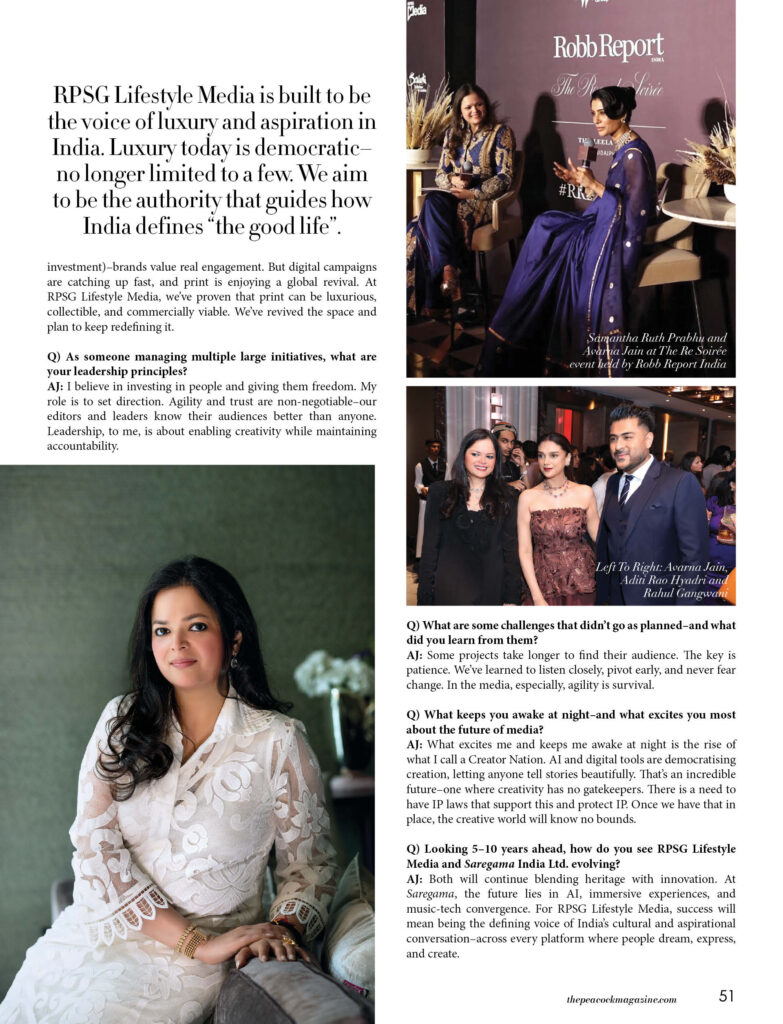
AJ: I believe in investing in people and giving them freedom. My role is to set direction. Agility and trust are non-negotiable–our editors and leaders know their audiences better than anyone. Leadership, to me, is about enabling creativity while maintaining accountability.
Q) What are some challenges that didn’t go as planned–and what did you learn from them?
AJ: Some projects take longer to find their audience. The key is patience. We’ve learned to listen closely, pivot early, and never fear change. In the media, especially, agility is survival.
Q) What keeps you awake at night–and what excites you most about the future of media?
AJ: What excites me and keeps me awake at night is the rise of what I call a Creator Nation. AI and digital tools are democratising creation, letting anyone tell stories beautifully. That’s an incredible future–one where creativity has no gatekeepers. There is a need to have IP laws that support this and protect IP. Once we have that in place, the creative world will know no bounds.
Q) Looking 5–10 years ahead, how do you see RPSG Lifestyle Media and Saregama India Ltd. evolving?
AJ: Both will continue blending heritage with innovation. At Saregama, the future lies in AI, immersive experiences, and music-tech convergence. For RPSG Lifestyle Media, success will mean being the defining voice of India’s cultural and aspirational conversation–across every platform where people dream, express, and create.