
CREDITS – All images sourced from Ricardo Woo’s team
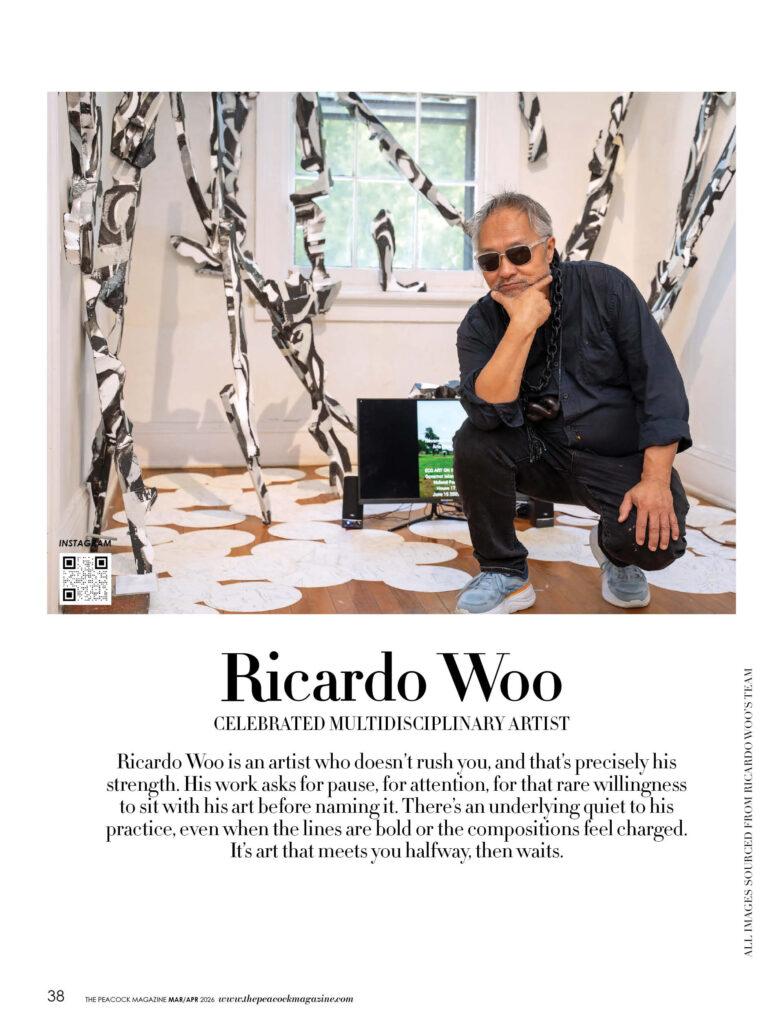
Ricardo Woo is an artist who doesn’t rush you, and that’s precisely his strength. His work asks for pause, for attention, for that rare willingness to sit with his art before naming it. There’s an underlying quiet to his practice, even when the lines are bold or the compositions feel charged. It’s art that meets you halfway, then waits.
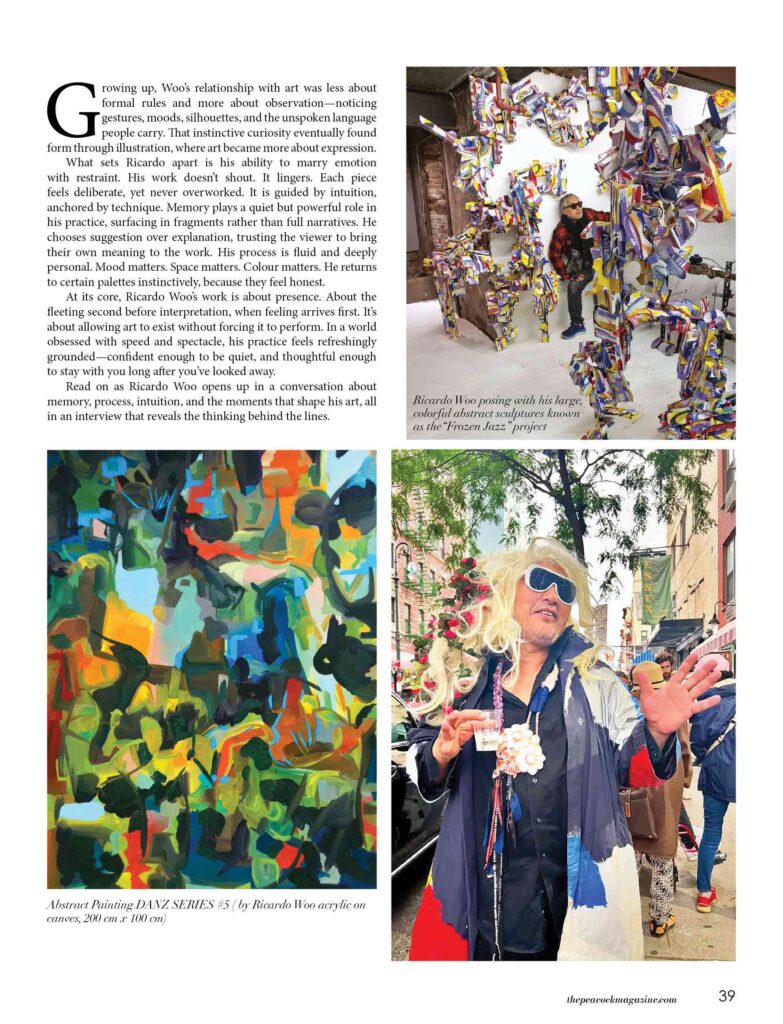
Growing up, Woo’s relationship with art was less about formal rules and more about observation—noticing gestures, moods, silhouettes, and the unspoken language people carry. That instinctive curiosity eventually found form through illustration, where art became more about expression.
What sets Ricardo apart is his ability to marry emotion with restraint. His work doesn’t shout. It lingers. Each piece feels deliberate, yet never overworked. It is guided by intuition, anchored by technique. Memory plays a quiet but powerful role in his practice, surfacing in fragments rather than full narratives. He chooses suggestion over explanation, trusting the viewer to bring their own meaning to the work. His process is fluid and deeply personal. Mood matters. Space matters. Colour matters. He returns to certain palettes instinctively, because they feel honest.
At its core, Ricardo Woo’s work is about presence. About the fleeting second before interpretation, when feeling arrives first. It’s about allowing art to exist without forcing it to perform. In a world obsessed with speed and spectacle, his practice feels refreshingly grounded—confident enough to be quiet, and thoughtful enough to stay with you long after you’ve looked away.
Read on as Ricardo Woo opens up in a conversation about memory, process, intuition, and the moments that shape his art, all in an interview that reveals the thinking behind the lines.
Q) What were your growing-up years like?
Ricardo Woo (RW): I had a great childhood. I spent a lot of time playing outside, flying kites, spinning tops, playing marbles, and playing football.
Q) What is your earliest memory of art?
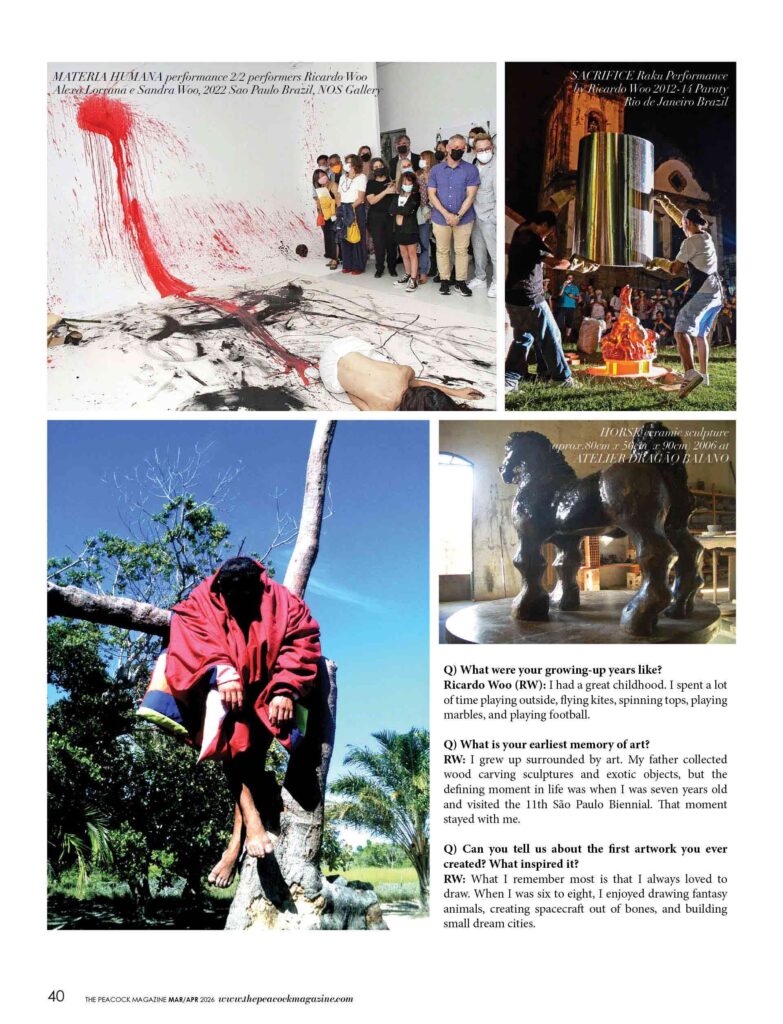
RW: I grew up surrounded by art. My father collected wood carving sculptures and exotic objects, but the defining moment in life was when I was seven years old and visited the 11th São Paulo Biennial. That moment stayed with me.
Q) Can you tell us about the first artwork you ever created? What inspired it?
RW: What I remember most is that I always loved to draw. When I was six to eight, I enjoyed drawing fantasy animals, creating spacecraft out of bones, and building small dream cities.
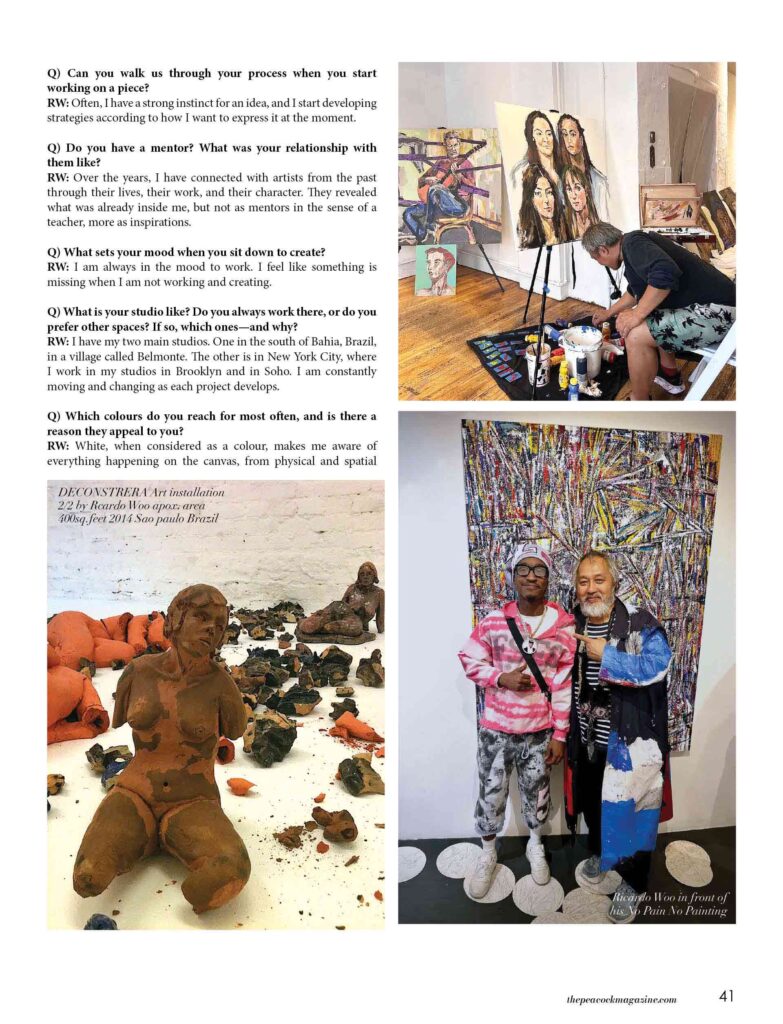
Q) Can you walk us through your process when you start working on a piece?
RW: Often, I have a strong instinct for an idea, and I start developing strategies according to how I want to express it at the moment.
Q) Do you have a mentor? What was your relationship with them like?
RW: Over the years, I have connected with artists from the past through their lives, their work, and their character. They revealed what was already inside me, but not as mentors in the sense of a teacher, more as inspirations.
Q) What sets your mood when you sit down to create?
RW: I am always in the mood to work. I feel like something is missing when I am not working and creating.
Q) What is your studio like? Do you always work there, or do you prefer other spaces? If so, which ones—and why?
RW: I have my two main studios. One in the south of Bahia, Brazil, in a village called Belmonte. The other is in New York City, where I work in my studios in Brooklyn and in Soho. I am constantly moving and changing as each project develops.
Q) Which colours do you reach for most often, and is there a reason they appeal to you?
RW: White, when considered as a colour, makes me aware of everything happening on the canvas, from physical and spatial relationships to blocking, and then to how colours interact with each other.
Q) Do you use any tech tools in your work? Which ones stand out?
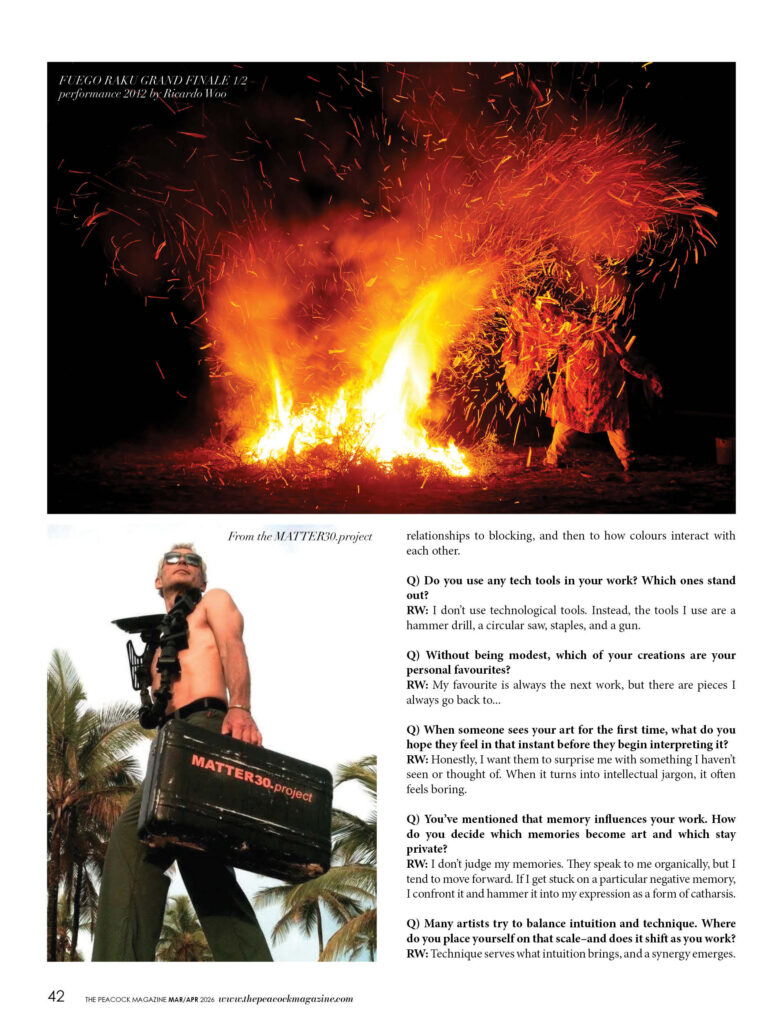
RW: I don’t use technological tools. Instead, the tools I use are a hammer drill, a circular saw, staples, and a gun.
Q) Without being modest, which of your creations are your personal favourites?
RW: My favourite is always the next work, but there are pieces I always go back to…
Q) When someone sees your art for the first time, what do you hope they feel in that instant before they begin interpreting it?
RW: Honestly, I want them to surprise me with something I haven’t seen or thought of. When it turns into intellectual jargon, it often feels boring.
Q) You’ve mentioned that memory influences your work. How do you decide which memories become art and which stay private?
RW: I don’t judge my memories. They speak to me organically, but I tend to move forward. If I get stuck on a particular negative memory, I confront it and hammer it into my expression as a form of catharsis.
Q) Many artists try to balance intuition and technique. Where do you place yourself on that scale–and does it shift as you work?
RW: Technique serves what intuition brings, and a synergy emerges.
Q) What’s the most surprising interpretation a viewer has shared with you, and did it change the way you see your own work?
RW: My work doesn’t change according to the viewer’s interpretation, but sometimes it can influence the viewer’s perception.
Q) Artists often develop recurring motifs that become their visual signatures. What would you say yours is—and is it intentional or instinctive?
RW: It is a fusion of the intentional and the instinctive.
Q) How does your cultural background shape your visual language? Is it a conscious choice or something that naturally flows into your work?
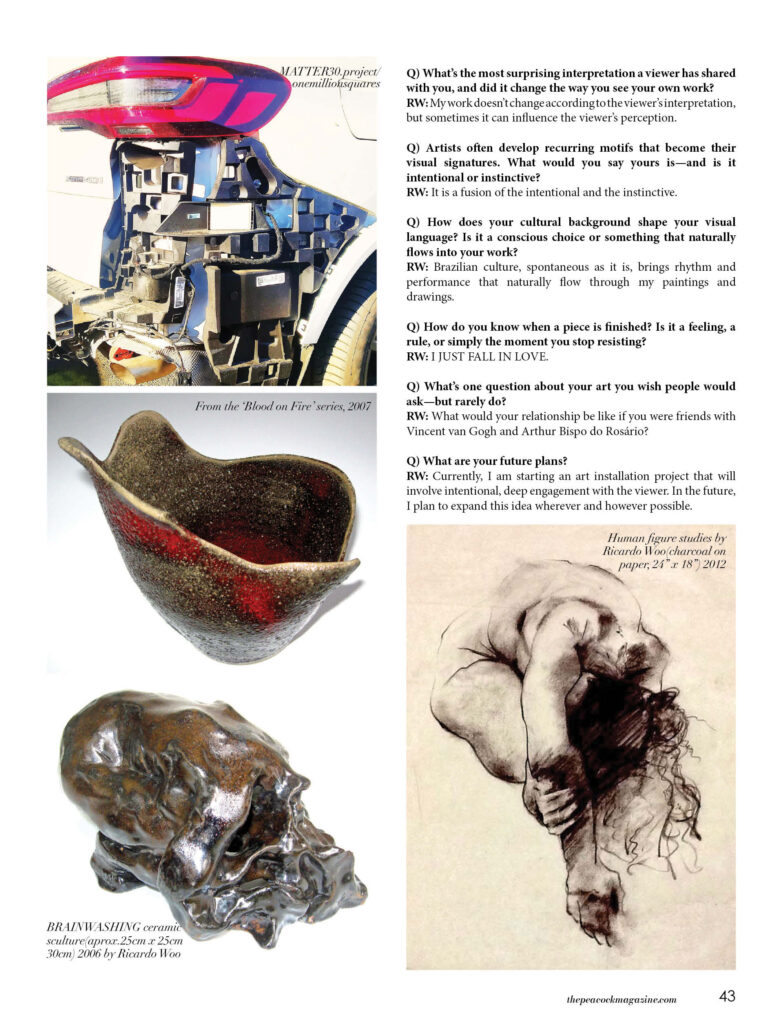
RW: Brazilian culture, spontaneous as it is, brings rhythm and performance that naturally flow through my paintings and drawings.
Q) How do you know when a piece is finished? Is it a feeling, a rule, or simply the moment you stop resisting?
RW: I JUST FALL IN LOVE.
Q) What’s one question about your art you wish people would ask—but rarely do?
RW: What would your relationship be like if you were friends with Vincent van Gogh and Arthur Bispo do Rosário?
Q) What are your future plans?
RW: Currently, I am starting an art installation project that will involve intentional, deep engagement with the viewer. In the future, I plan to expand this idea wherever and however possible.