
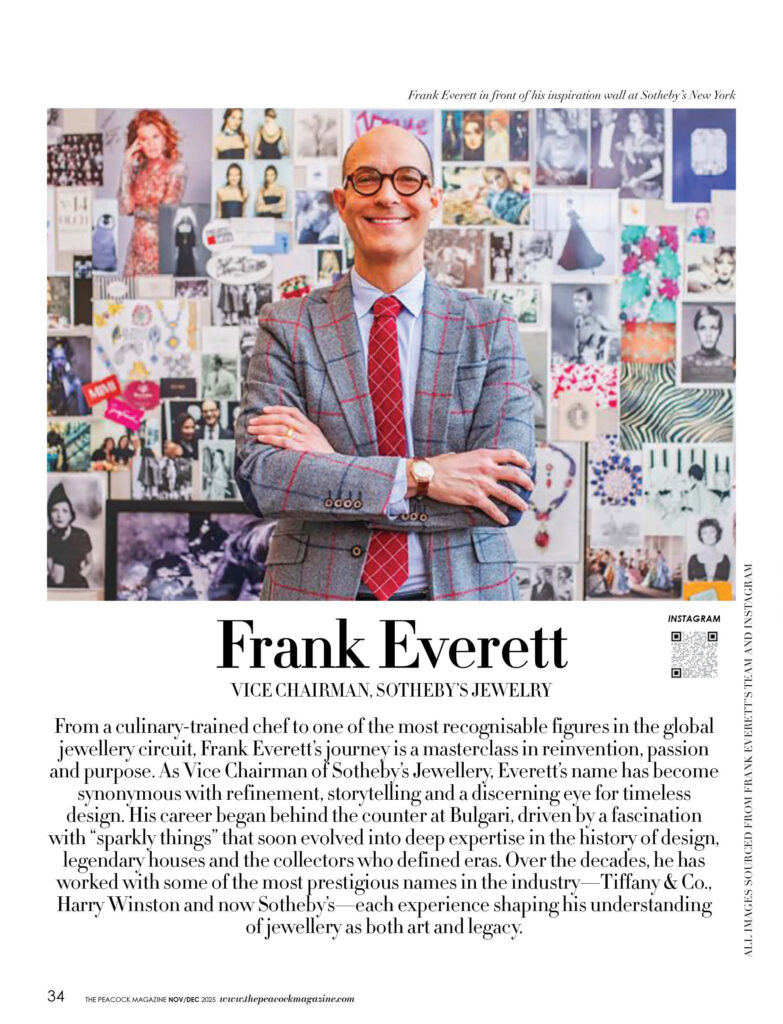
CREDITS – All images sourced from Frank Everett’s team and Instagram
From a culinary-trained chef to one of the most recognisable figures in the global jewellery circuit, Frank Everett’s journey is a masterclass in reinvention, passion and purpose. As Vice Chairman of Sotheby’s Jewellery, Everett’s name has become synonymous with refinement, storytelling and a discerning eye for timeless design. His career began behind the counter at Bulgari, driven by a fascination with “sparkly things” that soon evolved into deep expertise in the history of design, legendary houses and the collectors who defined eras. Over the decades, he has worked with some of the most prestigious names in the industry—Tiffany & Co., Harry Winston and now Sotheby’s—each experience shaping his understanding of jewellery as both art and legacy.
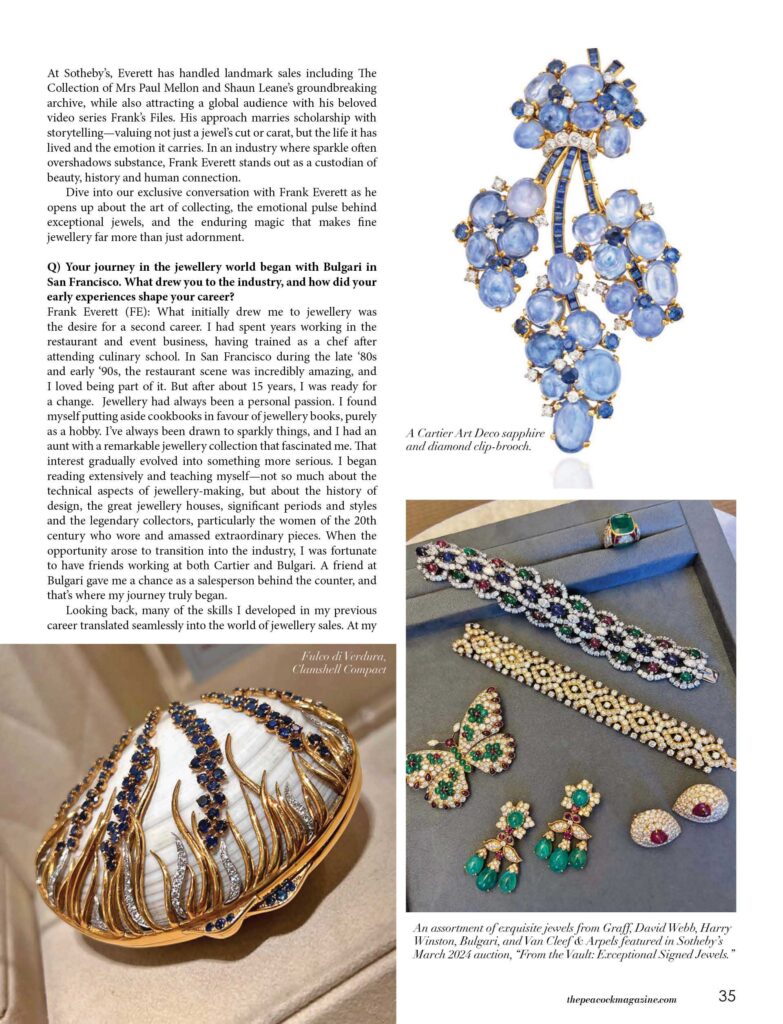
At Sotheby’s, Everett has handled landmark sales including The Collection of Mrs Paul Mellon and Shaun Leane’s groundbreaking archive, while also attracting a global audience with his beloved video series Frank’s Files. His approach marries scholarship with storytelling—valuing not just a jewel’s cut or carat, but the life it has lived and the emotion it carries. In an industry where sparkle often overshadows substance, Frank Everett stands out as a custodian of beauty, history and human connection.
Dive into our exclusive conversation with Frank Everett as he opens up about the art of collecting, the emotional pulse behind exceptional jewels, and the enduring magic that makes fine jewellery far more than just adornment.
Q) Your journey in the jewellery world began with Bulgari in San Francisco. What drew you to the industry, and how did your early experiences shape your career?
Frank Everett (FE): What initially drew me to jewellery was the desire for a second career. I had spent years working in the restaurant and event business, having trained as a chef after attending culinary school. In San Francisco during the late ’80s and early ’90s, the restaurant scene was incredibly amazing, and I loved being part of it. But after about 15 years, I was ready for a change. Jewellery had always been a personal passion. I found myself putting aside cookbooks in favour of jewellery books, purely as a hobby. I’ve always been drawn to sparkly things, and I had an aunt with a remarkable jewellery collection that fascinated me. That interest gradually evolved into something more serious. I began reading extensively and teaching myself—not so much about the technical aspects of jewellery-making, but about the history of design, the great jewellery houses, significant periods and styles and the legendary collectors, particularly the women of the 20th century who wore and amassed extraordinary pieces. When the opportunity arose to transition into the industry, I was fortunate to have friends working at both Cartier and Bulgari. A friend at Bulgari gave me a chance as a salesperson behind the counter, and that’s where my journey truly began.
Looking back, many of the skills I developed in my previous career translated seamlessly into the world of jewellery sales. At my core, I’ve always been a salesman—a shopkeeper, really. Working in restaurants meant catering to a clientele that appreciated luxury, and that experience helped me understand the nuances of selling high-end products. Additionally, my academic background in English Literature and Communications played a significant role. Studying public speaking and small-group discussions helped me refine my ability to connect with clients in a meaningful way. Effective communication is essential in sales, and those early skills proved invaluable in shaping my career in the jewellery world.
Q) Being largely self-taught in design, history, and gemology is impressive. What were some of the most valuable lessons you learned along the way?
FE: Over the past 13 years, one of the most valuable lessons I’ve learned is the importance of relying on the expertise of my colleagues—particularly graduate gemologists who have a deeper understanding of stones than I do. While I’ve completed basic training at GIA, including introductory courses on diamonds and coloured gemstones, I’m not a gemologist myself. When it comes to evaluating certain stones, I trust and collaborate with my colleagues to ensure accuracy. That said, the most important lesson I’ve learned isn’t just about gemology—it’s about building strong client relationships. Listening to my clients, understanding what they love and ensuring that while I share my expertise and opinions, the final decision is ultimately about their taste and preferences, not mine. They are the ones who will be wearing and cherishing these pieces, so my role is to guide them rather than impose my own perspective. People often say, “Frank could sell ice to an Eskimo”, but that’s not really true. I can’t just sell anything—I sell what I genuinely love. My passion for jewellery has led me to acquire a deep knowledge of it, and that enthusiasm naturally translates into my work. But at its core, successful sales come down to truly listening to the client, developing trust and offering the right advice.
At Sotheby’s, we have the unique advantage of working in the secondary market, meaning we don’t design or manufacture pieces—we act as brokers, sourcing the finest jewellery for our clients. This allows me the luxury of patience; I don’t have to sell what’s available today. Instead, I can take the time to find the perfect piece that fits seamlessly into a client’s collection. That long-term approach is one of the most rewarding aspects of my job. Sometimes, my role also involves advising clients when not to buy—whether because something is exceeding its value or because they already own similar pieces. Honest guidance is what builds lasting relationships, and I believe that’s been a key factor in my success.
Q) Joining Sotheby’s in 2013 marked a significant shift in your career. What excited you most about transitioning into the auction world?
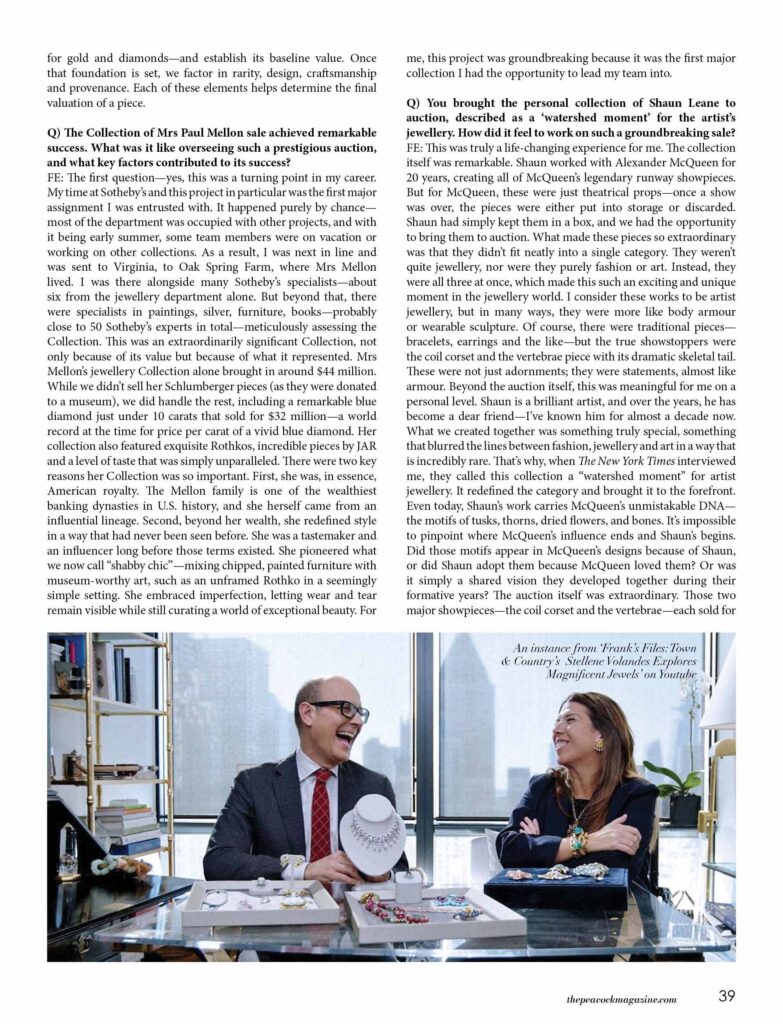
FE: What excited me the most was that I had no idea what to expect. To be perfectly honest, when I interviewed for the job, I didn’t fully realise how much I would love it. If I had known, I probably would have been far more nervous during the process. Interestingly, even Sotheby’s wasn’t entirely sure what they were looking for at the time. They knew they wanted someone from the retail world with experience across multiple brands—which I had, having worked at Bulgari, Tiffany’s and Harry Winston. They also wanted someone who had worked in multiple markets across the U.S., and my background in San Francisco, Philadelphia, Miami and Los Angeles aligned with that. But beyond those broad qualifications, the specifics of the role weren’t entirely defined. As I integrated into the team and the global jewellery department, I discovered ways I could contribute beyond just working with clients and selling jewellery at auctions. I found my niche in marketing and was an early adopter of social media, which I believe is a perfect platform for showcasing jewellery. That led to the creation of my video series, Frank’s Files, which I’m incredibly proud of. Over the past 11 years, I’ve produced nearly 140 episodes, and it has been an amazing way to engage with a wider audience. What made this experience so exciting for me was that, despite my extensive background in jewellery and retail, this felt like an entirely new chapter—almost like a second-and-a-half career. I knew nothing about auctions when I started, so there was a bit of “fake it till you make it” in those early months. I had to quickly learn industry-specific jargon—terms like hammer price versus aggregate price, IBs, guarantees, and all the unique terminology that comes with the auction world. One of the most rewarding aspects was the opportunity to become a student again. In my previous roles—such as overseeing multiple Tiffany’s stores—I was the one people turned to for answers. But at Sotheby’s, I was suddenly in a position where I got to ask questions and absorb knowledge. I was learning about the secondary market and vintage jewellery in a hands-on way, rather than just reading about it or admiring it at shows. Having these extraordinary pieces on my desk every day, studying their history and significance, was the most exciting and fulfilling part of the journey.
Q) You’ve worked with iconic brands like Tiffany & Co. and Harry Winston. How did these experiences contribute to your expertise in jewellery design and management?
FE: Each of the houses I worked with taught me something invaluable. At Bulgari, I learned the importance of client relationships and sales. I started in San Francisco, which had a particularly strong connection to the brand. At the time, Bulgari was still privately owned by the Bulgari brothers, and they visited San Francisco several times a year. They were passionate car collectors and would always come to California for the Pebble Beach Concours d’Elegance. Through them, I gained insight into what draws clients to a brand—what fuels their passion and loyalty.
Tiffany & Co. was where I truly learned the art of storytelling, and that became the foundation of much of what I do today in marketing, PR and press. Jewellery is more than just something beautiful to wear—clients crave the stories behind each piece. Whether it’s the history of the house, the designer’s vision or the notable individuals who once owned it, these narratives elevate a piece beyond its intrinsic value. Tiffany & Co. is a house rich in history, from Charles Lewis Tiffany’s legendary purchase of the French Crown Jewels to becoming the great jeweller of New York, to Paulding Farnham, one of the greatest gemologists and designers of all time. Then there’s the legacy of Louis Comfort Tiffany, the revolutionary designs of Elsa Peretti and Paloma Picasso, and, of course, Jean Schlumberger, whose work was beloved by icons like Bunny Mellon. I had the privilege of working on the sale of Mrs Paul Mellon’s Collection, which was a significant milestone in my career. In her will, she had bequeathed her 160-plus pieces of Schlumberger jewellery to the Virginia Museum of Fine Arts (VMFA). Sotheby’s played a key role in housing, cataloguing and photographing the collection until the estate was settled, before it was transferred to the museum. That experience underscored for me how deeply history and storytelling are woven into jewellery.
Harry Winston was a dream to work for and was my last role before Sotheby’s. That experience was all about extraordinary gemstones and an unparalleled legacy—the man, the house and the stones. It was an honour to be part of that world, working with some of the most breathtaking gems in existence. Even today, when we handle important stones at auction—whether large white diamonds or magnificent coloured gems—there’s something truly special when they bear the Harry Winston name. It immediately elevates them to another level.
Each of these houses left an imprint on me, shaping my understanding of jewellery not just as a luxury product, but as a living history of craftsmanship, design and personal significance.
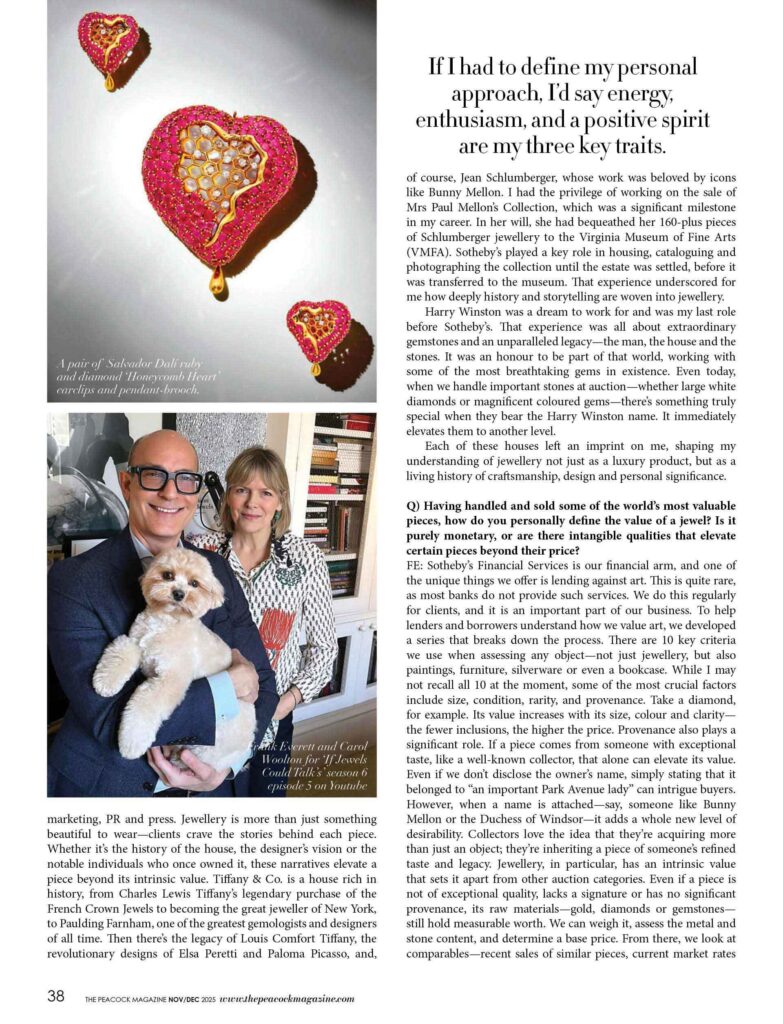
Q) Having handled and sold some of the world’s most valuable pieces, how do you personally define the value of a jewel? Is it purely monetary, or are there intangible qualities that elevate certain pieces beyond their price?
FE: Sotheby’s Financial Services is our financial arm, and one of the unique things we offer is lending against art. This is quite rare, as most banks do not provide such services. We do this regularly for clients, and it is an important part of our business. To help lenders and borrowers understand how we value art, we developed a series that breaks down the process. There are 10 key criteria we use when assessing any object—not just jewellery, but also paintings, furniture, silverware or even a bookcase. While I may not recall all 10 at the moment, some of the most crucial factors include size, condition, rarity, and provenance. Take a diamond, for example. Its value increases with its size, colour and clarity—the fewer inclusions, the higher the price. Provenance also plays a significant role. If a piece comes from someone with exceptional taste, like a well-known collector, that alone can elevate its value. Even if we don’t disclose the owner’s name, simply stating that it belonged to “an important Park Avenue lady” can intrigue buyers. However, when a name is attached—say, someone like Bunny Mellon or the Duchess of Windsor—it adds a whole new level of desirability. Collectors love the idea that they’re acquiring more than just an object; they’re inheriting a piece of someone’s refined taste and legacy. Jewellery, in particular, has an intrinsic value that sets it apart from other auction categories. Even if a piece is not of exceptional quality, lacks a signature or has no significant provenance, its raw materials—gold, diamonds or gemstones—still hold measurable worth. We can weigh it, assess the metal and stone content, and determine a base price. From there, we look at comparables—recent sales of similar pieces, current market rates for gold and diamonds—and establish its baseline value. Once that foundation is set, we factor in rarity, design, craftsmanship and provenance. Each of these elements helps determine the final valuation of a piece.
Q) The Collection of Mrs Paul Mellon sale achieved remarkable success. What was it like overseeing such a prestigious auction, and what key factors contributed to its success?
FE: The first question—yes, this was a turning point in my career. My time at Sotheby’s and this project in particular was the first major assignment I was entrusted with. It happened purely by chance—most of the department was occupied with other projects, and with it being early summer, some team members were on vacation or working on other collections. As a result, I was next in line and was sent to Virginia, to Oak Spring Farm, where Mrs Mellon lived. I was there alongside many Sotheby’s specialists—about six from the jewellery department alone. But beyond that, there were specialists in paintings, silver, furniture, books—probably close to 50 Sotheby’s experts in total—meticulously assessing the Collection. This was an extraordinarily significant Collection, not only because of its value but because of what it represented. Mrs Mellon’s jewellery Collection alone brought in around $44 million. While we didn’t sell her Schlumberger pieces (as they were donated to a museum), we did handle the rest, including a remarkable blue diamond just under 10 carats that sold for $32 million—a world record at the time for price per carat of a vivid blue diamond. Her collection also featured exquisite Rothkos, incredible pieces by JAR and a level of taste that was simply unparalleled. There were two key reasons her Collection was so important. First, she was, in essence, American royalty. The Mellon family is one of the wealthiest banking dynasties in U.S. history, and she herself came from an influential lineage. Second, beyond her wealth, she redefined style in a way that had never been seen before. She was a tastemaker and an influencer long before those terms existed. She pioneered what we now call “shabby chic”—mixing chipped, painted furniture with museum-worthy art, such as an unframed Rothko in a seemingly simple setting. She embraced imperfection, letting wear and tear remain visible while still curating a world of exceptional beauty. For me, this project was groundbreaking because it was the first major collection I had the opportunity to lead my team into.
Q) You brought the personal collection of Shaun Leane to auction, described as a ‘watershed moment’ for the artist’s How did it feel to work on such a groundbreaking sale?
FE: This was truly a life-changing experience for me. The collection itself was remarkable. Shaun worked with Alexander McQueen for 20 years, creating all of McQueen’s legendary runway showpieces. But for McQueen, these were just theatrical props—once a show was over, the pieces were either put into storage or discarded. Shaun had simply kept them in a box, and we had the opportunity to bring them to auction. What made these pieces so extraordinary was that they didn’t fit neatly into a single category. They weren’t quite jewellery, nor were they purely fashion or art. Instead, they were all three at once, which made this such an exciting and unique moment in the jewellery world. I consider these works to be artist jewellery, but in many ways, they were more like body armour or wearable sculpture. Of course, there were traditional pieces—bracelets, earrings and the like—but the true showstoppers were the coil corset and the vertebrae piece with its dramatic skeletal tail. These were not just adornments; they were statements, almost like armour. Beyond the auction itself, this was meaningful for me on a personal level. Shaun is a brilliant artist, and over the years, he has become a dear friend—I’ve known him for almost a decade now. What we created together was something truly special, something that blurred the lines between fashion, jewellery and art in a way that is incredibly rare. That’s why, when The New York Times interviewed me, they called this collection a “watershed moment” for artist jewellery. It redefined the category and brought it to the forefront. Even today, Shaun’s work carries McQueen’s unmistakable DNA—the motifs of tusks, thorns, dried flowers, and bones. It’s impossible to pinpoint where McQueen’s influence ends and Shaun’s begins. Did those motifs appear in McQueen’s designs because of Shaun, or did Shaun adopt them because McQueen loved them? Or was it simply a shared vision they developed together during their formative years? The auction itself was extraordinary. Those two major showpieces—the coil corset and the vertebrae—each sold for nearly half a million dollars. In total, we sold 42 pieces for almost $3 million, which was unheard of. These weren’t traditional high-value materials; they weren’t made of gold or diamonds. Some were crafted from sterling silver, but others were simply base metal, leather, bone or feathers. The value came entirely from the artistry and legacy behind them. It was an absolute privilege!
Q) Can you share the creative process behind the “IN BLOOM” floral jewellery exhibition? What was it like collaborating with Carol Woolton on this project?
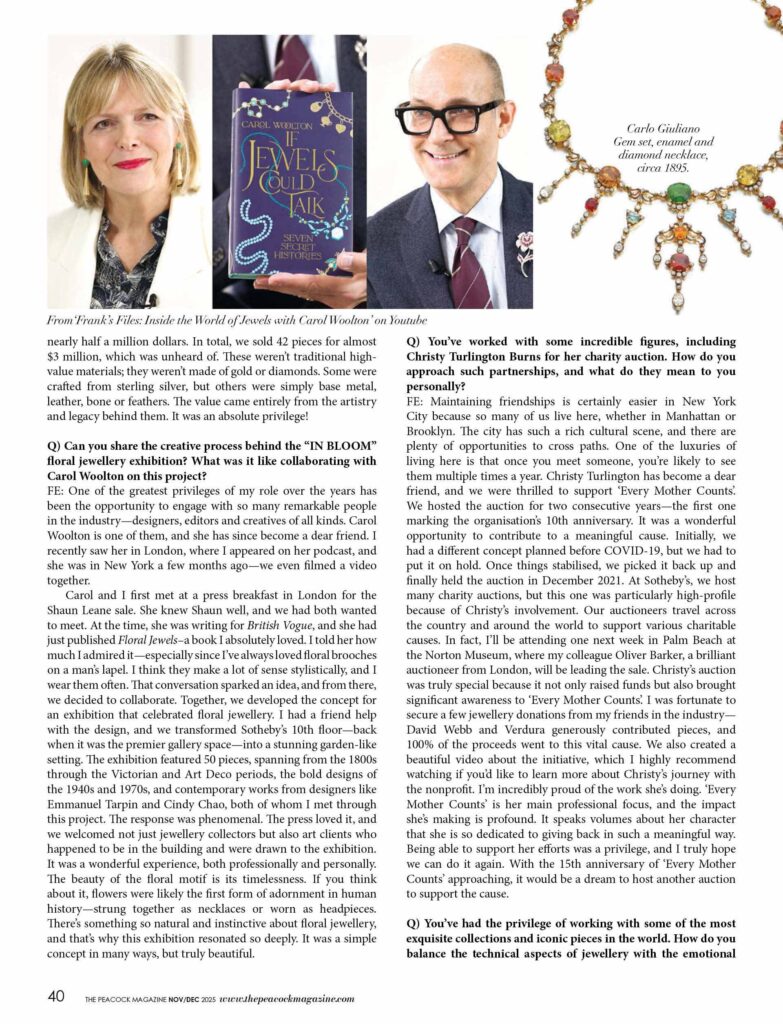
FE: One of the greatest privileges of my role over the years has been the opportunity to engage with so many remarkable people in the industry—designers, editors and creatives of all kinds. Carol Woolton is one of them, and she has since become a dear friend. I recently saw her in London, where I appeared on her podcast, and she was in New York a few months ago—we even filmed a video together.
Carol and I first met at a press breakfast in London for the Shaun Leane sale. She knew Shaun well, and we had both wanted to meet. At the time, she was writing for British Vogue, and she had just published Floral Jewels–a book I absolutely loved. I told her how much I admired it—especially since I’ve always loved floral brooches on a man’s lapel. I think they make a lot of sense stylistically, and I wear them often. That conversation sparked an idea, and from there, we decided to collaborate. Together, we developed the concept for an exhibition that celebrated floral jewellery. I had a friend help with the design, and we transformed Sotheby’s 10th floor—back when it was the premier gallery space—into a stunning garden-like setting. The exhibition featured 50 pieces, spanning from the 1800s through the Victorian and Art Deco periods, the bold designs of the 1940s and 1970s, and contemporary works from designers like Emmanuel Tarpin and Cindy Chao, both of whom I met through this project. The response was phenomenal. The press loved it, and we welcomed not just jewellery collectors but also art clients who happened to be in the building and were drawn to the exhibition. It was a wonderful experience, both professionally and personally. The beauty of the floral motif is its timelessness. If you think about it, flowers were likely the first form of adornment in human history—strung together as necklaces or worn as headpieces. There’s something so natural and instinctive about floral jewellery, and that’s why this exhibition resonated so deeply. It was a simple concept in many ways, but truly beautiful.
Q) You’ve worked with some incredible figures, including Christy Turlington Burns for her charity auction. How do you approach such partnerships, and what do they mean to you personally?
FE: Maintaining friendships is certainly easier in New York City because so many of us live here, whether in Manhattan or Brooklyn. The city has such a rich cultural scene, and there are plenty of opportunities to cross paths. One of the luxuries of living here is that once you meet someone, you’re likely to see them multiple times a year. Christy Turlington has become a dear friend, and we were thrilled to support ‘Every Mother Counts’. We hosted the auction for two consecutive years—the first one marking the organisation’s 10th anniversary. It was a wonderful opportunity to contribute to a meaningful cause. Initially, we had a different concept planned before COVID-19, but we had to put it on hold. Once things stabilised, we picked it back up and finally held the auction in December 2021. At Sotheby’s, we host many charity auctions, but this one was particularly high-profile because of Christy’s involvement. Our auctioneers travel across the country and around the world to support various charitable causes. In fact, I’ll be attending one next week in Palm Beach at the Norton Museum, where my colleague Oliver Barker, a brilliant auctioneer from London, will be leading the sale. Christy’s auction was truly special because it not only raised funds but also brought significant awareness to ‘Every Mother Counts’. I was fortunate to secure a few jewellery donations from my friends in the industry—David Webb and Verdura generously contributed pieces, and 100% of the proceeds went to this vital cause. We also created a beautiful video about the initiative, which I highly recommend watching if you’d like to learn more about Christy’s journey with the nonprofit. I’m incredibly proud of the work she’s doing. ‘Every Mother Counts’ is her main professional focus, and the impact she’s making is profound. It speaks volumes about her character that she is so dedicated to giving back in such a meaningful way. Being able to support her efforts was a privilege, and I truly hope we can do it again. With the 15th anniversary of ‘Every Mother Counts’ approaching, it would be a dream to host another auction to support the cause.
Q) You’ve had the privilege of working with some of the most exquisite collections and iconic pieces in the world. How do you balance the technical aspects of jewellery with the emotional and cultural significance they often hold?
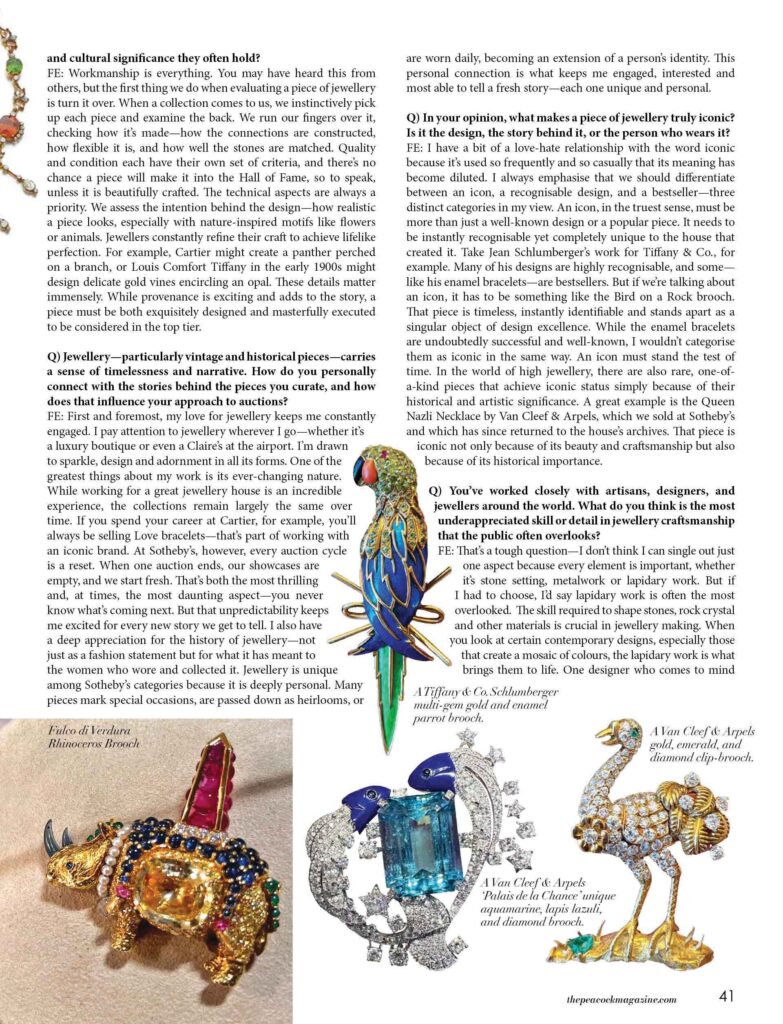
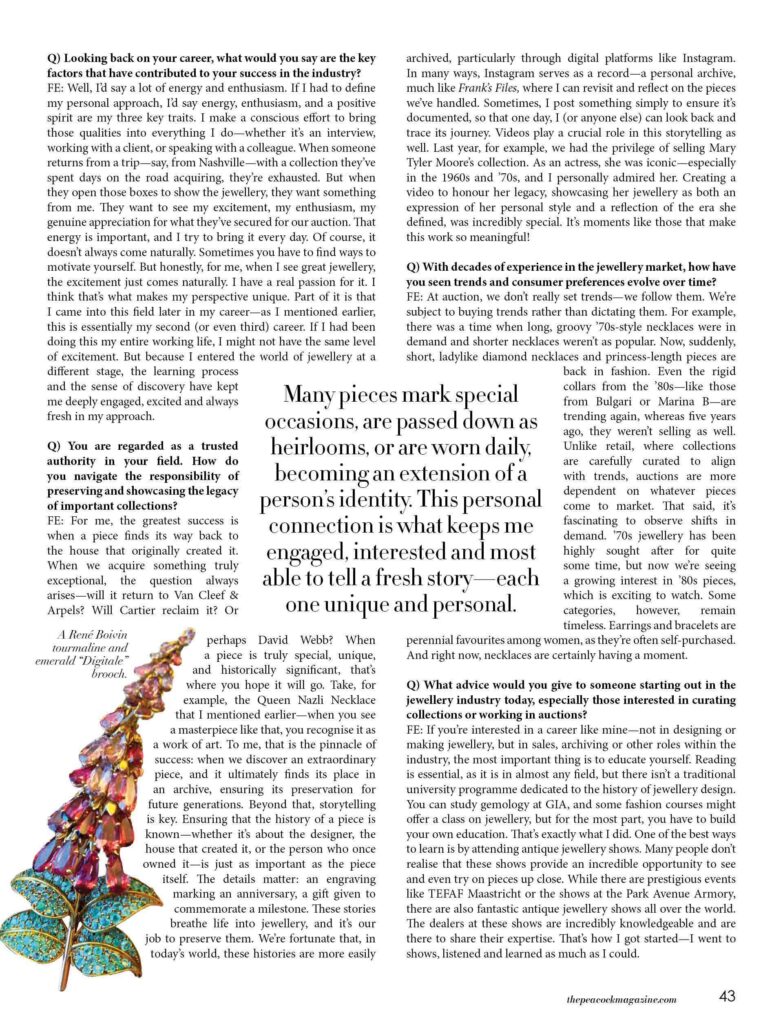
FE: Workmanship is everything. You may have heard this from others, but the first thing we do when evaluating a piece of jewellery is turn it over. When a collection comes to us, we instinctively pick up each piece and examine the back. We run our fingers over it, checking how it’s made—how the connections are constructed, how flexible it is, and how well the stones are matched. Quality and condition each have their own set of criteria, and there’s no chance a piece will make it into the Hall of Fame, so to speak, unless it is beautifully crafted. The technical aspects are always a priority. We assess the intention behind the design—how realistic a piece looks, especially with nature-inspired motifs like flowers or animals. Jewellers constantly refine their craft to achieve lifelike perfection. For example, Cartier might create a panther perched on a branch, or Louis Comfort Tiffany in the early 1900s might design delicate gold vines encircling an opal. These details matter immensely. While provenance is exciting and adds to the story, a piece must be both exquisitely designed and masterfully executed to be considered in the top tier.
Q) Jewellery—particularly vintage and historical pieces—carries a sense of timelessness and narrative. How do you personally connect with the stories behind the pieces you curate, and how does that influence your approach to auctions?
FE: First and foremost, my love for jewellery keeps me constantly engaged. I pay attention to jewellery wherever I go—whether it’s a luxury boutique or even a Claire’s at the airport. I’m drawn to sparkle, design and adornment in all its forms. One of the greatest things about my work is its ever-changing nature. While working for a great jewellery house is an incredible experience, the collections remain largely the same over time. If you spend your career at Cartier, for example, you’ll always be selling Love bracelets—that’s part of working with an iconic brand. At Sotheby’s, however, every auction cycle is a reset. When one auction ends, our showcases are empty, and we start fresh. That’s both the most thrilling and, at times, the most daunting aspect—you never know what’s coming next. But that unpredictability keeps me excited for every new story we get to tell. I also have a deep appreciation for the history of jewellery—not just as a fashion statement but for what it has meant to the women who wore and collected it. Jewellery is unique among Sotheby’s categories because it is deeply personal. Many pieces mark special occasions, are passed down as heirlooms, or are worn daily, becoming an extension of a person’s identity. This personal connection is what keeps me engaged, interested and most able to tell a fresh story—each one unique and personal.
Q) In your opinion, what makes a piece of jewellery truly iconic? Is it the design, the story behind it, or the person who wears it?
FE: I have a bit of a love-hate relationship with the word iconic because it’s used so frequently and so casually that its meaning has become diluted. I always emphasise that we should differentiate between an icon, a recognisable design, and a bestseller—three distinct categories in my view. An icon, in the truest sense, must be more than just a well-known design or a popular piece. It needs to be instantly recognisable yet completely unique to the house that created it. Take Jean Schlumberger’s work for Tiffany & Co., for example. Many of his designs are highly recognisable, and some—like his enamel bracelets—are bestsellers. But if we’re talking about an icon, it has to be something like the Bird on a Rock brooch. That piece is timeless, instantly identifiable and stands apart as a singular object of design excellence. While the enamel bracelets are undoubtedly successful and well-known, I wouldn’t categorise them as iconic in the same way. An icon must stand the test of time. In the world of high jewellery, there are also rare, one-of-a-kind pieces that achieve iconic status simply because of their historical and artistic significance. A great example is the Queen Nazli Necklace by Van Cleef & Arpels, which we sold at Sotheby’s and which has since returned to the house’s archives. That piece is iconic not only because of its beauty and craftsmanship but also because of its historical importance.
Q) You’ve worked closely with artisans, designers, and jewellers around the world. What do you think is the most underappreciated skill or detail in jewellery craftsmanship that the public often overlooks?
FE: That’s a tough question—I don’t think I can single out just one aspect because every element is important, whether it’s stone setting, metalwork or lapidary work. But if I had to choose, I’d say lapidary work is often the most overlooked. The skill required to shape stones, rock crystal and other materials is crucial in jewellery making. When you look at certain contemporary designs, especially those that create a mosaic of colours, the lapidary work is what brings them to life. One designer who comes to mind is Harwell Godfrey in California, who was part of our Billionaire’s Black show. Her use of colour and unusual stone shapes highlights just how essential lapidary work is. I think many people assume that stones naturally come in those perfectly cut and polished forms, without realising the immense craftsmanship involved in shaping them. To me, that’s probably the most underappreciated aspect of fine jewellery.
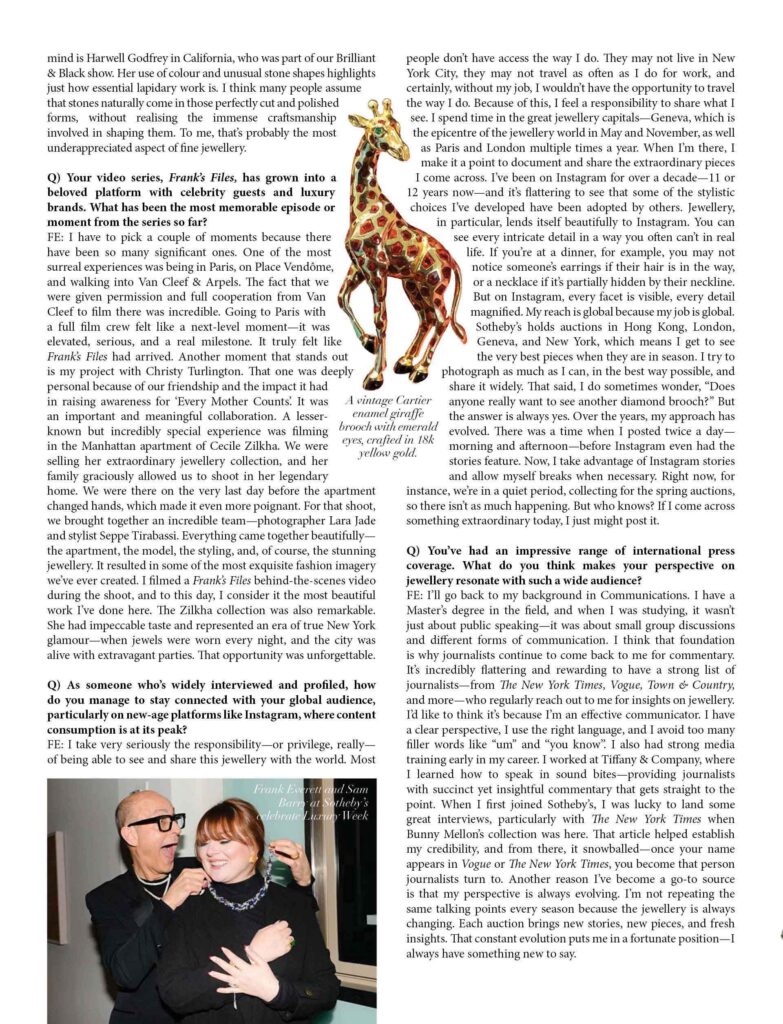
Q) Your video series, Frank’s Files, has grown into a beloved platform with celebrity guests and luxury brands. What has been the most memorable episode or moment from the series so far?
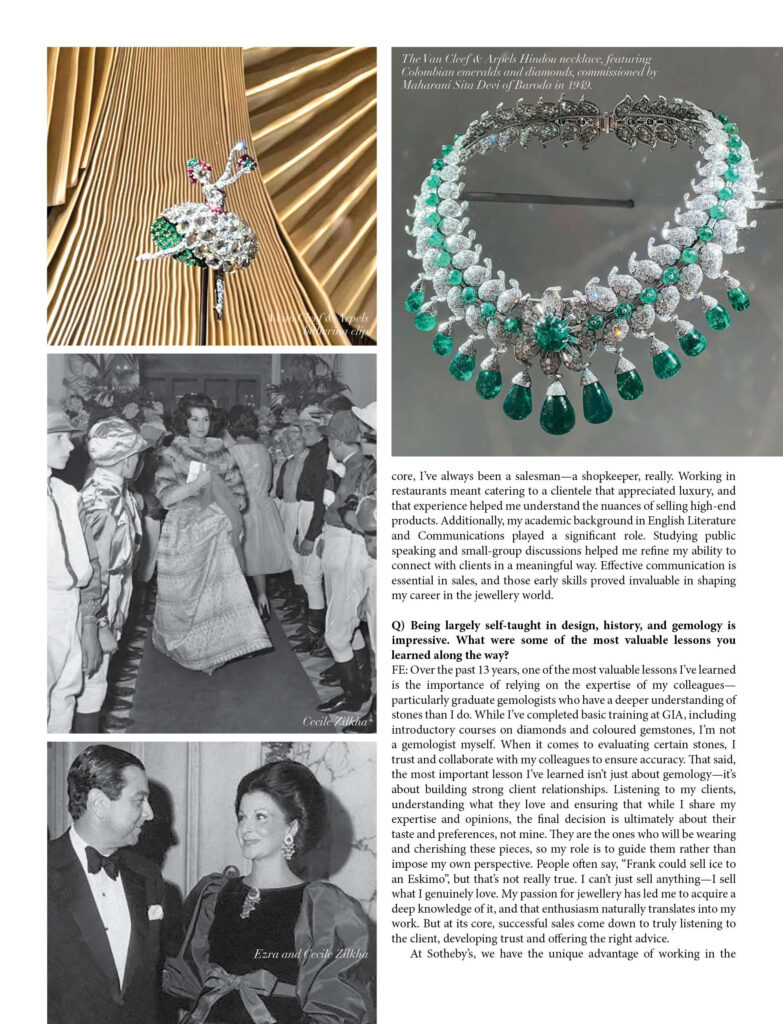
FE: I have to pick a couple of moments because there have been so many significant ones. One of the most surreal experiences was being in Paris, on Place Vendôme, and walking into Van Cleef & Arpels. The fact that we were given permission and full cooperation from Van Cleef to film there was incredible. Going to Paris with a full film crew felt like a next-level moment—it was elevated, serious, and a real milestone. It truly felt like Frank’s Files had arrived. Another moment that stands out is my project with Christy Turlington. That one was deeply personal because of our friendship and the impact it had in raising awareness for ‘Every Mother Counts’. It was an important and meaningful collaboration. A lesser-known but incredibly special experience was filming in the Manhattan apartment of Cecile Zilkha. We were selling her extraordinary jewellery collection, and her family graciously allowed us to shoot in her legendary home. We were there on the very last day before the apartment changed hands, which made it even more poignant. For that shoot, we brought together an incredible team—photographer Lara Jade and stylist Seppe Tirabassi. Everything came together beautifully—the apartment, the model, the styling, and, of course, the stunning jewellery. It resulted in some of the most exquisite fashion imagery we’ve ever created. I filmed a Frank’s Files behind-the-scenes video during the shoot, and to this day, I consider it the most beautiful work I’ve done here. The Zilkha collection was also remarkable. She had impeccable taste and represented an era of true New York glamour—when jewels were worn every night, and the city was alive with extravagant parties. That opportunity was unforgettable.
Q) As someone who’s widely interviewed and profiled, how do you manage to stay connected with your global audience, particularly on new-age platforms like Instagram, where content consumption is at its peak?
FE: I take very seriously the responsibility—or privilege, really—of being able to see and share this jewellery with the world. Most people don’t have access the way I do. They may not live in New York City, they may not travel as often as I do for work, and certainly, without my job, I wouldn’t have the opportunity to travel the way I do. Because of this, I feel a responsibility to share what I see. I spend time in the great jewellery capitals—Geneva, which is the epicentre of the jewellery world in May and November, as well as Paris and London multiple times a year. When I’m there, I make it a point to document and share the extraordinary pieces I come across. I’ve been on Instagram for over a decade—11 or 12 years now—and it’s flattering to see that some of the stylistic choices I’ve developed have been adopted by others. Jewellery, in particular, lends itself beautifully to Instagram. You can see every intricate detail in a way you often can’t in real life. If you’re at a dinner, for example, you may not notice someone’s earrings if their hair is in the way, or a necklace if it’s partially hidden by their neckline. But on Instagram, every facet is visible, every detail magnified. My reach is global because my job is global. Sotheby’s holds auctions in Hong Kong, London, Geneva, and New York, which means I get to see the very best pieces when they are in season. I try to photograph as much as I can, in the best way possible, and share it widely. That said, I do sometimes wonder, “Does anyone really want to see another diamond brooch?” But the answer is always yes. Over the years, my approach has evolved. There was a time when I posted twice a day—morning and afternoon—before Instagram even had the stories feature. Now, I take advantage of Instagram stories and allow myself breaks when necessary. Right now, for instance, we’re in a quiet period, collecting for the spring auctions, so there isn’t as much happening. But who knows? If I come across something extraordinary today, I just might post it.
Q) You’ve had an impressive range of international press coverage. What do you think makes your perspective on jewellery resonate with such a wide audience?
FE: I’ll go back to my background in Communications. I have a Master’s degree in the field, and when I was studying, it wasn’t just about public speaking—it was about small group discussions and different forms of communication. I think that foundation is why journalists continue to come back to me for commentary. It’s incredibly flattering and rewarding to have a strong list of journalists—from The New York Times, Vogue, Town & Country, and more—who regularly reach out to me for insights on jewellery. I’d like to think it’s because I’m an effective communicator. I have a clear perspective, I use the right language, and I avoid too many filler words like “um” and “you know”. I also had strong media training early in my career. I worked at Tiffany & Company, where I learned how to speak in sound bites—providing journalists with succinct yet insightful commentary that gets straight to the point. When I first joined Sotheby’s, I was lucky to land some great interviews, particularly with The New York Times when Bunny Mellon’s collection was here. That article helped establish my credibility, and from there, it snowballed—once your name appears in Vogue or The New York Times, you become that person journalists turn to. Another reason I’ve become a go-to source is that my perspective is always evolving. I’m not repeating the same talking points every season because the jewellery is always changing. Each auction brings new stories, new pieces, and fresh insights. That constant evolution puts me in a fortunate position—I always have something new to say.
Q) Looking back on your career, what would you say are the key factors that have contributed to your success in the industry?
FE: Well, I’d say a lot of energy and enthusiasm. If I had to define my personal approach, I’d say energy, enthusiasm, and a positive spirit are my three key traits. I make a conscious effort to bring those qualities into everything I do—whether it’s an interview, working with a client, or speaking with a colleague. When someone returns from a trip—say, from Nashville—with a collection they’ve spent days on the road acquiring, they’re exhausted. But when they open those boxes to show the jewellery, they want something from me. They want to see my excitement, my enthusiasm, my genuine appreciation for what they’ve secured for our auction. That energy is important, and I try to bring it every day. Of course, it doesn’t always come naturally. Sometimes you have to find ways to motivate yourself. But honestly, for me, when I see great jewellery, the excitement just comes naturally. I have a real passion for it. I think that’s what makes my perspective unique. Part of it is that I came into this field later in my career—as I mentioned earlier, this is essentially my second (or even third) career. If I had been doing this my entire working life, I might not have the same level of excitement. But because I entered the world of jewellery at a different stage, the learning process and the sense of discovery have kept me deeply engaged, excited and always fresh in my approach.
Q) You are regarded as a trusted authority in your field. How do you navigate the responsibility of preserving and showcasing the legacy of important collections?
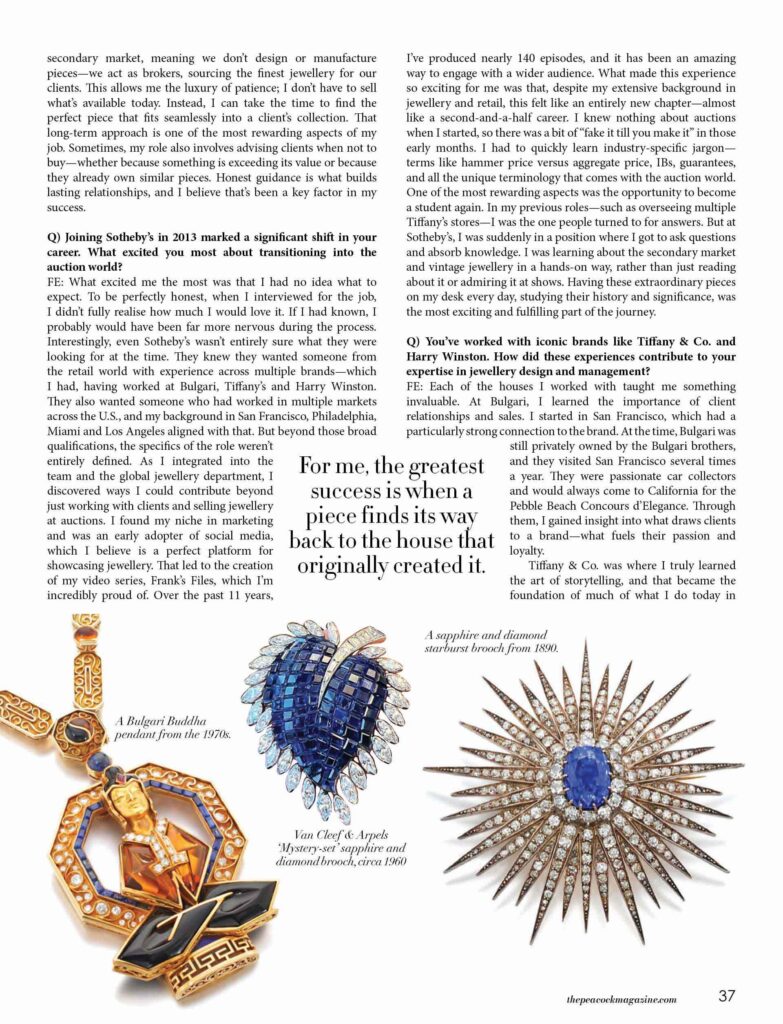
FE: For me, the greatest success is when a piece finds its way back to the house that originally created it. When we acquire something truly exceptional, the question always arises—will it return to Van Cleef & Arpels? Will Cartier reclaim it? Or perhaps David Webb? When a piece is truly special, unique, and historically significant, that’s where you hope it will go. Take, for example, the Queen Nazli Necklace that I mentioned earlier—when you see a masterpiece like that, you recognise it as a work of art. To me, that is the pinnacle of success: when we discover an extraordinary piece, and it ultimately finds its place in an archive, ensuring its preservation for future generations. Beyond that, storytelling is key. Ensuring that the history of a piece is known—whether it’s about the designer, the house that created it, or the person who once owned it—is just as important as the piece itself. The details matter: an engraving marking an anniversary, a gift given to commemorate a milestone. These stories breathe life into jewellery, and it’s our job to preserve them. We’re fortunate that, in today’s world, these histories are more easily archived, particularly through digital platforms like Instagram. In many ways, Instagram serves as a record—a personal archive, much like Frank’s Files, where I can revisit and reflect on the pieces we’ve handled. Sometimes, I post something simply to ensure it’s documented, so that one day, I (or anyone else) can look back and trace its journey. Videos play a crucial role in this storytelling as well. Last year, for example, we had the privilege of selling Mary Tyler Moore’s collection. As an actress, she was iconic—especially in the 1960s and ’70s, and I personally admired her. Creating a video to honour her legacy, showcasing her jewellery as both an expression of her personal style and a reflection of the era she defined, was incredibly special. It’s moments like those that make this work so meaningful!
Q) With decades of experience in the jewellery market, how have you seen trends and consumer preferences evolve over time?
FE: At auction, we don’t really set trends—we follow them. We’re subject to buying trends rather than dictating them. For example, there was a time when long, groovy ’70s-style necklaces were in demand and shorter necklaces weren’t as popular. Now, suddenly, short, ladylike diamond necklaces and princess-length pieces are back in fashion. Even the rigid collars from the ’80s—like those from Bulgari or Marina B—are trending again, whereas five years ago, they weren’t selling as well. Unlike retail, where collections are carefully curated to align with trends, auctions are more dependent on whatever pieces come to market. That said, it’s fascinating to observe shifts in demand. ’70s jewellery has been highly sought after for quite some time, but now we’re seeing a growing interest in ’80s pieces, which is exciting to watch. Some categories, however, remain timeless. Earrings and bracelets are perennial favourites among women, as they’re often self-purchased. And right now, necklaces are certainly having a moment.
Q) What advice would you give to someone starting out in the jewellery industry today, especially those interested in curating collections or working in auctions?
FE: If you’re interested in a career like mine—not in designing or making jewellery, but in sales, archiving or other roles within the industry, the most important thing is to educate yourself. Reading is essential, as it is in almost any field, but there isn’t a traditional university programme dedicated to the history of jewellery design. You can study gemology at GIA, and some fashion courses might offer a class on jewellery, but for the most part, you have to build your own education. That’s exactly what I did. One of the best ways to learn is by attending antique jewellery shows. Many people don’t realise that these shows provide an incredible opportunity to see and even try on pieces up close. While there are prestigious events like TEFAF Maastricht or the shows at the Park Avenue Armory, there are also fantastic antique jewellery shows all over the world. The dealers at these shows are incredibly knowledgeable and are there to share their expertise. That’s how I got started—I went to shows, listened and learned as much as I could.