
Luxury brands seem to be in love with nostalgia, going by the trend of reintroducing some key pieces.
By Manish Mishra
The past often informs the present, at least, in the cyclical and chaotic world of fashion. Take a look at the newest offerings from the luxury brands, and everything seems strongly linked to the house archives. It could be a house’s classic handbag originally launched in the seventies, which has been upgraded and reintroduced with a contemporary finish. Or it could be a Hollywood actor re-wearing an old look from the early noughties on the red carpet. Retro revival seems to be the flavour in luxury over the last couple of seasons. Here are some noteworthy examples…
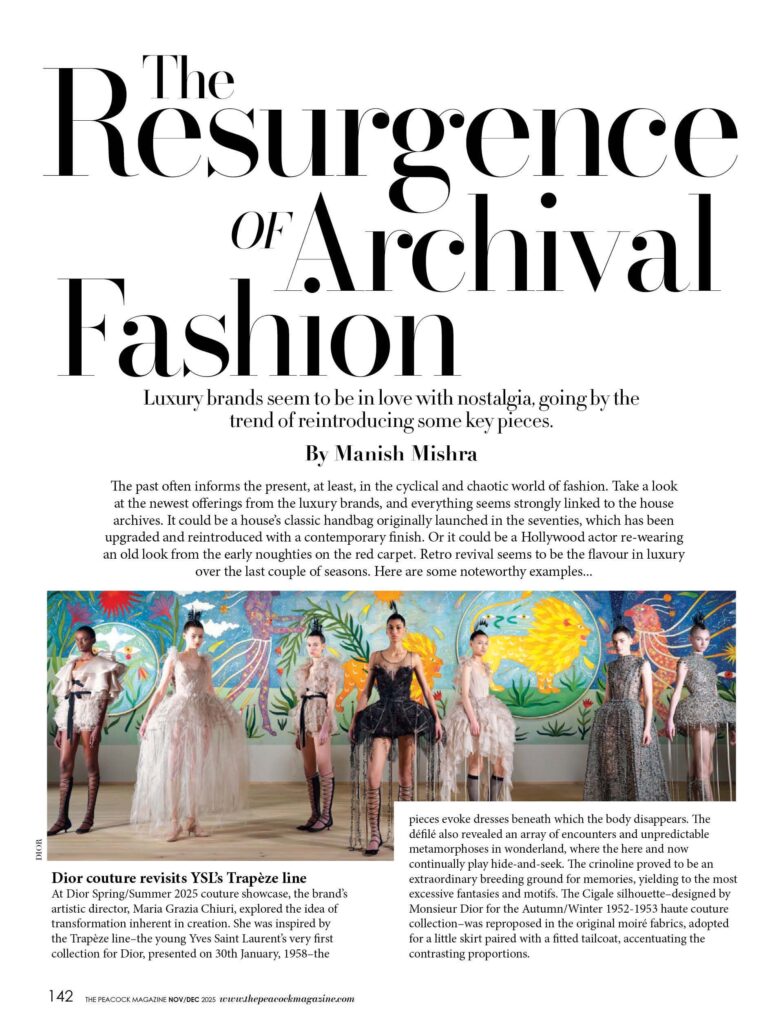
Dior couture revisits YSL’s Trapèze line
At Dior Spring/Summer 2025 couture showcase, the brand’s artistic director, Maria Grazia Chiuri, explored the idea of transformation inherent in creation. She was inspired by the Trapèze line–the young Yves Saint Laurent’s very first collection for Dior, presented on 30th January, 1958–the pieces evoke dresses beneath which the body disappears. The défilé also revealed an array of encounters and unpredictable metamorphoses in wonderland, where the here and now continually play hide-and-seek. The crinoline proved to be an extraordinary breeding ground for memories, yielding to the most excessive fantasies and motifs. The Cigale silhouette–designed by Monsieur Dior for the Autumn/Winter 1952-1953 haute couture collection–was reproposed in the original moiré fabrics, adopted for a little skirt paired with a fitted tailcoat, accentuating the contrasting proportions.
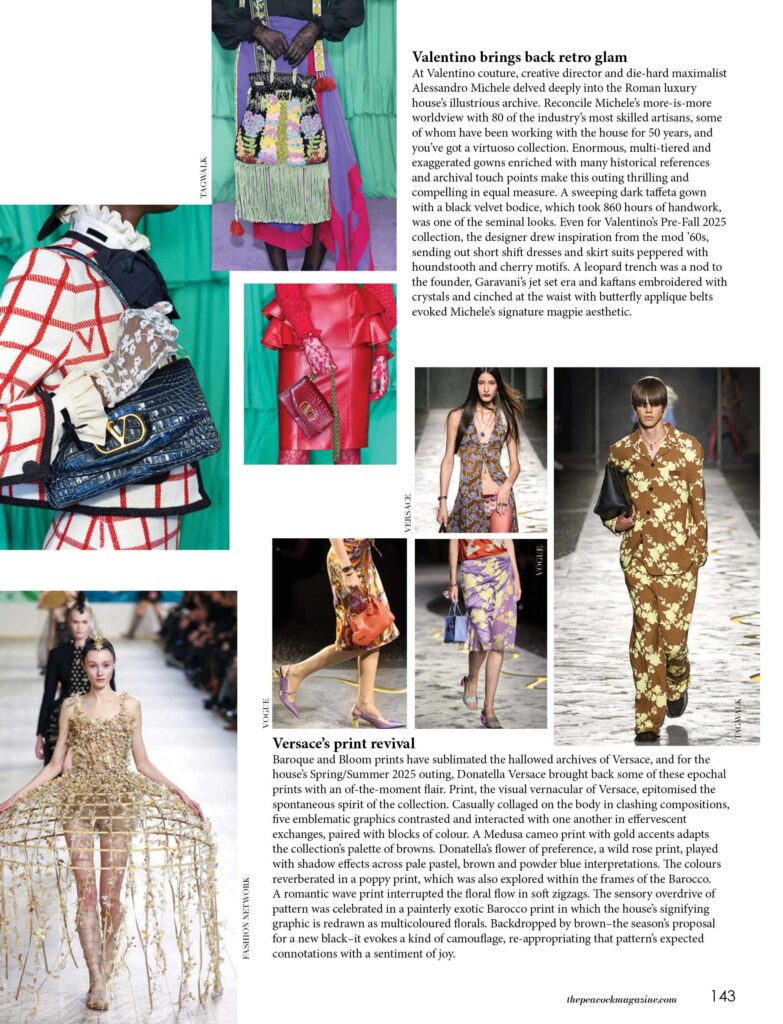
Valentino brings back retro glam
At Valentino couture, creative director and die-hard maximalist Alessandro Michele delved deeply into the Roman luxury house’s illustrious archive. Reconcile Michele’s more-is-more worldview with 80 of the industry’s most skilled artisans, some of whom have been working with the house for 50 years, and you’ve got a virtuoso collection. Enormous, multi-tiered and exaggerated gowns enriched with many historical references and archival touch points make this outing thrilling and compelling in equal measure. A sweeping dark taffeta gown with a black velvet bodice, which took 860 hours of handwork, was one of the seminal looks. Even for Valentino’s Pre-Fall 2025 collection, the designer drew inspiration from the mod ’60s, sending out short shift dresses and skirt suits peppered with houndstooth and cherry motifs. A leopard trench was a nod to the founder, Garavani’s jet set era and kaftans embroidered with crystals and cinched at the waist with butterfly applique belts evoked Michele’s signature magpie aesthetic.
Versace’s print revival
Baroque and Bloom prints have sublimated the hallowed archives of Versace, and for the house’s Spring/Summer 2025 outing, Donatella Versace brought back some of these epochal prints with an of-the-moment flair. Print, the visual vernacular of Versace, epitomised the spontaneous spirit of the collection. Casually collaged on the body in clashing compositions, five emblematic graphics contrasted and interacted with one another in effervescent exchanges, paired with blocks of colour. A Medusa cameo print with gold accents adapts the collection’s palette of browns. Donatella’s flower of preference, a wild rose print, played with shadow effects across pale pastel, brown and powder blue interpretations. The colours reverberated in a poppy print, which was also explored within the frames of the Barocco. A romantic wave print interrupted the floral flow in soft zigzags. The sensory overdrive of pattern was celebrated in a painterly exotic Barocco print in which the house’s signifying graphic is redrawn as multicoloured florals. Backdropped by brown–the season’s proposal for a new black–it evokes a kind of camouflage, re-appropriating that pattern’s expected connotations with a sentiment of joy.
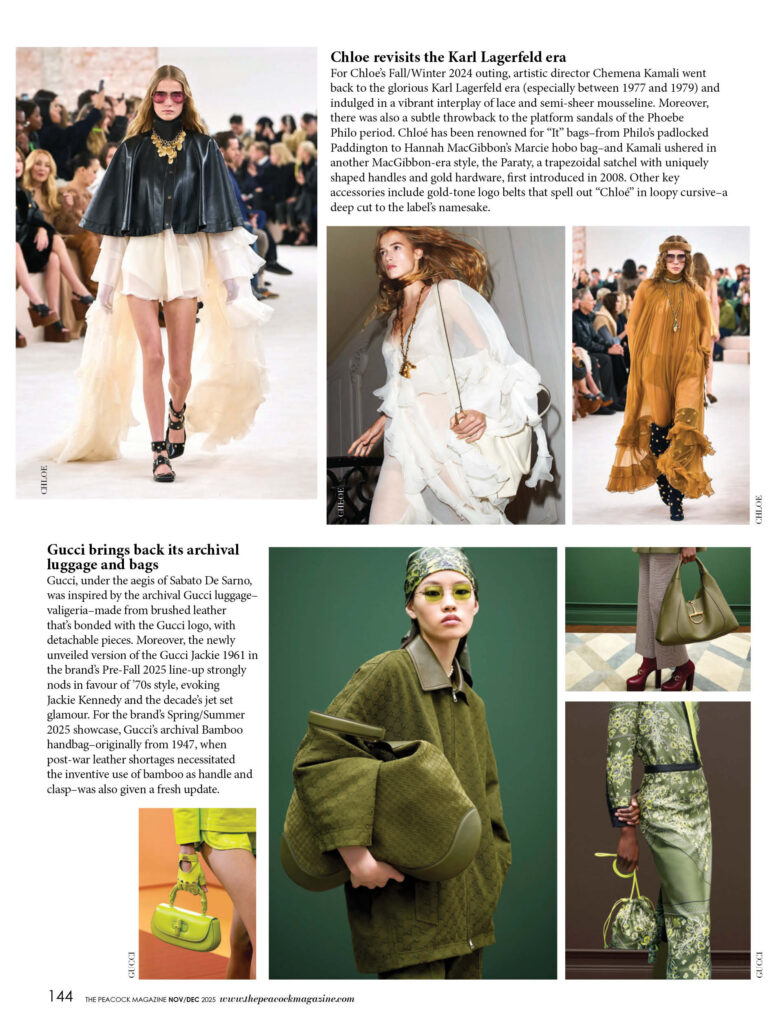
Chloe revisits the Karl Lagerfeld era
For Chloe’s Fall/Winter 2024 outing, artistic director Chemena Kamali went back to the glorious Karl Lagerfeld era (especially between 1977 and 1979) and indulged in a vibrant interplay of lace and semi-sheer mousseline. Moreover, there was also a subtle throwback to the platform sandals of the Phoebe Philo period. Chloé has been renowned for “It” bags–from Philo’s padlocked Paddington to Hannah MacGibbon’s Marcie hobo bag–and Kamali ushered in another MacGibbon-era style, the Paraty, a trapezoidal satchel with uniquely shaped handles and gold hardware, first introduced in 2008. Other key accessories include gold-tone logo belts that spell out “Chloé” in loopy cursive–a deep cut to the label’s namesake.
Gucci brings back its archival luggage and bags
Gucci, under the aegis of Sabato De Sarno, was inspired by the archival Gucci luggage–valigeria–made from brushed leather that’s bonded with the Gucci logo, with detachable pieces. Moreover, the newly unveiled version of the Gucci Jackie 1961 in the brand’s Pre-Fall 2025 line-up strongly nods in favour of ’70s style, evoking Jackie Kennedy and the decade’s jet set glamour. For the brand’s Spring/Summer 2025 showcase, Gucci’s archival Bamboo handbag–originally from 1947, when post-war leather shortages necessitated the inventive use of bamboo as handle and clasp–was also given a fresh update.
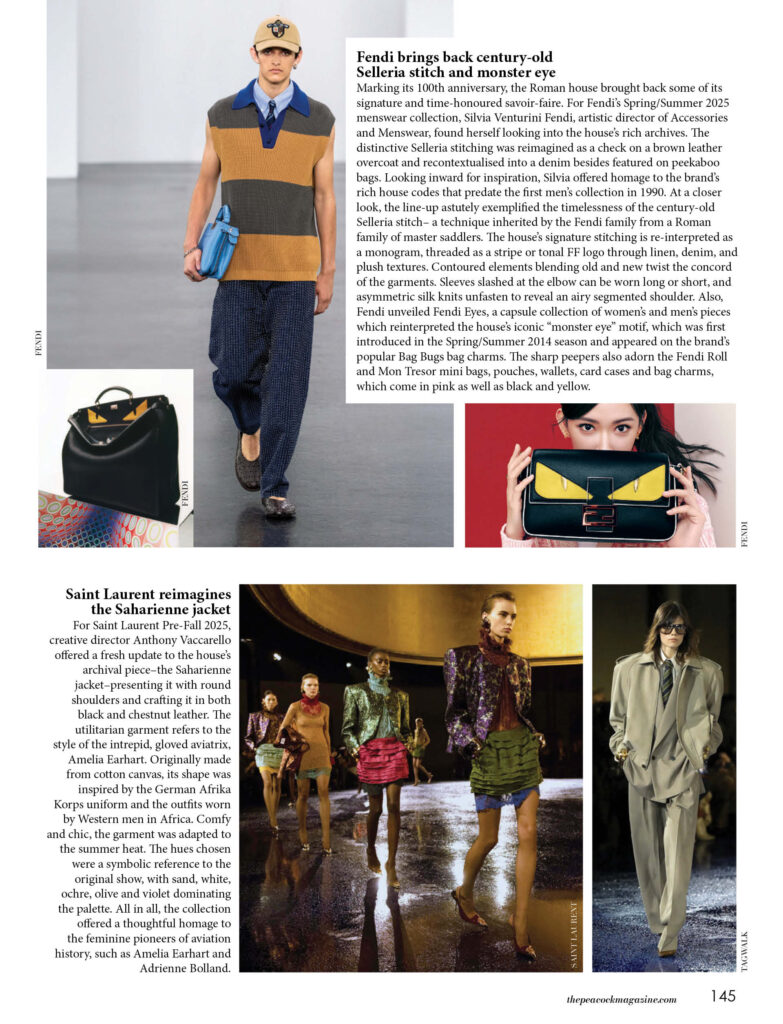
Fendi brings back century-old Selleria stitch and monster eye
Marking its 100th anniversary, the Roman house brought back some of its signature and time-honoured savoir-faire. For Fendi’s Spring/Summer 2025 menswear collection, Silvia Venturini Fendi, artistic director of Accessories and Menswear, found herself looking into the house’s rich archives. The distinctive Selleria stitching was reimagined as a check on a brown leather overcoat and recontextualised into a denim besides featured on peekaboo bags. Looking inward for inspiration, Silvia offered homage to the brand’s rich house codes that predate the first men’s collection in 1990. At a closer look, the line-up astutely exemplified the timelessness of the century-old Selleria stitch– a technique inherited by the Fendi family from a Roman family of master saddlers. The house’s signature stitching is re-interpreted as a monogram, threaded as a stripe or tonal FF logo through linen, denim, and plush textures. Contoured elements blending old and new twist the concord of the garments. Sleeves slashed at the elbow can be worn long or short, and asymmetric silk knits unfasten to reveal an airy segmented shoulder. Also, Fendi unveiled Fendi Eyes, a capsule collection of women’s and men’s pieces which reinterpreted the house’s iconic “monster eye” motif, which was first introduced in the Spring/Summer 2014 season and appeared on the brand’s popular Bag Bugs bag charms. The sharp peepers also adorn the Fendi Roll and Mon Tresor mini bags, pouches, wallets, card cases and bag charms, which come in pink as well as black and yellow.
Saint Laurent reimagines the Saharienne jacket
For Saint Laurent Pre-Fall 2025, creative director Anthony Vaccarello offered a fresh update to the house’s archival piece–the Saharienne jacket–presenting it with round shoulders and crafting it in both black and chestnut leather. The utilitarian garment refers to the style of the intrepid, gloved aviatrix, Amelia Earhart. Originally made from cotton canvas, its shape was inspired by the German Afrika Korps uniform and the outfits worn by Western men in Africa. Comfy and chic, the garment was adapted to the summer heat. The hues chosen were a symbolic reference to the original show, with sand, white, ochre, olive and violet dominating the palette. All in all, the collection offered a thoughtful homage to the feminine pioneers of aviation history, such as Amelia Earhart and Adrienne Bolland.
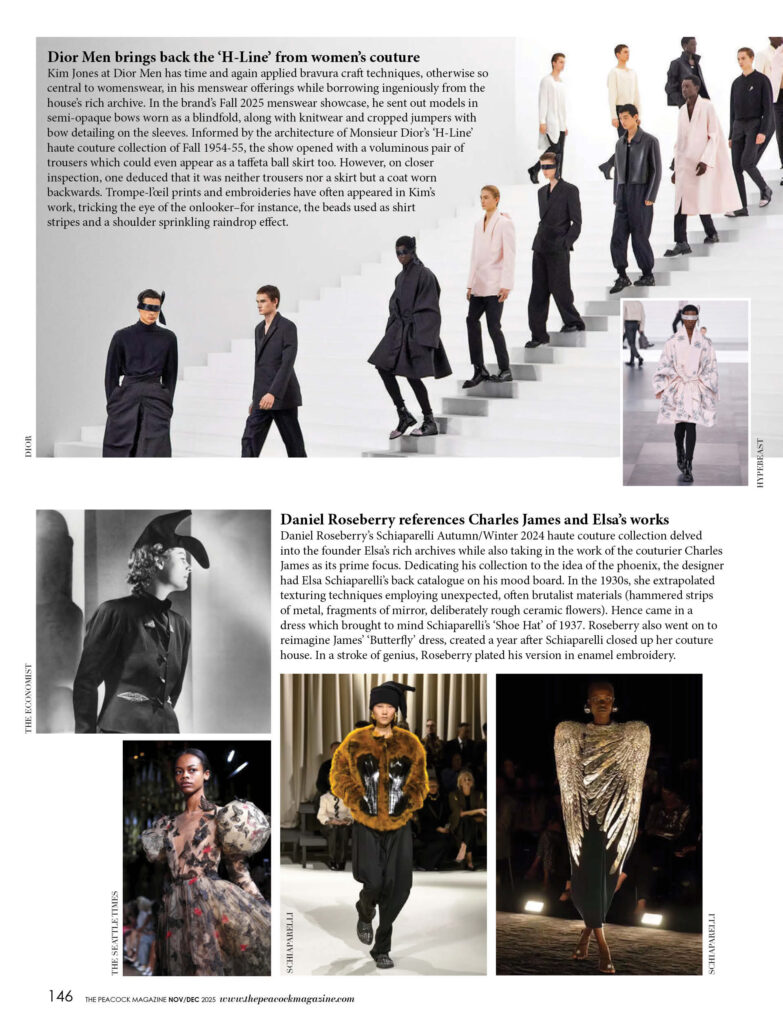
Dior Men brings back the ‘H-Line’ from women’s couture
Kim Jones at Dior Men has time and again applied bravura craft techniques, otherwise so central to womenswear, in his menswear offerings while borrowing ingeniously from the house’s rich archive. In the brand’s Fall 2025 menswear showcase, he sent out models in semi-opaque bows worn as a blindfold, along with knitwear and cropped jumpers with bow detailing on the sleeves. Informed by the architecture of Monsieur Dior’s ‘H-Line’ haute couture collection of Fall 1954-55, the show opened with a voluminous pair of trousers which could even appear as a taffeta ball skirt too. However, on closer inspection, one deduced that it was neither trousers nor a skirt but a coat worn backwards. Trompe-l’œil prints and embroideries have often appeared in Kim’s work, tricking the eye of the onlooker–for instance, the beads used as shirt stripes and a shoulder sprinkling raindrop effect.
Daniel Roseberry references Charles James and Elsa’s works
Daniel Roseberry’s Schiaparelli Autumn/Winter 2024 haute couture collection delved into the founder Elsa’s rich archives while also taking in the work of the couturier Charles James as its prime focus. Dedicating his collection to the idea of the phoenix, the designer had Elsa Schiaparelli’s back catalogue on his mood board. In the 1930s, she extrapolated texturing techniques employing unexpected, often brutalist materials (hammered strips of metal, fragments of mirror, deliberately rough ceramic flowers). Hence came in a dress which brought to mind Schiaparelli’s ‘Shoe Hat’ of 1937. Roseberry also went on to reimagine James’ ‘Butterfly’ dress, created a year after Schiaparelli closed up her couture house. In a stroke of genius, Roseberry plated his version in enamel embroidery.