
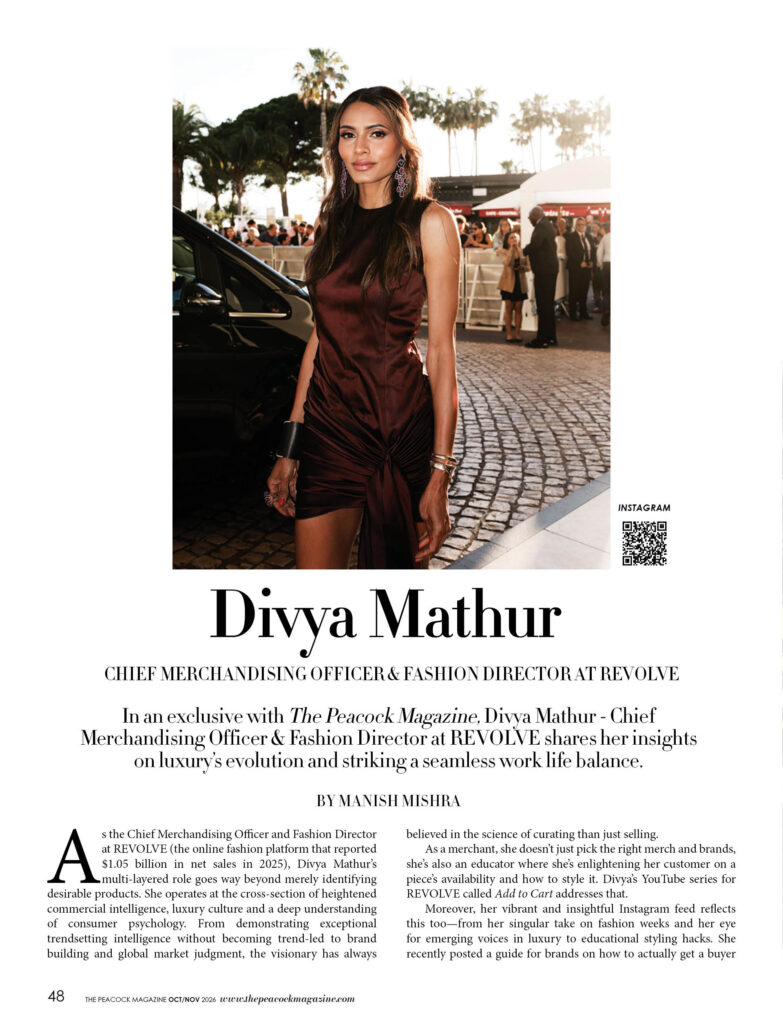
In an exclusive with The Peacock Magazine, Divya Mathur – Chief Merchandising Officer & Fashion Director at REVOLVE shares her insights on luxury’s evolution and striking a seamless work life balance.
By Manish Mishra
As the Chief Merchandising Officer and Fashion Director at REVOLVE (the online fashion platform that reported $1.05 billion in net sales in 2025), Divya Mathur’s multi-layered role goes way beyond merely identifying desirable products. She operates at the cross-section of heightened commercial intelligence, luxury culture and a deep understanding of consumer psychology. From demonstrating exceptional trendsetting intelligence without becoming trend-led to brand building and global market judgment, the visionary has always believed in the science of curating than just selling.
As a merchant, she doesn’t just pick the right merch and brands, she’s also an educator where she’s enlightening her customer on a piece’s availability and how to style it. Divya’s YouTube series for REVOLVE called Add to Cart addresses that.
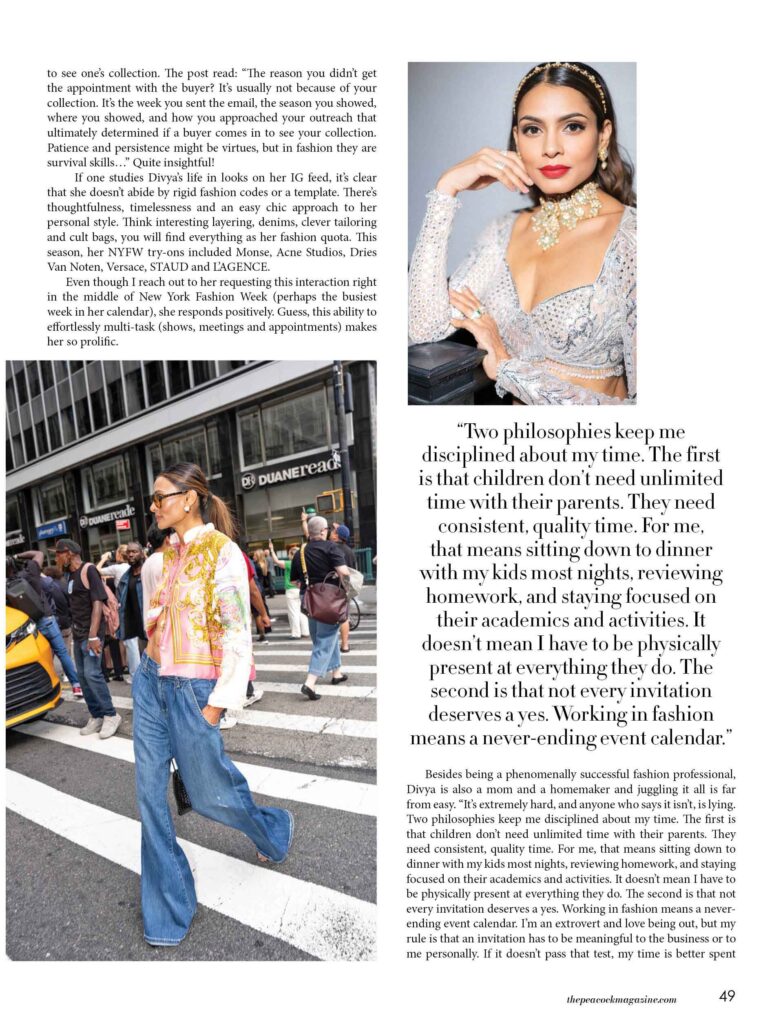
Moreover, her vibrant and insightful Instagram feed reflects this too—from her singular take on fashion weeks and her eye for emerging voices in luxury to educational styling hacks. She recently posted a guide for brands on how to actually get a buyer to see one’s collection. The post read: “The reason you didn’t get the appointment with the buyer? It’s usually not because of your collection. It’s the week you sent the email, the season you showed, where you showed, and how you approached your outreach that ultimately determined if a buyer comes in to see your collection. Patience and persistence might be virtues, but in fashion they are survival skills…” Quite insightful!
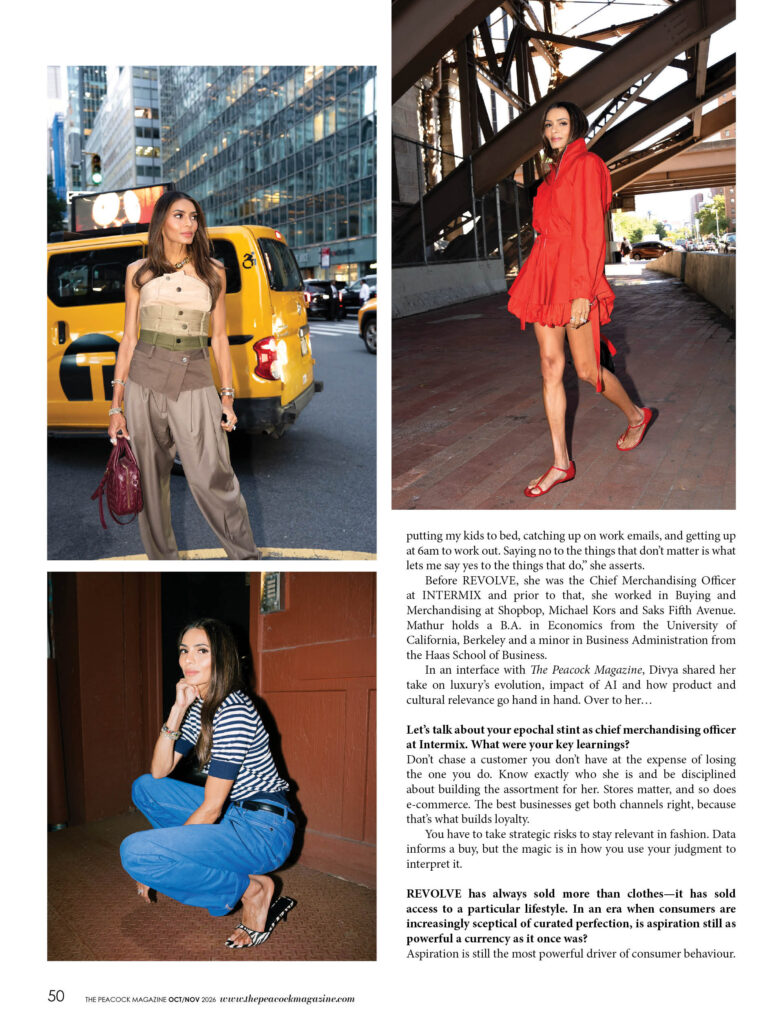
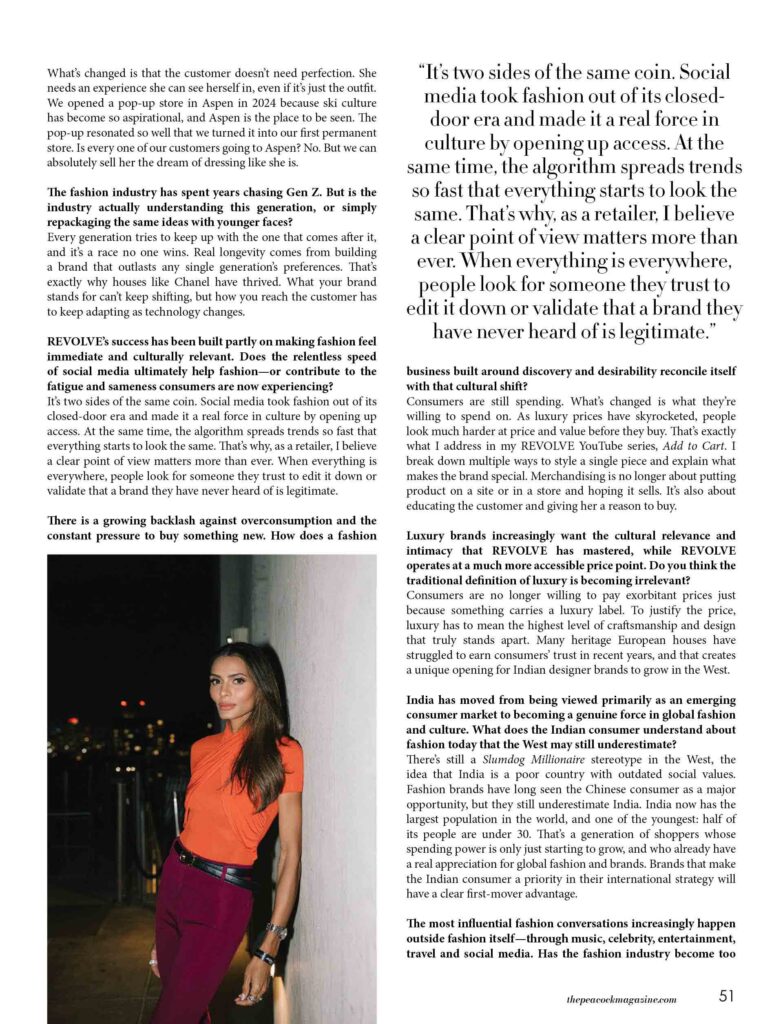
If one studies Divya’s life in looks on her IG feed, it’s clear that she doesn’t abide by rigid fashion codes or a template. There’s thoughtfulness, timelessness and an easy chic approach to her personal style. Think interesting layering, denims, clever tailoring and cult bags, you will find everything as her fashion quota. This season, her NYFW try-ons included Monse, Acne Studios, Dries Van Noten, Versace, STAUD and L’AGENCE.
Even though I reach out to her requesting this interaction right in the middle of New York Fashion Week (perhaps the busiest week in her calendar), she responds positively. Guess, this ability to effortlessly multi-task (shows, meetings and appointments) makes her so prolific.
Besides being a phenomenally successful fashion professional, Divya is also a mom and a homemaker and juggling it all is far from easy. “It’s extremely hard, and anyone who says it isn’t, is lying. Two philosophies keep me disciplined about my time. The first is that children don’t need unlimited time with their parents. They need consistent, quality time. For me, that means sitting down to dinner with my kids most nights, reviewing homework, and staying focused on their academics and activities. It doesn’t mean I have to be physically present at everything they do. The second is that not every invitation deserves a yes. Working in fashion means a never-ending event calendar. I’m an extrovert and love being out, but my rule is that an invitation has to be meaningful to the business or to me personally. If it doesn’t pass that test, my time is better spent putting my kids to bed, catching up on work emails, and getting up at 6am to work out. Saying no to the things that don’t matter is what lets me say yes to the things that do,” she asserts.
Before REVOLVE, she was the Chief Merchandising Officer at INTERMIX and prior to that, she worked in Buying and Merchandising at Shopbop, Michael Kors and Saks Fifth Avenue. Mathur holds a B.A. in Economics from the University of California, Berkeley and a minor in Business Administration from the Haas School of Business.
In an interface with The Peacock Magazine, Divya shared her take on luxury’s evolution, impact of AI and how product and cultural relevance go hand in hand. Over to her…
Let’s talk about your epochal stint as chief merchandising officer at Intermix. What were your key learnings?
Don’t chase a customer you don’t have at the expense of losing the one you do. Know exactly who she is and be disciplined about building the assortment for her. Stores matter, and so does e-commerce. The best businesses get both channels right, because that’s what builds loyalty.
You have to take strategic risks to stay relevant in fashion. Data informs a buy, but the magic is in how you use your judgment to interpret it.
REVOLVE has always sold more than clothes—it has sold access to a particular lifestyle. In an era when consumers are increasingly sceptical of curated perfection, is aspiration still as powerful a currency as it once was?
Aspiration is still the most powerful driver of consumer behaviour. What’s changed is that the customer doesn’t need perfection. She needs an experience she can see herself in, even if it’s just the outfit. We opened a pop-up store in Aspen in 2024 because ski culture has become so aspirational, and Aspen is the place to be seen. The pop-up resonated so well that we turned it into our first permanent store. Is every one of our customers going to Aspen? No. But we can absolutely sell her the dream of dressing like she is.
The fashion industry has spent years chasing Gen Z. But is the industry actually understanding this generation, or simply repackaging the same ideas with younger faces?
Every generation tries to keep up with the one that comes after it, and it’s a race no one wins. Real longevity comes from building a brand that outlasts any single generation’s preferences. That’s exactly why houses like Chanel have thrived. What your brand stands for can’t keep shifting, but how you reach the customer has to keep adapting as technology changes.
REVOLVE’s success has been built partly on making fashion feel immediate and culturally relevant. Does the relentless speed of social media ultimately help fashion—or contribute to the fatigue and sameness consumers are now experiencing?
It’s two sides of the same coin. Social media took fashion out of its closed-door era and made it a real force in culture by opening up access. At the same time, the algorithm spreads trends so fast that everything starts to look the same. That’s why, as a retailer, I believe a clear point of view matters more than ever. When everything is everywhere, people look for someone they trust to edit it down or validate that a brand they have never heard of is legitimate.
There is a growing backlash against overconsumption and the constant pressure to buy something new. How does a fashion business built around discovery and desirability reconcile itself with that cultural shift?
Consumers are still spending. What’s changed is what they’re willing to spend on. As luxury prices have skyrocketed, people look much harder at price and value before they buy. That’s exactly what I address in my REVOLVE YouTube series, Add to Cart. I break down multiple ways to style a single piece and explain what makes the brand special. Merchandising is no longer about putting product on a site or in a store and hoping it sells. It’s also about educating the customer and giving her a reason to buy.
Luxury brands increasingly want the cultural relevance and intimacy that REVOLVE has mastered, while REVOLVE operates at a much more accessible price point. Do you think the traditional definition of luxury is becoming irrelevant?
Consumers are no longer willing to pay exorbitant prices just because something carries a luxury label. To justify the price, luxury has to mean the highest level of craftsmanship and design that truly stands apart. Many heritage European houses have struggled to earn consumers’ trust in recent years, and that creates a unique opening for Indian designer brands to grow in the West.
India has moved from being viewed primarily as an emerging consumer market to becoming a genuine force in global fashion and culture. What does the Indian consumer understand about fashion today that the West may still underestimate?
There’s still a Slumdog Millionaire stereotype in the West, the idea that India is a poor country with outdated social values. Fashion brands have long seen the Chinese consumer as a major opportunity, but they still underestimate India. India now has the largest population in the world, and one of the youngest: half of its people are under 30. That’s a generation of shoppers whose spending power is only just starting to grow, and who already have a real appreciation for global fashion and brands. Brands that make the Indian consumer a priority in their international strategy will have a clear first-mover advantage.
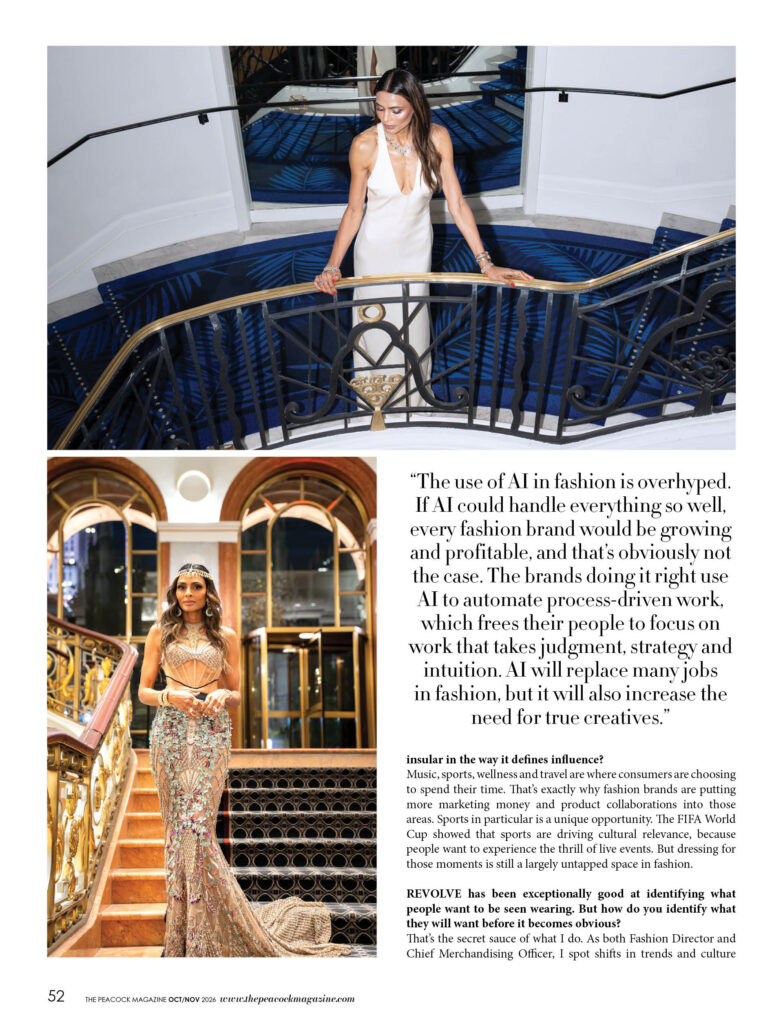
The most influential fashion conversations increasingly happen outside fashion itself—through music, celebrity, entertainment, travel and social media. Has the fashion industry become too insular in the way it defines influence?
Music, sports, wellness and travel are where consumers are choosing to spend their time. That’s exactly why fashion brands are putting more marketing money and product collaborations into those areas. Sports in particular is a unique opportunity. The FIFA World Cup showed that sports are driving cultural relevance, because people want to experience the thrill of live events. But dressing for those moments is still a largely untapped space in fashion.
REVOLVE has been exceptionally good at identifying what people want to be seen wearing. But how do you identify what they will want before it becomes obvious?
That’s the secret sauce of what I do. As both Fashion Director and Chief Merchandising Officer, I spot shifts in trends and culture and then use that same instinct to build assortments that succeed commercially. Some trends are too editorial or niche to ever sell widely. Others just need the right styling and storytelling to feel relatable. Micro shorts and miniskirts are a good example of the second kind. I saw that trend coming before it dominated fashion over the last few years, and we turned it into a meaningful driver of sales through how we bought it, how we styled it on the site, and how we shot our editorial content.
With AI now capable of generating campaigns, styling suggestions and increasingly sophisticated shopping experiences, what part of fashion discovery do you think should remain fundamentally human?
The use of AI in fashion is overhyped. If AI could handle everything so well, every fashion brand would be growing and profitable, and that’s obviously not the case. The brands doing it right use AI to automate process-driven work, which frees their people to focus on work that takes judgment, strategy and intuition. AI will replace many jobs in fashion, but it will also increase the need for true creatives.
There is an argument that algorithms are making fashion more democratic—and another that they are making everyone dress alike. Which side of that debate do you fall on?
Everyone is dressing alike because the algorithm pushes the same trends to everyone at the same time. Personal style has never been scarcer.
REVOLVE has turned events such as the Revolve Festival into extensions of the brand rather than conventional marketing exercises. Where does the boundary lie between creating genuine culture and manufacturing a cultural moment?
REVOLVE’s goal is to connect with our customer wherever she is. When music festivals started making headlines for the style rather than the music, we saw a clear opportunity, and that’s how REVOLVE Festival was born. We didn’t invent the moment. We were just quick to recognise that our customer was already there, and we followed her. Since then, we’ve built an entire ecosystem around festival dressing. My team curates brands and styles specifically for festival season, and partners with brands on exclusive capsules that capture what the It Girls are wearing to concerts. Showing up authentically where our customer already is, with a relevant point of view on product, is what builds loyalty.
The fashion business has historically been obsessed with exclusivity. Digital culture, meanwhile, rewards accessibility and immediacy. Can fashion still create genuine desire without creating distance?
Digital culture is about visibility, and no brand can survive today without it. But being visible doesn’t mean being accessible. A brand’s positioning decides how accessible it wants to be, and whether scarcity will build demand or kill it.
What is the biggest assumption about today’s fashion consumer that you think brands are getting wrong?
Brands assume shoppers fall neatly into one price range: luxury or affordable. In reality, today’s fashion consumer is incredibly savvy about product. There’s a small group of customers who only want to buy designer. But a much larger group dresses high to low. She’ll invest in a designer piece when she knows she’ll get a lot of wear out of it, and she’ll choose a lower-priced option when it’s more of a trend purchase. She isn’t loyal to a price point. She’s loyal to value, and she decides what’s worth the price piece by piece.
REVOLVE has often been described as a company that understands the consumer before traditional fashion does. What is the consumer telling you today that the broader fashion industry isn’t listening closely enough to?
The consumer is completely overwhelmed by choice, and she’s missing direction on what to wear for the life she’s actually living. That’s why I curate and merchandise our site around specific occasions. Vacation is no longer a single page with thousands of items. It’s broken into specific edits, like Hamptons Summer, Ibiza Girl, Chic Beach and Euro Vacay. I’m building trust with the customer not just by offering the most relevant brands and products, but by making sure she fits in wherever she’s going.
And finally, what do you think will matter more over the next five years: having the right product, having the right community, or having the ability to create cultural relevance around that product?
Product and cultural relevance go hand in hand. Great product won’t sell if no one’s talking about it, and cultural buzz fades fast if the product doesn’t deliver. Community is valuable, but plenty of brands succeed without building one. I can’t think of a brand that succeeds without the other two.