
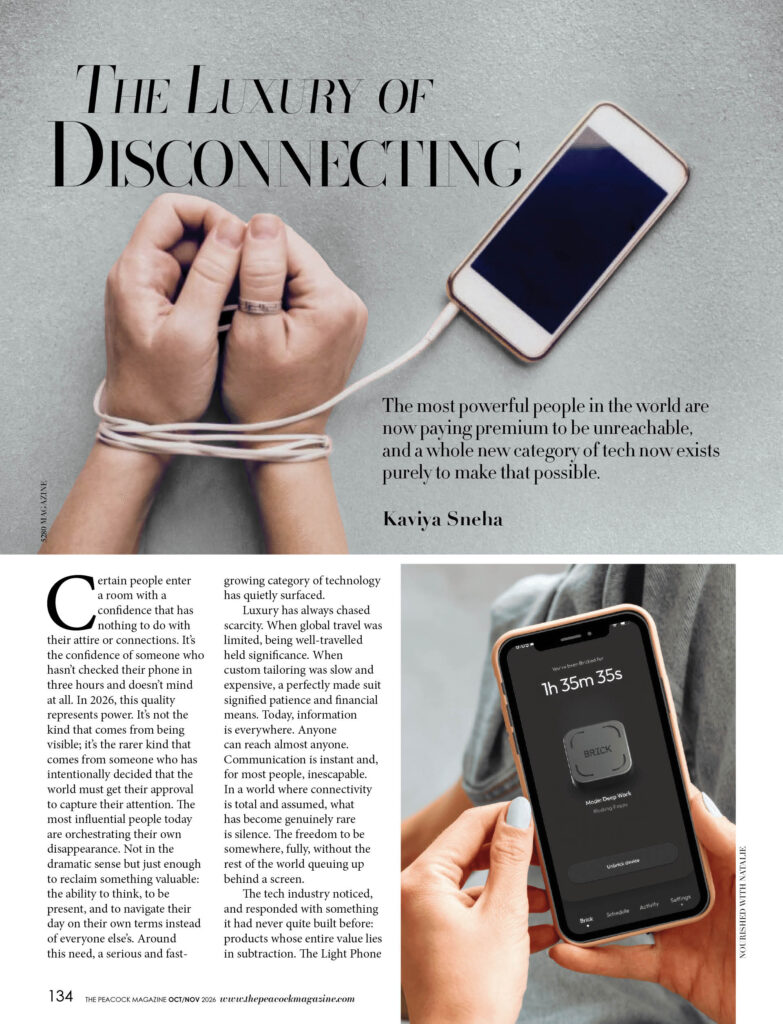
The most powerful people in the world are now paying premium to be unreachable, and a whole new category of tech now exists purely to make that possible.
By Kaviya Sneha
Certain people enter a room with a confidence that has nothing to do with their attire or connections. It’s the confidence of someone who hasn’t checked their phone in three hours and doesn’t mind at all. In 2026, this quality represents power. It’s not the kind that comes from being visible; it’s the rarer kind that comes from someone who has intentionally decided that the world must get their approval to capture their attention. The most influential people today are orchestrating their own disappearance. Not in the dramatic sense but just enough to reclaim something valuable: the ability to think, to be present, and to navigate their day on their own terms instead of everyone else’s. Around this need, a serious and fast-growing category of technology has quietly surfaced.
Luxury has always chased scarcity. When global travel was limited, being well-travelled held significance. When custom tailoring was slow and expensive, a perfectly made suit signified patience and financial means. Today, information is everywhere. Anyone can reach almost anyone. Communication is instant and, for most people, inescapable. In a world where connectivity is total and assumed, what has become genuinely rare is silence. The freedom to be somewhere, fully, without the rest of the world queuing up behind a screen.
The tech industry noticed, and responded with something it had never quite built before: products whose entire value lies in subtraction. The Light Phone II is the most elegant example. Matte, thin, built around an e-ink screen that feels closer to paper than to the glass rectangles most of us carry, it handles calls, messages, and a handful of deliberate tools. No social media and no camera pulling you into documentation mode every time something happens worth remembering. Its designers call it a tool on purpose, because tools do not demand your attention between uses. Its waiting list is populated with founders, investors, and executives who have concluded that their high-end smartphone was running them rather than the other way around.
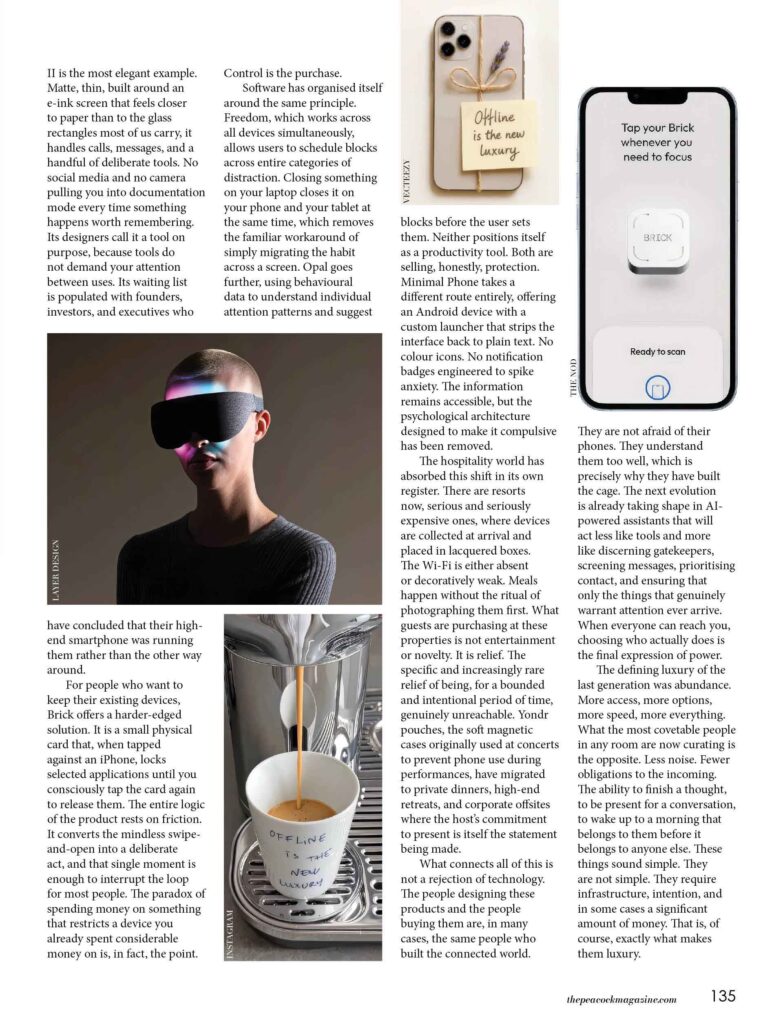
For people who want to keep their existing devices, Brick offers a harder-edged solution. It is a small physical card that, when tapped against an iPhone, locks selected applications until you consciously tap the card again to release them. The entire logic of the product rests on friction. It converts the mindless swipe-and-open into a deliberate act, and that single moment of having to mean it is enough to interrupt the loop for most people. The paradox of spending money on something that restricts a device you already spent considerable money on is, in fact, the point. Control is the purchase.
Software has organised itself around the same principle. Freedom, which works across all devices simultaneously, allows users to schedule blocks across entire categories of distraction. Closing something on your laptop closes it on your phone and your tablet at the same time, which removes the familiar workaround of simply migrating the habit across a screen. Opal goes further, using behavioural data to understand individual attention patterns and suggest blocks before the user thinks to set them. Neither positions itself as a productivity tool. Both are selling, honestly, protection. Minimal Phone takes a different route entirely, offering an Android device with a custom launcher that strips the interface back to plain text. No colour icons. No notification badges engineered to spike anxiety. The information remains accessible, but the psychological architecture designed to make it compulsive has been removed.
The hospitality world has absorbed this shift in its own register. There are resorts now, serious and seriously expensive ones, where devices are collected at arrival and placed in lacquered boxes. The Wi-Fi is either absent or decoratively weak. Meals happen without the ritual of photographing them first. What guests are purchasing at these properties is not entertainment or novelty. It is relief. The specific and increasingly rare relief of being, for a bounded and intentional period of time, genuinely unreachable. Yondr pouches, the soft magnetic cases originally used at concerts to prevent phone use during performances, have migrated to private dinners, high-end retreats, and corporate offsites where the host’s commitment to presence is itself the statement being made.
What connects all of this is not a rejection of technology. The people designing these products and the people buying them are, in many cases, the same people who built the connected world. They are not afraid of their phones. They understand them too well, which is precisely why they have built the cage. The next evolution is already taking shape in AI-powered assistants that will act less like tools and more like discerning gatekeepers, screening messages, prioritising contact, and ensuring that only the things that genuinely warrant attention ever arrive. When everyone can reach you, choosing who actually does is the final expression of power.
The defining luxury of the last generation was abundance. More access, more options, more speed, more everything. What the most covetable people in any room are now curating is the opposite. Less noise. Fewer obligations to the incoming. The ability to finish a thought, to be present for a conversation, to wake up to a morning that belongs to them before it belongs to anyone else. These things sound simple. They are not simple. They require infrastructure, intention, and in some cases a significant amount of money. That is, of course, exactly what makes them luxury.