
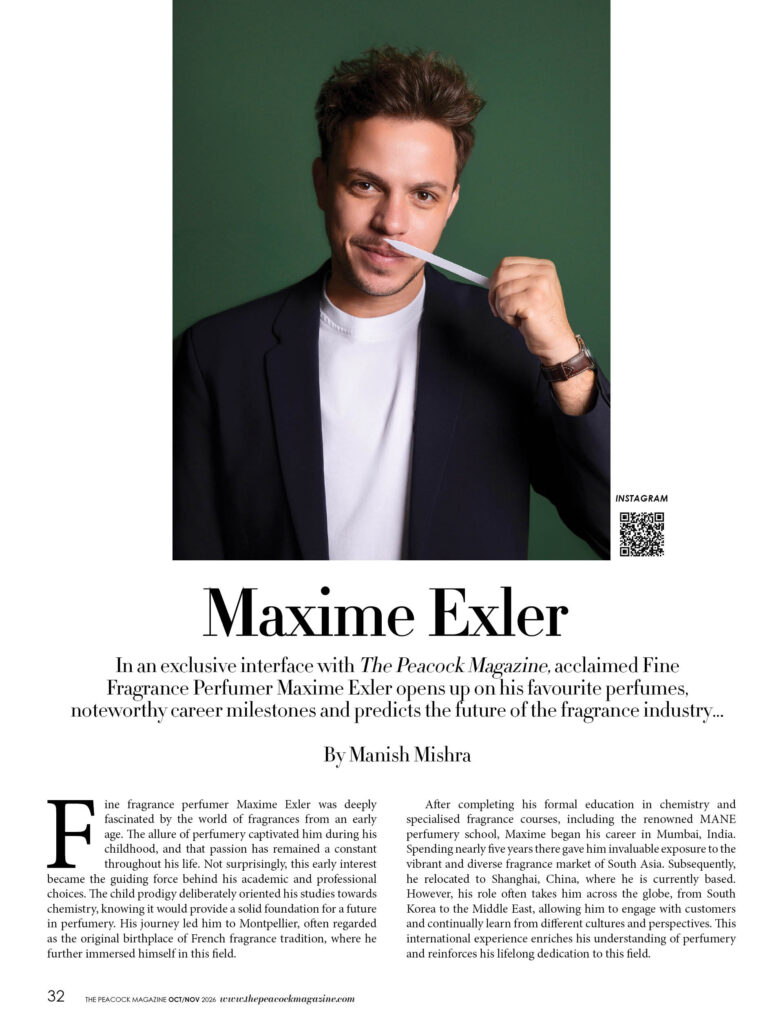
In an exclusive interface with THE PEACOCK MAGAZINE, acclaimed Fine Fragrance Perfumer Maxime Exler opens up on his favourite perfumes, noteworthy career milestones and predicts the future of the fragrance industry…
By Manish Mishra
Fine Fragrance Perfumer Maxime Exler was deeply fascinated by the world of fragrances from an early age. The allure of perfumery captivated him during his childhood, and that passion has remained a constant throughout his life. Not surprisingly, this early interest became the guiding force behind his academic and professional choices. The child prodigy deliberately oriented his studies towards chemistry, knowing it would provide a solid foundation for a future in perfumery. His journey led him to Montpellier, often regarded as the original birthplace of French fragrance tradition, where he further immersed himself in this field.
After completing his formal education in chemistry and specialised fragrance courses, including the renowned MANE perfumery school, Maxime began his career in Mumbai, India. Spending nearly five years there gave him invaluable exposure to the vibrant and diverse fragrance market of South Asia. Subsequently, he relocated to Shanghai, China, where he is currently based. However, his role often takes him across the globe, from South Korea to the Middle East, allowing him to engage with customers and continually learn from different cultures and perspectives. This international experience enriches his understanding of perfumery and reinforces his lifelong dedication to this field.
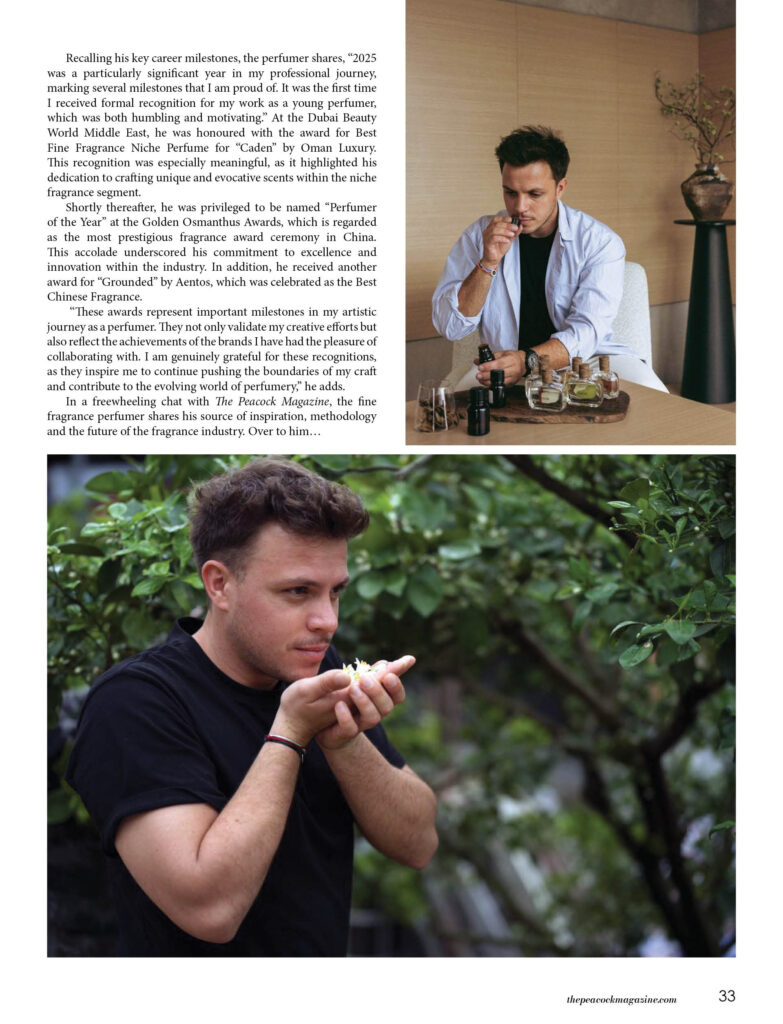
Recalling his key career milestones, the perfumer shares, “2025 was a particularly significant year in my professional journey, marking several milestones that I am proud of. It was the first time I received formal recognition for my work as a young perfumer, which was both humbling and motivating.” At the Dubai Beauty World Middle East, he was honoured with the award for Best Fine Fragrance Niche Perfume for “Caden” by Oman Luxury. This recognition was especially meaningful, as it highlighted his dedication to crafting unique and evocative scents within the niche fragrance segment.
Shortly thereafter, he was privileged to be named “Perfumer of the Year” at the Golden Osmanthus Awards, which is regarded as the most prestigious fragrance award ceremony in China. This accolade underscored his commitment to excellence and innovation within the industry. In addition, he received another award for “Grounded” by Aentos, which was celebrated as the Best Chinese Fragrance.
“These awards represent important milestones in my artistic journey as a perfumer. They not only validate my creative efforts but also reflect the achievements of the brands I have had the pleasure of collaborating with. I am genuinely grateful for these recognitions, as they inspire me to continue pushing the boundaries of my craft and contribute to the evolving world of perfumery,” he adds.
In a freewheeling chat with THE PEACOCK MAGAZINE, the Fine Fragrance Perfumer shares his source of inspiration, methodology and the future of fragrance industry. Over to him…
What is your earliest or most impactful scent memory?
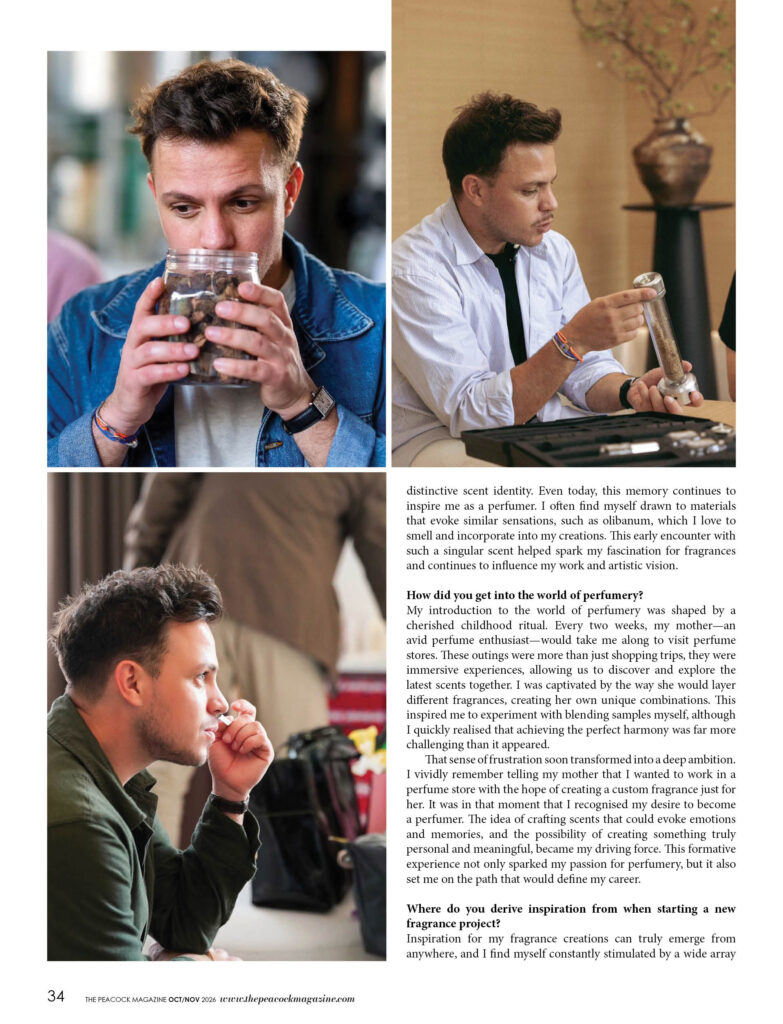
One of my most vivid and influential scent memories dates back to my childhood, when I lived in Djibouti. I can still recall, with remarkable clarity, the unique feeling of Lake Assal, a truly extraordinary place in Africa, known for being the lowest point on the continent at 155 meters below sea level. The lake itself is predominantly composed of salt, creating an environment that is both striking and unforgettable.
The scent of Lake Assal left a lasting impression on me. It was a complex blend: warm and salty, with watery and almost fishy undertones. This olfactory experience was not only powerful, but it also shaped my understanding of how a place can have its own distinctive scent identity. Even today, this memory continues to inspire me as a perfumer. I often find myself drawn to materials that evoke similar sensations, such as olibanum, which I love to smell and incorporate into my creations. This early encounter with such a singular scent helped spark my fascination for fragrances and continues to influence my work and artistic vision.
How did you get into the world of perfumery?
My introduction to the world of perfumery was shaped by a cherished childhood ritual. Every two weeks, my mother—an avid perfume enthusiast—would take me along to visit perfume stores. These outings were more than just shopping trips, they were immersive experiences, allowing us to discover and explore the latest scents together. I was captivated by the way she would layer different fragrances, creating her own unique combinations. This inspired me to experiment with blending samples myself, although I quickly realised that achieving the perfect harmony was far more challenging than it appeared.
That sense of frustration soon transformed into a deep ambition. I vividly remember telling my mother that I wanted to work in a perfume store with the hope of creating a custom fragrance just for her. It was in that moment that I recognised my desire to become a perfumer. The idea of crafting scents that could evoke emotions and memories, and the possibility of creating something truly personal and meaningful, became my driving force. This formative experience not only sparked my passion for perfumery but also set me on the path that would define my career.
Where do you derive inspiration from when starting a new fragrance project?
Inspiration for my fragrance creations can truly emerge from anywhere, and I find myself constantly stimulated by a wide array of sources. Art, particularly painting, plays a significant role in sparking my imagination. The interplay of colours, textures, and emotions in visual art often translates into olfactory concepts that I explore in my work. Food is another rich source of inspiration. The complexity of flavours and aromas encountered in different cuisines opens up new possibilities for scent compositions.
My travels across the Middle East, Southeast Asia, and North Asia have also been profoundly influential. Each journey allows me to immerse myself in new cultures and environments, and I approach these experiences with the curiosity and wonder of a child discovering something entirely new. I make it a point to spend time with local people wherever I go, as these interactions are among the most rewarding moments. Through them, I gain a deeper understanding of the tastes, traditions, and subtleties that define each culture.
Ultimately, it is this blend of artistic exploration, culinary discovery, and cultural exchange that fuels my creativity. Each new project becomes an opportunity to weave together these diverse influences, resulting in fragrances that tell unique and meaningful stories.
How do you translate abstract concepts, emotions, or memories into a scent profile?
Translating abstract concepts, emotions, or memories into a fragrance is a nuanced process that requires both empathy and creativity. For me, the journey begins with a deep understanding of the brand universe I am collaborating with. It is essential to move beyond surface-level ideas and truly connect with the people behind the brand, their vision, values, and the emotions they wish to evoke. I believe that effective communication is key, so I invest time in listening to their stories and aspirations, striving to find a common language that bridges the gap between their abstract ideas and my olfactory expertise.
During the creative process, I often present various raw materials and small accords to the brand team. This interactive approach allows us to align our visions and ensure that we are moving in the same direction. Each raw material holds a personal significance for me, often tied to specific memories or emotions from my own experiences. When I am tasked with translating an abstract concept into a scent, I draw upon both the brand’s identity and my own sensory memories to shape the initial composition.
I also believe that pleasure and emotion are fundamental dimensions of any fragrance. A scent must not only capture a concept but also be enjoyable and wearable. To achieve this, I rely on the wealth of knowledge I have gained from my travels around the world, which have exposed me to a diverse range of olfactory cultures and preferences. Ultimately, my goal is to create fragrances that resonate on multiple levels, intellectually, emotionally, and sensorially, while staying true to the essence of the brand and the story we wish to tell.
What are your favourite raw materials to work with, and why?
I am particularly drawn to raw materials that possess an element of surprise. Those that appear simple at first glance yet reveal unexpected facets as they unfold within a composition. Fir balsam, for example, is a material I greatly enjoy working with. What fascinates me about fir balsam is its remarkable versatility: it can impart a sense of freshness, yet also evoke warmth and comfort, depending on how it is paired with other ingredients. This duality allows for creative exploration and enables me to craft fragrances with intriguing contrasts and depth.
Incense is another favourite of mine, largely due to its multifaceted nature. It can introduce a fresh, resinous quality, while also offering soft woody and balsamic notes that add complexity and sophistication to a fragrance. The ability of incense to seamlessly shift between different olfactory impressions makes it an invaluable component in my palette.
Ultimately, I am most inspired by materials that bring depth, sophistication, and lasting performance to a fragrance. I seek out ingredients that not only enhance the overall structure of a scent, but also invite discovery, materials that encourage wearers to experience new sensations with each encounter. Working with such raw materials allows me to push the boundaries of creativity and deliver fragrances that are both memorable and distinctive.
How do you gauge when a perfume formulation is truly finished?
Determining when a perfume formulation is truly complete is both an art and a collaborative process. In reality, a fragrance can always be further refined, there is always the temptation to tweak and adjust, searching for that elusive sense of perfection. This is why the role of the fragrance development manager is absolutely essential. While perfumers bring creativity and technical expertise to the table, we do not work in isolation, the development of a fragrance is very much a team effort.
The fragrance development manager acts as a crucial partner and guide, helping to shape the direction of the project and ultimately making the call on when a creation is ready to be considered finished. Since the evaluation of a scent is inherently subjective, it is important to have this external perspective to balance the perfumer’s creative instincts. I often say that a truly successful fragrance is born from the synergy between the perfumer and the fragrance development manager. Together, we strive to reach a point where the fragrance fully embodies the intended vision and resonates with its audience, while also recognising that, in the world of perfumery, a formulation is rarely ever ‘perfectly’ finished but rather, it is complete when it achieves the right harmony and meets the shared goals of the team.
Do you prefer working with natural ingredients or synthetic molecules?
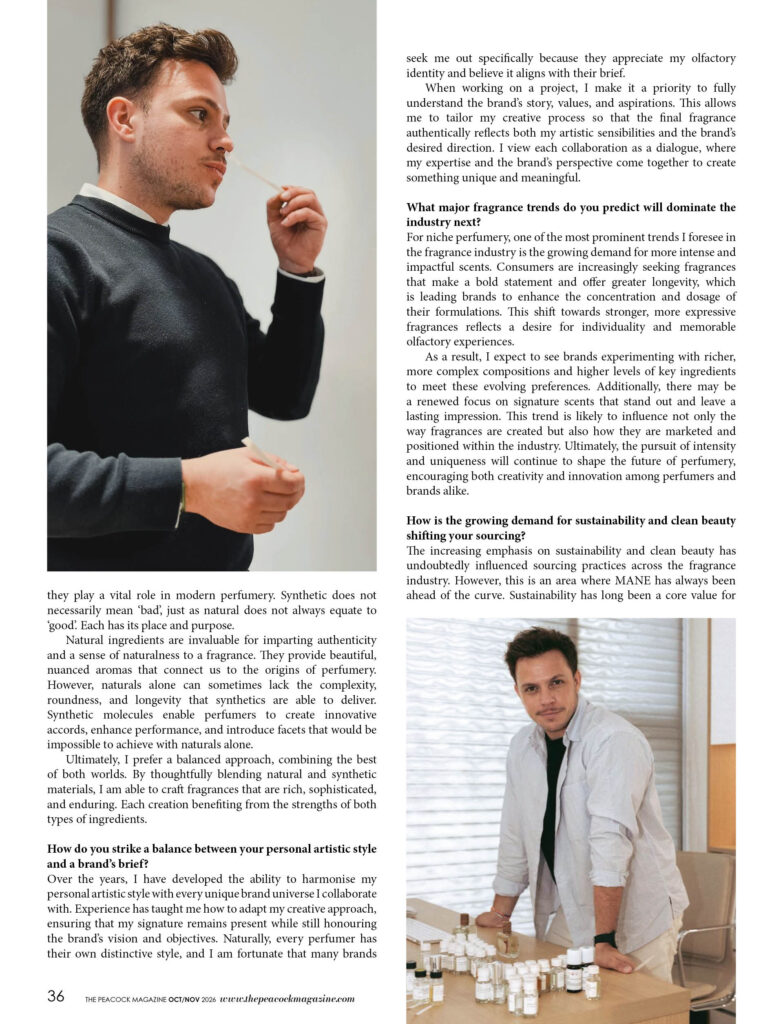
In my approach to perfumery, I believe that both natural ingredients and synthetic molecules are essential, each offering unique advantages that contribute to the overall character and performance of a fragrance. There is often a misconception that synthetic molecules are inferior or less desirable, but in reality, they play a vital role in modern perfumery. Synthetic does not necessarily mean ‘bad,’ just as natural does not always equate to ‘good.’ Each has its place and purpose.
Natural ingredients are invaluable for imparting authenticity and a sense of naturalness to a fragrance. They provide beautiful, nuanced aromas that connect us to the origins of perfumery. However, naturals alone can sometimes lack the complexity, roundness, and longevity that synthetics are able to deliver. Synthetic molecules enable perfumers to create innovative accords, enhance performance, and introduce facets that would be impossible to achieve with naturals alone.
Ultimately, I prefer a balanced approach, combining the best of both worlds. By thoughtfully blending natural and synthetic materials, I am able to craft fragrances that are rich, sophisticated, and enduring. Each creation benefiting from the strengths of both types of ingredients.
How do you strike a balance between your personal artistic style and a brand’s brief?
Over the years, I have developed the ability to harmonise my personal artistic style with the unique universe of each brand I collaborate with. Experience has taught me how to adapt my creative approach, ensuring that my signature remains present while still honouring the brand’s vision and objectives. Naturally, every perfumer has their own distinctive style, and I am fortunate that many brands seek me out specifically because they appreciate my olfactory identity and believe it aligns with their brief.
When working on a project, I make it a priority to fully understand the brand’s story, values, and aspirations. This allows me to tailor my creative process so that the final fragrance authentically reflects both my artistic sensibilities and the brand’s desired direction. I view each collaboration as a dialogue, where my expertise and the brand’s perspective come together to create something unique and meaningful.
What major fragrance trends do you predict will dominate the industry next?
For niche perfumery, one of the most prominent trends I foresee in the fragrance industry is the growing demand for more intense and impactful scents. Consumers are increasingly seeking fragrances that make a bold statement and offer greater longevity, which is leading brands to enhance the concentration and dosage of their formulations. This shift towards stronger, more expressive fragrances reflects a desire for individuality and memorable olfactory experiences.
As a result, I expect to see brands experimenting with richer, more complex compositions and higher levels of key ingredients to meet these evolving preferences. Additionally, there may be a renewed focus on signature scents that stand out and leave a lasting impression. This trend is likely to influence not only the way fragrances are created, but also how they are marketed and positioned within the industry. Ultimately, the pursuit of intensity and uniqueness will continue to shape the future of perfumery, encouraging both creativity and innovation among perfumers and brands alike.
How is the growing demand for sustainability and clean beauty shifting your sourcing?
The increasing emphasis on sustainability and clean beauty has undoubtedly influenced sourcing practices across the fragrance industry. However, this is an area where MANE has always been ahead of the curve. Sustainability has long been a core value for us, guiding our approach to sourcing raw materials and developing new products. As consumer awareness and expectations continue to rise, we remain committed to responsible sourcing, ensuring that our ingredients are ethically and sustainably obtained.
Rather than making drastic changes in response to market trends, we continue to uphold the principles that have always defined MANE’s philosophy. This means prioritising transparency, traceability, and environmental stewardship throughout our supply chain. By staying true to our values and maintaining rigorous standards, we are able to meet the growing demand for sustainable and clean beauty solutions, while also contributing positively to the industry and the communities we work with.
What is the biggest misconception people have about the job of a perfumer?
One of the most common misconceptions about the role of a perfumer is that our work is limited to simply designing fragrances. In reality, the profession has evolved significantly, and today, perfumers are also storytellers. We are tasked with translating emotions, concepts, and narratives into olfactory experiences, crafting scents that evoke memories and connect with people on a deeper level. This storytelling from the creator’s aspect was not as prominent in the past, but it has become an essential part of our craft in the modern era.
Another misconception is that the process of creating a fragrance is straightforward or effortless. In truth, it is a demanding and often challenging journey that requires immense patience, perseverance, and resilience. Each creation is the result of countless experiments and adjustments, as we strive to achieve the perfect harmony. The artistry of perfumery lies not only in the creative vision, but also in the dedication and determination to bring that vision to life.
Personally, what are your favourite perfumes and how do you wear them?
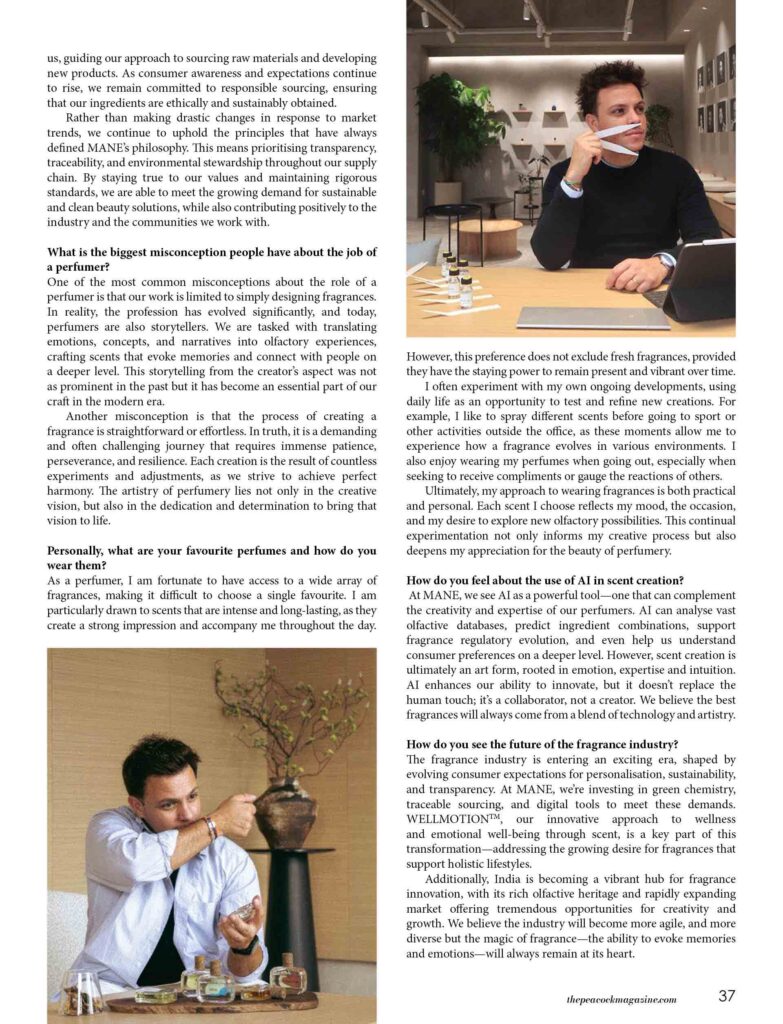
As a perfumer, I am fortunate to have access to a wide array of fragrances, making it difficult to choose a single favourite. I am particularly drawn to scents that are intense and long-lasting, as they create a strong impression and accompany me throughout the day. However, this preference does not exclude fresh fragrances, provided they have the staying power to remain present and vibrant over time.
I often experiment with my own ongoing developments, using daily life as an opportunity to test and refine new creations. For example, I like to spray different scents before going to sport or other activities outside the office, as these moments allow me to experience how a fragrance evolves in various environments. I also enjoy wearing my perfumes when going out, especially when seeking to receive compliments or gauge the reactions of others.
Ultimately, my approach to wearing fragrances is both practical and personal. Each scent I choose reflects my mood, the occasion, and my desire to explore new olfactory possibilities. This continual experimentation not only informs my creative process but also deepens my appreciation for the beauty of perfumery.
How do you feel about the use of AI in scent creation?
At MANE, we see AI as a powerful tool—one that can complement the creativity and expertise of our perfumers. AI can analyse vast olfactive databases, predict ingredient combinations, support fragrance regulatory evolution, and even help us understand consumer preferences on a deeper level. However, scent creation is ultimately an art form, rooted in emotion, expertise and intuition. AI enhances our ability to innovate, but it doesn’t replace the human touch; it’s a collaborator, not a creator. We believe the best fragrances will always come from a blend of technology and artistry.
How do you see the future of the fragrance industry?
The fragrance industry is entering an exciting era, shaped by evolving consumer expectations for personalisation, sustainability, and transparency. At MANE, we’re investing in green chemistry, traceable sourcing, and digital tools to meet these demands. WELLMOTIONTM, our innovative approach to wellness and emotional well-being through scent, is a key part of this transformation—addressing the growing desire for fragrances that support holistic lifestyles.
Additionally, India is becoming a vibrant hub for fragrance innovation, with its rich olfactive heritage and rapidly expanding market offering tremendous opportunities for creativity and growth. We believe the industry will become more agile, and more diverse but the magic of fragrance—the ability to evoke memories and emotions—will always remain at its heart.