
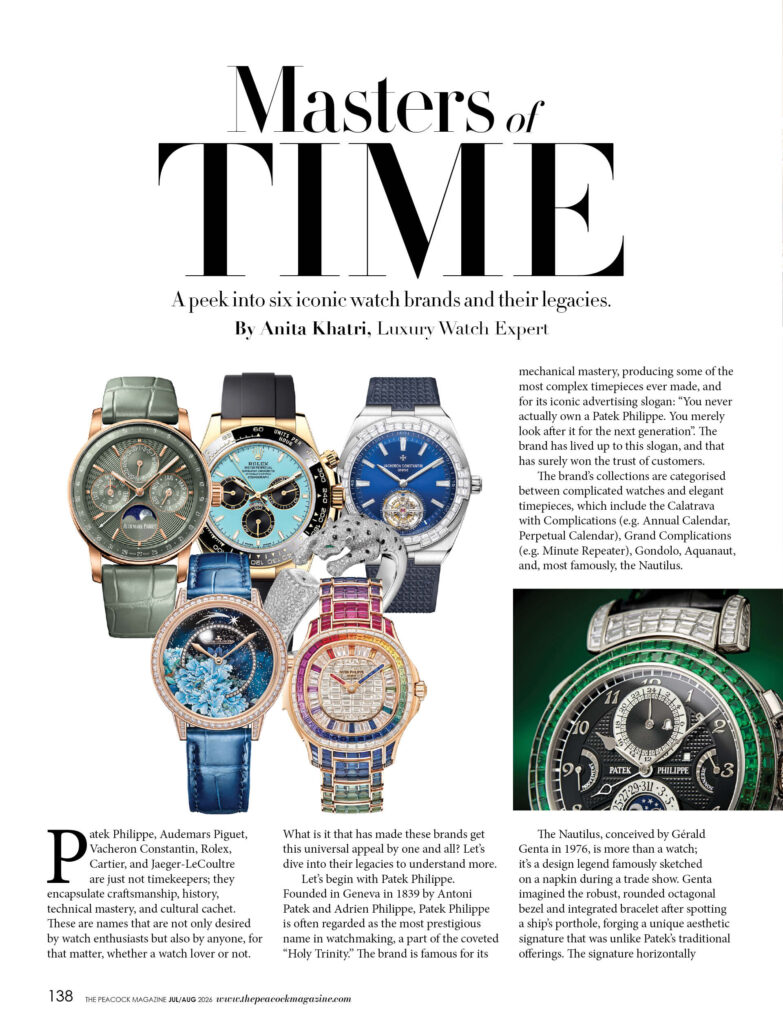
A peek into six iconic watch brands and their legacies.
By Anita Khatri, Luxury Watch Expert
Patek Philippe, Audemars Piguet, Vacheron Constantin, Rolex, Cartier, and Jaeger-LeCoultre are just not timekeepers; they encapsulate craftsmanship, history, technical mastery, and cultural cachet. These are names that are not only desired by watch enthusiasts but also by anyone, for that matter, whether a watch lover or not. What is it that has made these brands get this universal appeal by one and all? Let’s dive into their legacies to understand more.
Let’s begin with Patek Philippe. Founded in Geneva in 1839 by Antoni Patek and Adrien Philippe, Patek Philippe is often regarded as the most prestigious name in watchmaking, a part of the coveted “Holy Trinity.” The brand is famous for its mechanical mastery, producing some of the most complex timepieces ever made, and for its iconic advertising slogan: “You never actually own a Patek Philippe. You merely look after it for the next generation”. The brand has lived up to this slogan, and that has surely won the trust of customers.
The brand’s collections are categorised between complicated watches and elegant timepieces, which include the Calatrava with Complications (e.g. Annual Calendar, Perpetual Calendar), Grand Complications (e.g. Minute Repeater), Gondolo, Aquanaut, and, most famously, the Nautilus.
The Nautilus, conceived by Gérald Genta in 1976, is more than a watch; it’s a design legend famously sketched on a napkin during a trade show. Genta imagined the robust, rounded octagonal bezel and integrated bracelet after spotting a ship’s porthole, forging a unique aesthetic signature that was unlike Patek’s traditional offerings. The signature horizontally embossed dial (the “Teak Deck” pattern) and sleek profile instantly defined the luxury steel sports segment. When Genta debuted the Nautilus, its initial size—the Reference 3700/1A, nicknamed “Jumbo” was considered massive for the time then, a deliberate challenge to the norms of slim gold dress watches. The original concept was to create the “most expensive steel watch in the world”, a piece of Haute Horlogerie that could withstand salt water. This paradoxical combination of luxurious finishing and robust utility immediately captivated a sophisticated, globe-trotting clientele. While its steel variants are the most demanded, the Nautilus is also frequently crafted in precious metals, including rose gold, white gold, and the ultra-rare platinum, often featuring baguette or brilliant-cut diamond settings on the bezel. The design’s execution is defined by its meticulous craftsmanship, particularly the hand-finished satin brushing on the bezel, which contrasts sharply with the high-polished edges. This level of detail in a sports watch casing is one reason Patek’s production is so limited. The enduring power of the Nautilus lies not just in scarcity, but in the brand’s quiet promise: owning one means buying into a legacy that perpetually validates its initial, daring statement, ensuring that its value not only holds but accelerates with each passing generation.
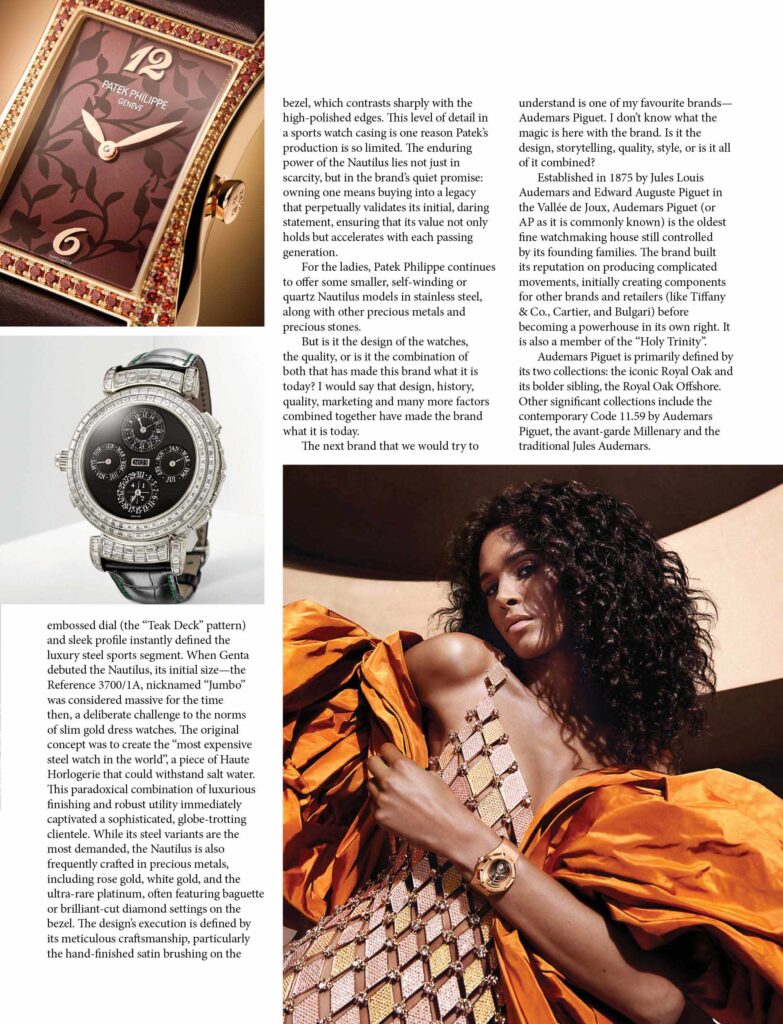
For the ladies, Patek Philippe continues to offer some smaller, self-winding or quartz Nautilus models in stainless steel, along with other precious metals and precious stones.
But is it the design of the watches, the quality, or is it the combination of both that has made this brand what it is today? I would say that design, history, quality, marketing and many more factors combined together have made the brand what it is today.
The next brand that we would try to understand is one of my favourite brands—Audemars Piguet. I don’t know what the magic is here with the brand. Is it the design, storytelling, quality, style, or is it all of it combined?
Established in 1875 by Jules Louis Audemars and Edward Auguste Piguet in the Vallée de Joux, Audemars Piguet (or AP as it is commonly known) is the oldest fine watchmaking house still controlled by its founding families. The brand built its reputation on producing complicated movements, initially creating components for other brands and retailers (like Tiffany & Co., Cartier, and Bulgari) before becoming a powerhouse in its own right. It is also a member of the “Holy Trinity”.
Audemars Piguet is primarily defined by its two collections: the iconic Royal Oak and its bolder sibling, the Royal Oak Offshore. Other significant collections include the contemporary Code 11.59 by Audemars Piguet, the avant-garde Millenary and the traditional Jules Audemars.
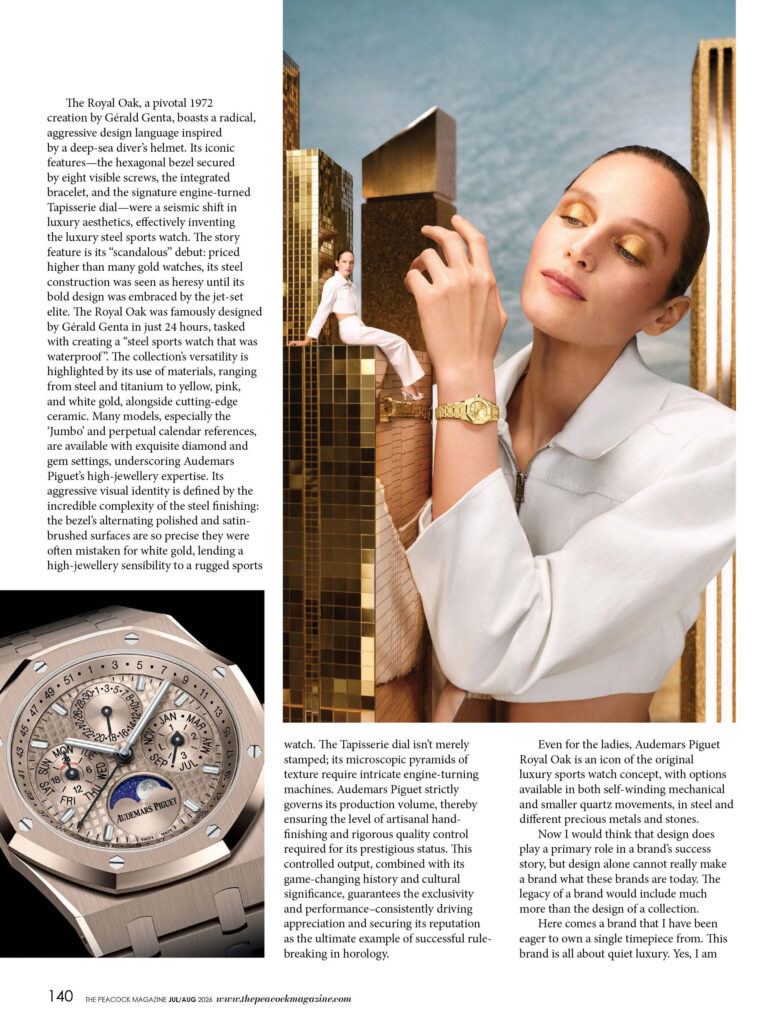
The Royal Oak, a pivotal 1972 creation by Gérald Genta, boasts a radical, aggressive design language inspired by a deep-sea diver’s helmet. Its iconic features—the hexagonal bezel secured by eight visible screws, the integrated bracelet, and the signature engine-turned Tapisserie dial—were a seismic shift in luxury aesthetics, effectively inventing the luxury steel sports watch. The story feature is its “scandalous” debut: priced higher than many gold watches, its steel construction was seen as heresy until its bold design was embraced by the jet-set elite. The Royal Oak was famously designed by Gérald Genta in just 24 hours, tasked with creating a “steel sports watch that was waterproof”. The collection’s versatility is highlighted by its use of materials, ranging from steel and titanium to yellow, pink, and white gold, alongside cutting-edge ceramic. Many models, especially the ‘Jumbo’ and perpetual calendar references, are available with exquisite diamond and gem settings, underscoring Audemars Piguet’s high-jewellery expertise. Its aggressive visual identity is defined by the incredible complexity of the steel finishing: the bezel’s alternating polished and satin-brushed surfaces are so precise they were often mistaken for white gold, lending a high-jewellery sensibility to a rugged sports watch. The Tapisserie dial isn’t merely stamped; its microscopic pyramids of texture require intricate engine-turning machines. Audemars Piguet strictly governs its production volume, thereby ensuring the level of artisanal hand-finishing and rigorous quality control required for its prestigious status. This controlled output, combined with its game-changing history and cultural significance, guarantees the exclusivity and performance–consistently driving appreciation and securing its reputation as the ultimate example of successful rule-breaking in horology.
Even for the ladies, Audemars Piguet Royal Oak is an icon of the original luxury sports watch concept, with options available in both self-winding mechanical and smaller quartz movements, in steel and different precious metals and stones.
Now I would think that design does play a primary role in a brand’s success story, but design alone cannot really make a brand what these brands are today. The legacy of a brand would include much more than the design of a collection.
Here comes a brand that I have been eager to own a single timepiece from. This brand is all about quiet luxury. Yes, I am referring to none other than Vacheron Constantin.
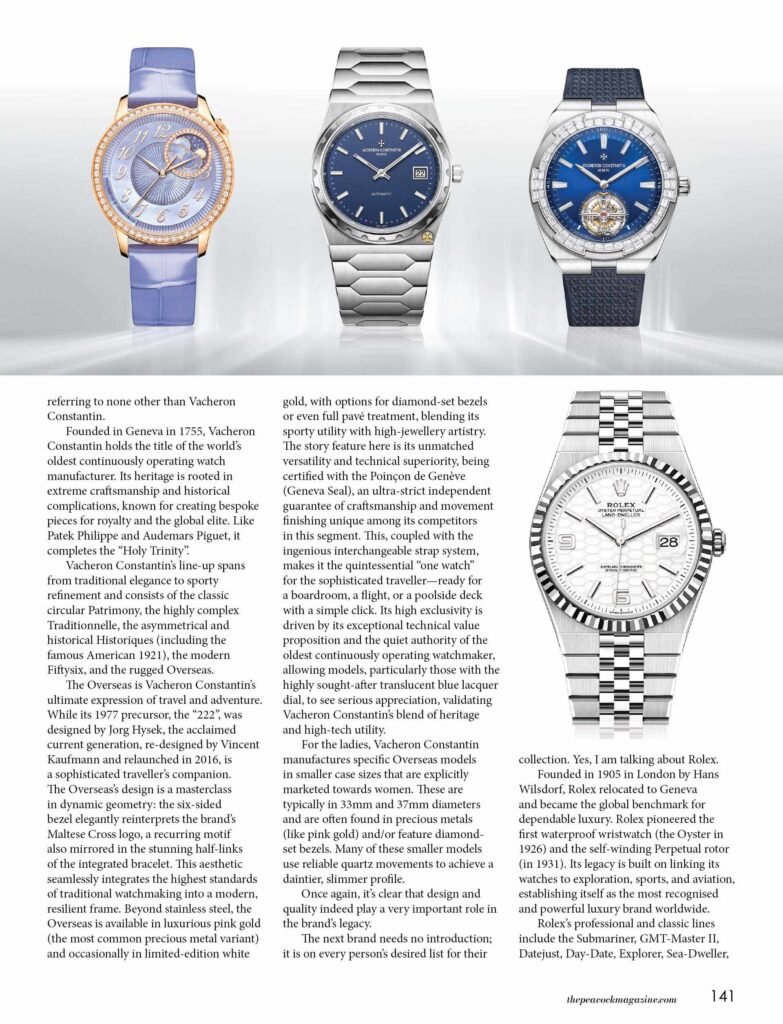
Founded in Geneva in 1755, Vacheron Constantin holds the title of the world’s oldest continuously operating watch manufacturer. Its heritage is rooted in extreme craftsmanship and historical complications, known for creating bespoke pieces for royalty and the global elite. Like Patek Philippe and Audemars Piguet, it completes the “Holy Trinity”.
Vacheron Constantin’s line-up spans from traditional elegance to sporty refinement and consists of the classic circular Patrimony, the highly complex Traditionnelle, the asymmetrical and historical Historiques (including the famous American 1921), the modern Fiftysix, and the rugged Overseas.
The Overseas is Vacheron Constantin’s ultimate expression of travel and adventure. While its 1977 precursor, the “222”, was designed by Jorg Hysek, the acclaimed current generation, re-designed by Vincent Kaufmann and relaunched in 2016, is a sophisticated traveller’s companion. The Overseas’s design is a masterclass in dynamic geometry: the six-sided bezel elegantly reinterprets the brand’s Maltese Cross logo, a recurring motif also mirrored in the stunning half-links of the integrated bracelet. This aesthetic seamlessly integrates the highest standards of traditional watchmaking into a modern, resilient frame. Beyond stainless steel, the Overseas is available in luxurious pink gold (the most common precious metal variant) and occasionally in limited-edition white gold, with options for diamond-set bezels or even full pavé treatment, blending its sporty utility with high-jewellery artistry. The story feature here is its unmatched versatility and technical superiority, being certified with the Poinçon de Genève (Geneva Seal), an ultra-strict independent guarantee of craftsmanship and movement finishing unique among its competitors in this segment. This, coupled with the ingenious interchangeable strap system, makes it the quintessential “one watch” for the sophisticated traveller—ready for a boardroom, a flight, or a poolside deck with a simple click. Its high exclusivity is driven by its exceptional technical value proposition and the quiet authority of the oldest continuously operating watchmaker, allowing models, particularly those with the highly sought-after translucent blue lacquer dial, to see serious appreciation, validating Vacheron Constantin’s blend of heritage and high-tech utility.
For the ladies, Vacheron Constantin manufactures specific Overseas models in smaller case sizes that are explicitly marketed towards women. These are typically in 33mm and 37mm diameters and are often found in precious metals (like pink gold) and/or feature diamond-set bezels. Many of these smaller models use reliable quartz movements to achieve a daintier, slimmer profile.
Once again, it’s clear that design and quality indeed play a very important role in the brand’s legacy.
The next brand needs no introduction; it is on every person’s desired list for their collection. Yes, I am talking about Rolex.
Founded in 1905 in London by Hans Wilsdorf, Rolex relocated to Geneva and became the global benchmark for dependable luxury. Rolex pioneered the first waterproof wristwatch (the Oyster in 1926) and the self-winding Perpetual rotor (in 1931). Its legacy is built on linking its watches to exploration, sports, and aviation, establishing itself as the most recognised and powerful luxury brand worldwide.
Rolex’s professional and classic lines include the Submariner, GMT-Master II, Datejust, Day-Date, Explorer, Sea-Dweller, and the Cosmograph Daytona.
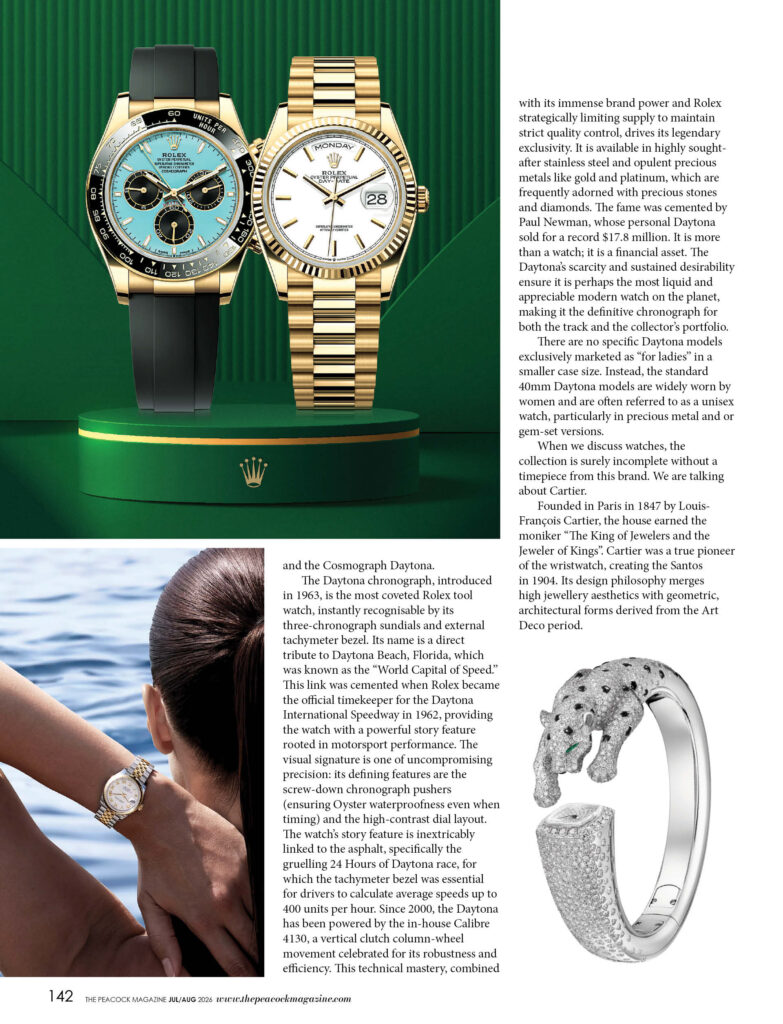
The Daytona chronograph, introduced in 1963, is the most coveted Rolex tool watch, instantly recognisable by its three-chronograph sundials and external tachymeter bezel. Its name is a direct tribute to Daytona Beach, Florida, which was known as the “World Capital of Speed.” This link was cemented when Rolex became the official timekeeper for the Daytona International Speedway in 1962, providing the watch with a powerful story feature rooted in motorsport performance. The visual signature is one of uncompromising precision: its defining features are the screw-down chronograph pushers (ensuring Oyster waterproofness even when timing) and the high-contrast dial layout. The watch’s story feature is inextricably linked to the asphalt, specifically the gruelling 24 Hours of Daytona race, for which the tachymeter bezel was essential for drivers to calculate average speeds up to 400 units per hour. Since 2000, the Daytona has been powered by the in-house Calibre 4130, a vertical clutch column-wheel movement celebrated for its robustness and efficiency. This technical mastery, combined with its immense brand power and Rolex strategically limiting supply to maintain strict quality control, drives its legendary exclusivity. It is available in highly sought-after stainless steel and opulent precious metals like gold and platinum, which are frequently adorned with precious stones and diamonds. The fame was cemented by Paul Newman, whose personal Daytona sold for a record $17.8 million. It is more than a watch; it is a financial asset. The Daytona’s scarcity and sustained desirability ensure it is perhaps the most liquid and appreciable modern watch on the planet, making it the definitive chronograph for both the track and the collector’s portfolio.
There are no specific Daytona models exclusively marketed as “for ladies” in a smaller case size. Instead, the standard 40mm Daytona models are widely worn by women and are often referred to as a unisex watch, particularly in precious metal and or gem-set versions.
When we discuss watches, the collection is surely incomplete without a timepiece from this brand. We are talking about Cartier.
Founded in Paris in 1847 by Louis-François Cartier, the house earned the moniker “The King of Jewelers and the Jeweler of Kings”. Cartier was a true pioneer of the wristwatch, creating the Santos in 1904. Its design philosophy merges high jewellery aesthetics with geometric, architectural forms derived from the Art Deco period.
Key collections include the circular Ballon Bleu, the curved square Panthère, the distinctive pilot watch Santos, the asymmetrical Pasha de Cartier, and the foundational Tank.
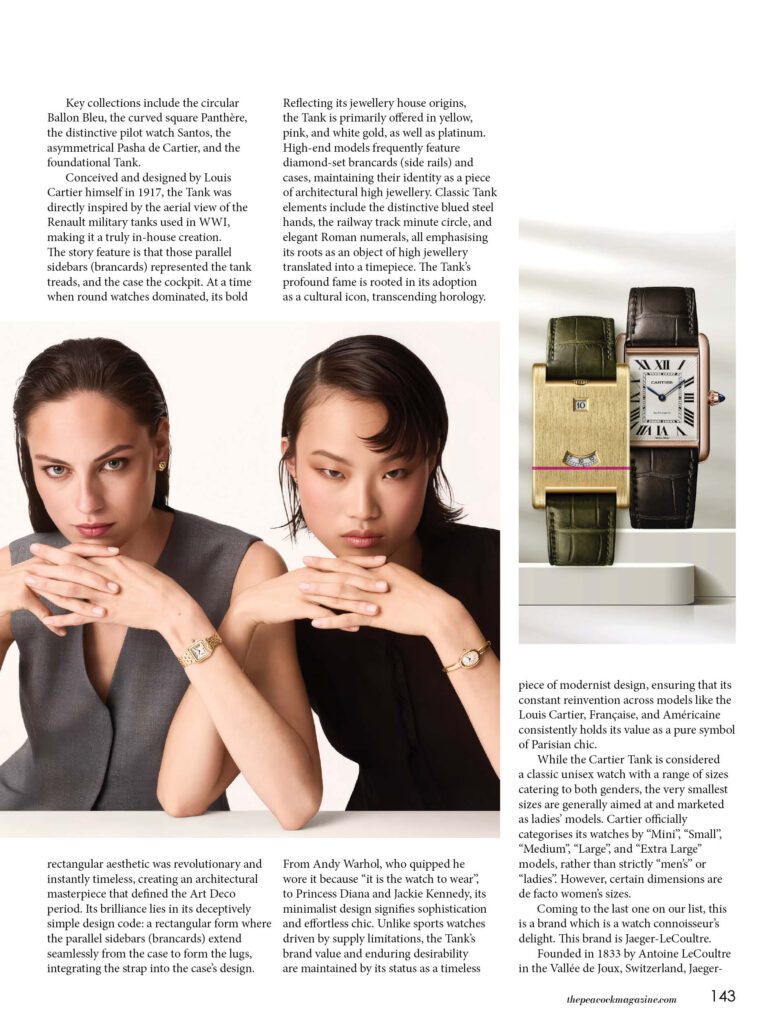
Conceived and designed by Louis Cartier himself in 1917, the Tank was directly inspired by the aerial view of the Renault military tanks used in WWI, making it a truly in-house creation. The story feature is that those parallel sidebars (brancards) represented the tank treads, and the case the cockpit. At a time when round watches dominated, its bold rectangular aesthetic was revolutionary and instantly timeless, creating an architectural masterpiece that defined the Art Deco period. Its brilliance lies in its deceptively simple design code: a rectangular form where the parallel sidebars (brancards) extend seamlessly from the case to form the lugs, integrating the strap into the case’s design. Reflecting its jewellery house origins, the Tank is primarily offered in yellow, pink, and white gold, as well as platinum. High-end models frequently feature diamond-set brancards (side rails) and cases, maintaining their identity as a piece of architectural high jewellery. Classic Tank elements include the distinctive blued steel hands, the railway track minute circle, and elegant Roman numerals, all emphasising its roots as an object of high jewellery translated into a timepiece. The Tank’s profound fame is rooted in its adoption as a cultural icon, transcending horology. From Andy Warhol, who quipped he wore it because “it is the watch to wear”, to Princess Diana and Jackie Kennedy, its minimalist design signifies sophistication and effortless chic. Unlike sports watches driven by supply limitations, the Tank’s brand value and enduring desirability are maintained by its status as a timeless piece of modernist design, ensuring that its constant reinvention across models like the Louis Cartier, Française, and Américaine consistently holds its value as a pure symbol of Parisian chic.
While the Cartier Tank is considered a classic unisex watch with a range of sizes catering to both genders, the very smallest sizes are generally aimed at and marketed as ladies’ models. Cartier officially categorises its watches by “Mini”, “Small”, “Medium”, “Large”, and “Extra Large” models, rather than strictly “men’s” or “ladies”. However, certain dimensions are de facto women’s sizes.
Coming to the last one on our list, this is a brand which is a watch connoisseur’s delight. This brand is Jaeger-LeCoultre.
Founded in 1833 by Antoine LeCoultre in the Vallée de Joux, Switzerland, Jaeger-LeCoultre (JLC) is often nicknamed the “Grande Maison” and the “Watchmaker of Watchmakers” due to its role in supplying movements and components to many of its competitors, including Patek Philippe, Audemars Piguet, and Cartier. Jaeger-LeCoultre is a true manufacturer, with over 1,400 calibres and 430 patents to its name, underscoring its historical technical mastery and innovation.
Jaeger-LeCoultre’s portfolio is exceptionally deep, spanning ultra-thin dress watches, high complications, and dive watches. Key collections include the revolutionary rectangular Reverso, the classic circular Master series (Master Control, Master ultra thin, Master Grande Tradition), the luxury sports watch Polaris, the feminine Rendez-Vous, the innovative Duomètre, and the near-perpetual Atmos clock.
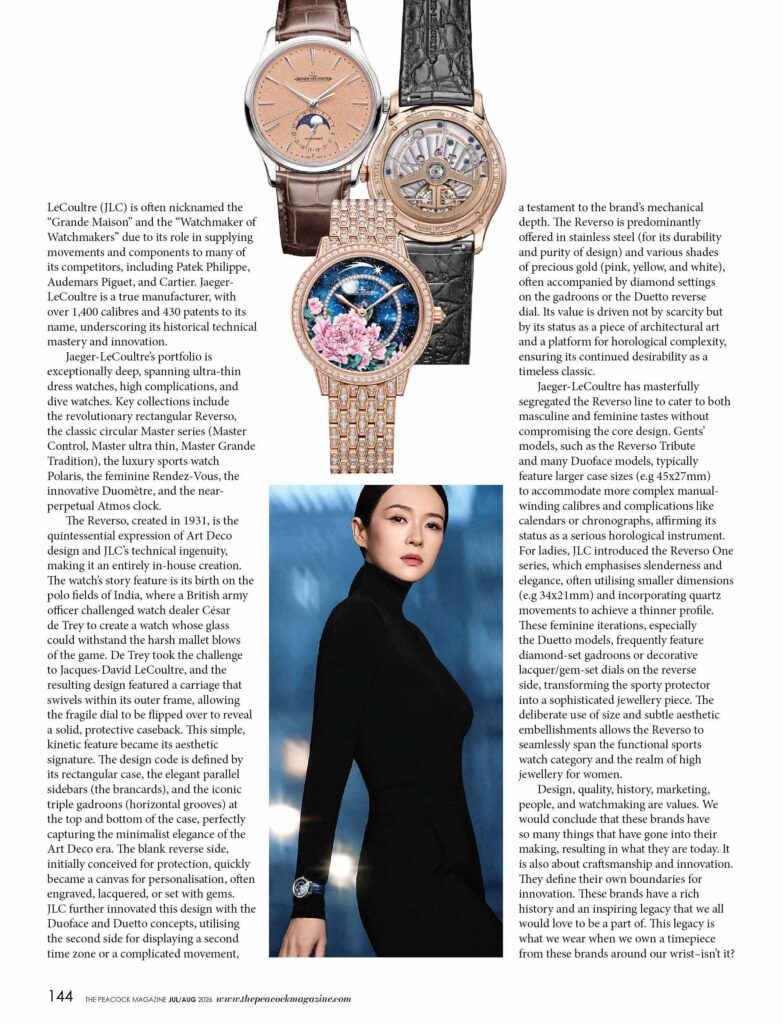
The Reverso, created in 1931, is the quintessential expression of Art Deco design and JLC’s technical ingenuity, making it an entirely in-house creation. The watch’s story feature is its birth on the polo fields of India, where a British army officer challenged watch dealer César de Trey to create a watch whose glass could withstand the harsh mallet blows of the game. De Trey took the challenge to Jacques-David LeCoultre, and the resulting design featured a carriage that swivels within its outer frame, allowing the fragile dial to be flipped over to reveal a solid, protective caseback. This simple, kinetic feature became its aesthetic signature. The design code is defined by its rectangular case, the elegant parallel sidebars (the brancards), and the iconic triple gadroons (horizontal grooves) at the top and bottom of the case, perfectly capturing the minimalist elegance of the Art Deco era. The blank reverse side, initially conceived for protection, quickly became a canvas for personalisation, often engraved, lacquered, or set with gems. JLC further innovated this design with the Duoface and Duetto concepts, utilising the second side for displaying a second time zone or a complicated movement, a testament to the brand’s mechanical depth. The Reverso is predominantly offered in stainless steel (for its durability and purity of design) and various shades of precious gold (pink, yellow, and white), often accompanied by diamond settings on the gadroons or the Duetto reverse dial. Its value is driven not by scarcity but by its status as a piece of architectural art and a platform for horological complexity, ensuring its continued desirability as a timeless classic.
Jaeger-LeCoultre has masterfully segregated the Reverso line to cater to both masculine and feminine tastes without compromising the core design. Gents’ models, such as the Reverso Tribute and many Duoface models, typically feature larger case sizes (e.g 45x27mm) to accommodate more complex manual-winding calibres and complications like calendars or chronographs, affirming its status as a serious horological instrument. For ladies, JLC introduced the Reverso One series, which emphasises slenderness and elegance, often utilising smaller dimensions (e.g 34x21mm) and incorporating quartz movements to achieve a thinner profile. These feminine iterations, especially the Duetto models, frequently feature diamond-set gadroons or decorative lacquer/gem-set dials on the reverse side, transforming the sporty protector into a sophisticated jewellery piece. The deliberate use of size and subtle aesthetic embellishments allows the Reverso to seamlessly span the functional sports watch category and the realm of high jewellery for women.
Design, quality, history, marketing, people, and watchmaking are values. We would conclude that these brands have so many things that have gone into their making, resulting in what they are today. It is also about craftsmanship and innovation. They define their own boundaries for innovation. These brands have a rich history and an inspiring legacy that we all would love to be a part of. This legacy is what we wear when we own a timepiece from these brands around our wrist–isn’t it?