
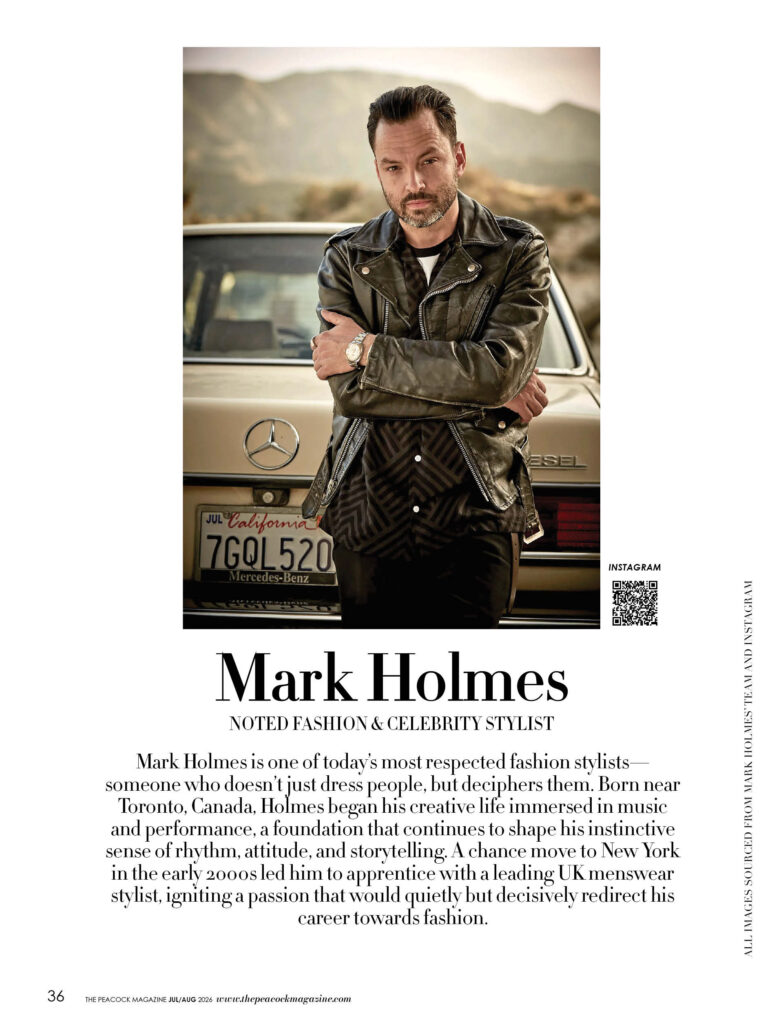
Mark Holmes is one of today’s most respected fashion stylists—someone who doesn’t just dress people, but deciphers them. Born near Toronto, Canada, Holmes began his creative life immersed in music and performance, a foundation that continues to shape his instinctive sense of rhythm, attitude, and storytelling. A chance move to New York in the early 2000s led him to apprentice with a leading UK menswear stylist, igniting a passion that would quietly but decisively redirect his career towards fashion.
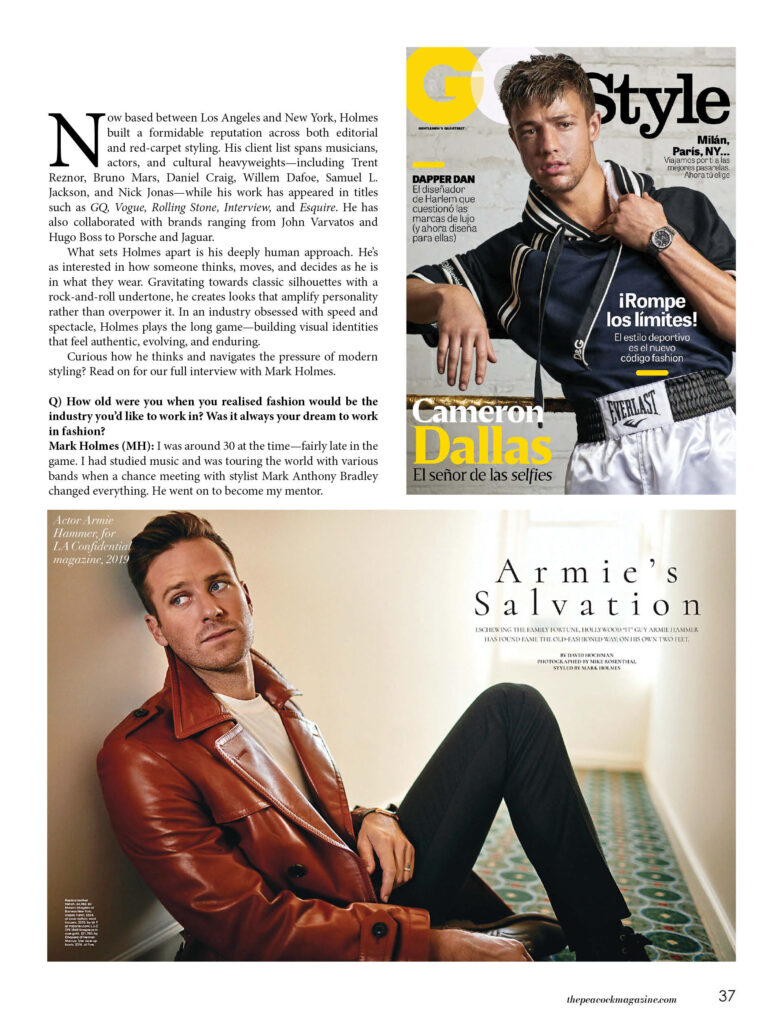
Now based between Los Angeles and New York, Holmes built a formidable reputation across both editorial and red-carpet styling. His client list spans musicians, actors, and cultural heavyweights—including Trent Reznor, Bruno Mars, Daniel Craig, Willem Dafoe, Samuel L. Jackson, and Nick Jonas—while his work has appeared in titles such as GQ, Vogue, Rolling Stone, Interview, and Esquire. He has also collaborated with brands ranging from John Varvatos and Hugo Boss to Porsche and Jaguar.
What sets Holmes apart is his deeply human approach. He’s as interested in how someone thinks, moves, and decides as he is in what they wear. Gravitating towards classic silhouettes with a rock-and-roll undertone, he creates looks that amplify personality rather than overpower it. In an industry obsessed with speed and spectacle, Holmes plays the long game—building visual identities that feel authentic, evolving, and enduring.
Curious how he thinks and navigates the pressure of modern styling? Read on for our full interview with Mark Holmes.
Q) How old were you when you realised fashion would be the industry you’d like to work in? Was it always your dream to work in fashion?
Mark Holmes (MH): I was around 30 at the time—fairly late in the game. I had studied music and was touring the world with various bands when a chance meeting with stylist Mark Anthony Bradley changed everything. He went on to become my mentor.
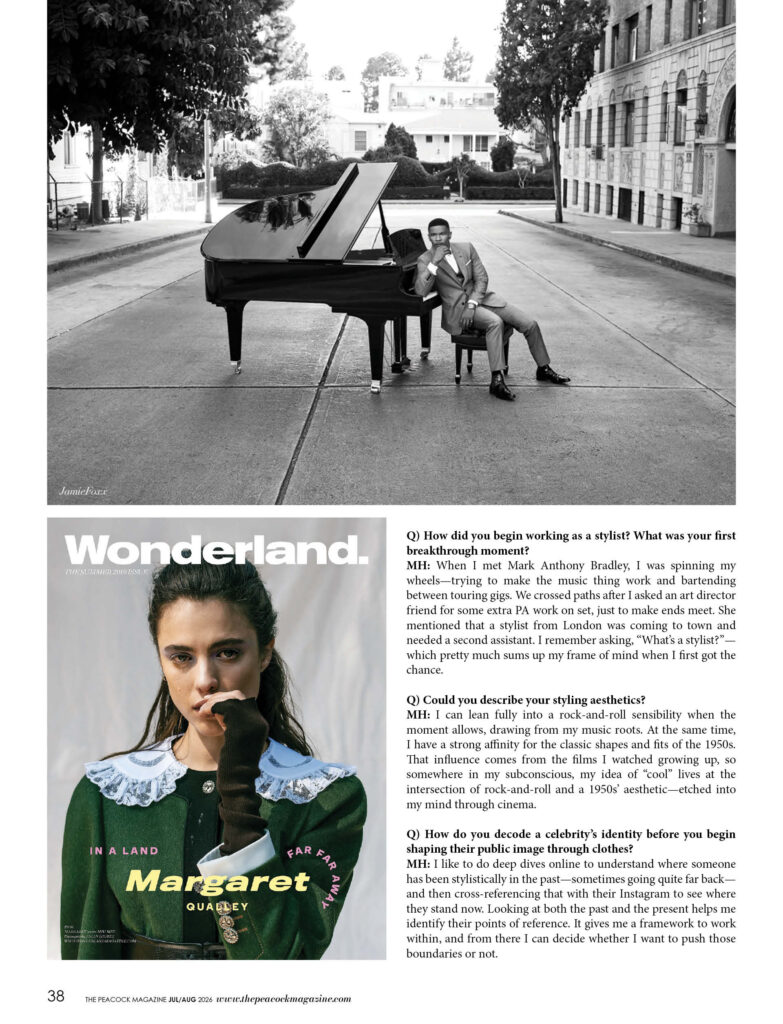
Q) How did you begin working as a stylist? What was your first breakthrough moment?
MH: When I met Mark Anthony Bradley, I was spinning my wheels—trying to make the music thing work and bartending between touring gigs. We crossed paths after I asked an art director friend for some extra PA work on set, just to make ends meet. She mentioned that a stylist from London was coming to town and needed a second assistant. I remember asking, “What’s a stylist?”—which pretty much sums up my frame of mind when I first got the chance.
Q) Could you describe your styling aesthetics?
MH: I can lean fully into a rock-and-roll sensibility when the moment allows, drawing from my music roots. At the same time, I have a strong affinity for the classic shapes and fits of the 1950s. That influence comes from the films I watched growing up, so somewhere in my subconscious, my idea of “cool” lives at the intersection of rock-and-roll and a 1950s’ aesthetic—etched into my mind through cinema.
Q) How do you decode a celebrity’s identity before you begin shaping their public image through clothes?
MH: I like to do deep dives online to understand where someone has been stylistically in the past—sometimes going quite far back—and then cross-referencing that with their Instagram to see where they stand now. Looking at both the past and the present helps me identify their points of reference. It gives me a framework to work within, and from there I can decide whether I want to push those boundaries or not.
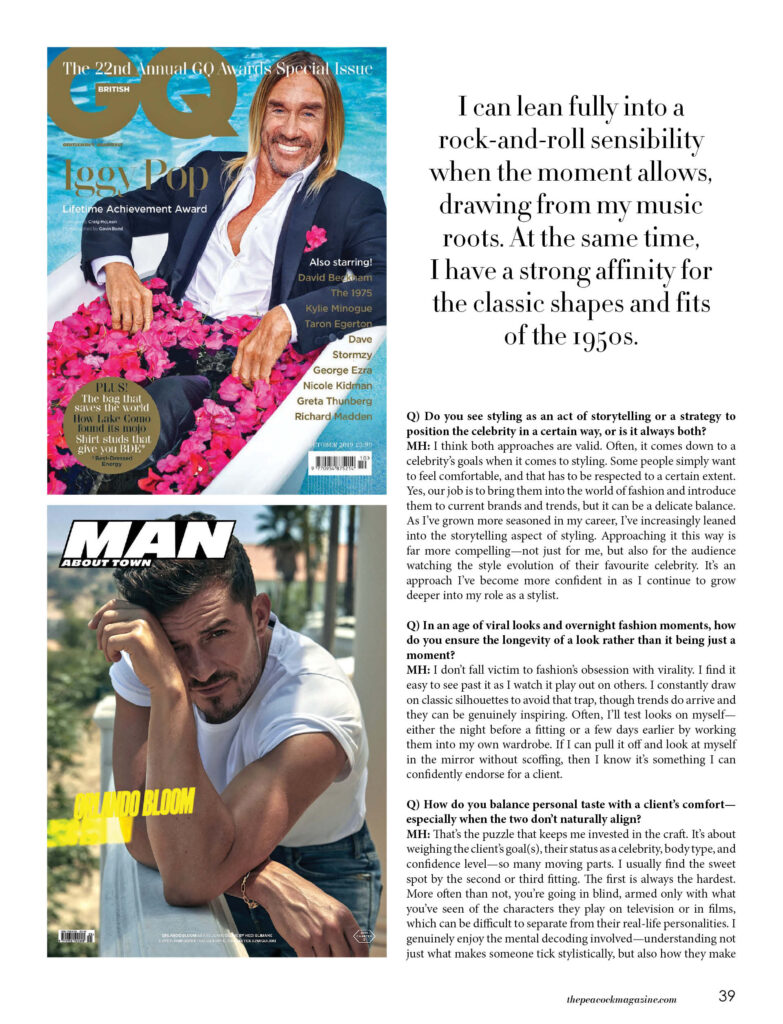
Q) Do you see styling as an act of storytelling or a strategy to position the celebrity in a certain way, or is it always both?
MH: I think both approaches are valid. Often, it comes down to a celebrity’s goals when it comes to styling. Some people simply want to feel comfortable, and that has to be respected to a certain extent. Yes, our job is to bring them into the world of fashion and introduce them to current brands and trends, but it can be a delicate balance. As I’ve grown more seasoned in my career, I’ve increasingly leaned into the storytelling aspect of styling. Approaching it this way is far more compelling—not just for me, but also for the audience watching the style evolution of their favourite celebrity. It’s an approach I’ve become more confident in as I continue to grow deeper into my role as a stylist.
Q) In an age of viral looks and overnight fashion moments, how do you ensure the longevity of a look rather than it being just a moment?
MH: I don’t fall victim to fashion’s obsession with virality. I find it easy to see past it as I watch it play out on others. I constantly draw on classic silhouettes to avoid that trap, though trends do arrive and they can be genuinely inspiring. Often, I’ll test looks on myself—either the night before a fitting or a few days earlier by working them into my own wardrobe. If I can pull it off and look at myself in the mirror without scoffing, then I know it’s something I can confidently endorse for a client.
Q) How do you balance personal taste with a client’s comfort—especially when the two don’t naturally align?
MH: That’s the puzzle that keeps me invested in the craft. It’s about weighing the client’s goal(s), their status as a celebrity, body type, and confidence level—so many moving parts. I usually find the sweet spot by the second or third fitting. The first is always the hardest. More often than not, you’re going in blind, armed only with what you’ve seen of the characters they play on television or in films, which can be difficult to separate from their real-life personalities. I genuinely enjoy the mental decoding involved—understanding not just what makes someone tick stylistically, but also how they make
decisions. Once you start to grasp that, the pieces of the puzzle fall into place. That, for me, is the most intriguing part.
Q) What role does cultural awareness play in your styling choices today, especially on global platforms?
MH: I’ve had a few instances where clients have travelled abroad and wanted the designers, they wore to reflect the countries they were visiting, which can be quite exciting. It creates a new framework—new walls through which to view and approach the look. That said, it isn’t something I’ve had to navigate very often.
Q) Has the rise of social media changed the power dynamic between stylists, designers, and celebrities?
MH: Absolutely—on many levels. In some ways, it gives stylists more power, as it allows us to shape our own narrative in support of the story we’re trying to tell.
Q) What separates a well-dressed celebrity from a truly iconic one?
MH: An icon is someone whose personality and stature are bigger than the clothes they wear. You can be impeccably dressed, but if the clothes are wearing you—rather than the other way around—you will never be iconic.
Q) How do you know when to push a client and when restraint is the smarter choice?
MH: That’s a tough one—I’ve been on both sides of that situation. There have been times when I wanted to push but didn’t, and it turned out to be the right decision. There have also been moments when I played it safe and later wished I’d pushed a little further. In the end, all you really have is the moment you’re in. Your instincts, your gut, and your ability to read the room have to guide you.
Q) Styling often looks glamorous from the outside. What does the job actually demand on the days no one sees?
MH: Patience. Yoga and (deep) breathing… (laughs)—I’m kidding, but not entirely. It’s an incredibly demanding job that goes far beyond having a good eye. The level of stress—both personal and external—is hard to explain to anyone outside the industry. I often hear people say, “It’s just clothing; it’s not like we’re saving lives,” and while that’s true, the pressure can sometimes make it feel otherwise. At the end of the day, you have to believe in yourself and have a lot of confidence and fortitude. When a moment or event with a client is successful, it’s exhilarating and deeply validating. But when something goes wrong, social media amplifies it, and that can be genuinely crippling.
Q) What’s the most common misconception celebrities have about personal style when they first come to you?
MH: I think the idea of staying strictly within one’s own box can be difficult. Yes, having a personal style is important, but our role is to both support and amplify it—carefully expanding the story while preserving its core. That means introducing new colours, shades, and silhouettes. The reality of how social content moves today is that everything is seen, commented on, and dissected. If someone wears essentially the same thing to every event, it stops reading as “personal style” and starts to feel formulaic, ultimately cancelling out the narrative rather than strengthening it.
Q) Have red carpets become too formulaic, or do you still see space for genuine risk-taking?
MH: Not at all—if anything, it’s quite the opposite today. Risk-taking is encouraged and, when done well, rewarded.
Q) Who do you look up to when it comes to styling?
MH: I love George Cortina’s work as a stylist. He has a strong, unmistakable thumbprint and a very specific lens through which he views the world—and if you buy into that lens, it’s flawless.
Q) Looking back, which styling decision taught you the most—not necessarily the most successful one?
MH: The ability to improvise—more as an overall mindset than a single decision. I’m a control freak and a planner by nature; I like to map out every outfit in advance. But over time, I’ve learned that if you aren’t prepared to deviate from the plan and improvise in the moment, it can quickly become your downfall. So yes, have a plan—but be ready to abandon it at any time.
Q) What advice would you give young stylists navigating an industry that looks accessible online but remains deeply nuanced?
MH: Be prepared—it’s not easy. Be passionate and confident, but also remain humble.
Q) What are your future plans?
MH: As I’m writing these answers, I’m sitting on a couch waiting for a client to arrive for their final fitting for the Golden Globes tomorrow in LA. So, for now, my immediate plans are simply to get through this year’s award season—ha ha!