
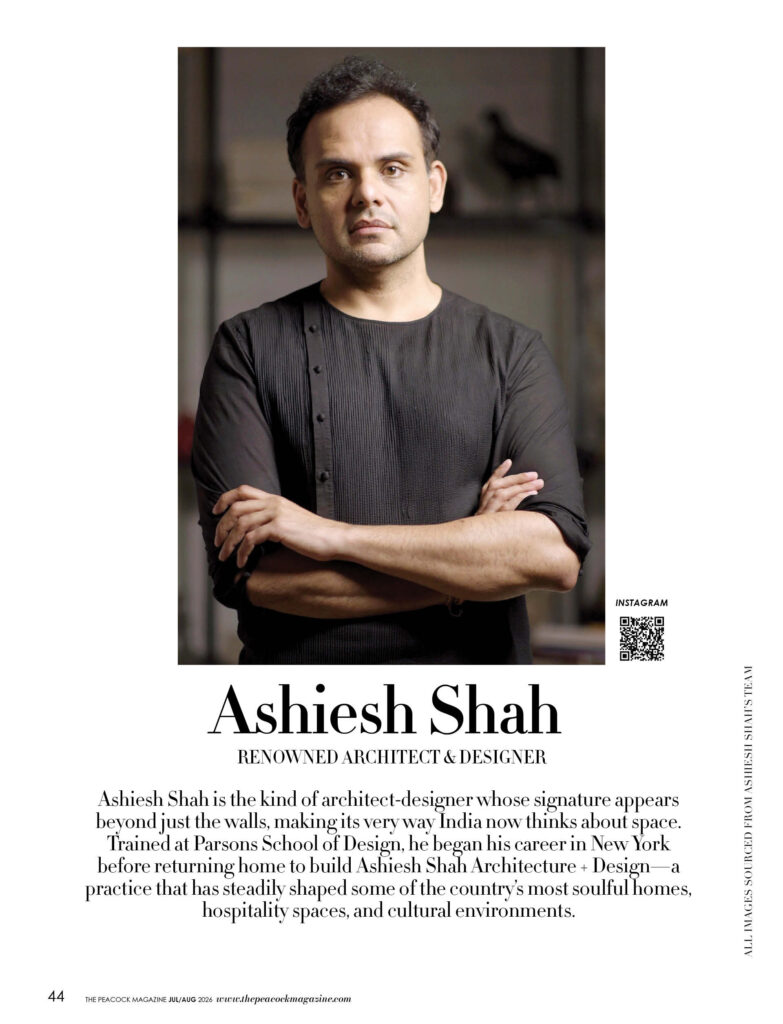
Ashiesh Shah is the kind of architect-designer whose signature appears beyond just the walls, making its very way India now thinks about space. Trained at Parsons School of Design, he began his career in New York before returning home to build Ashiesh Shah Architecture + Design—a practice that has steadily shaped some of the country’s most soulful homes, hospitality spaces, and cultural environments.
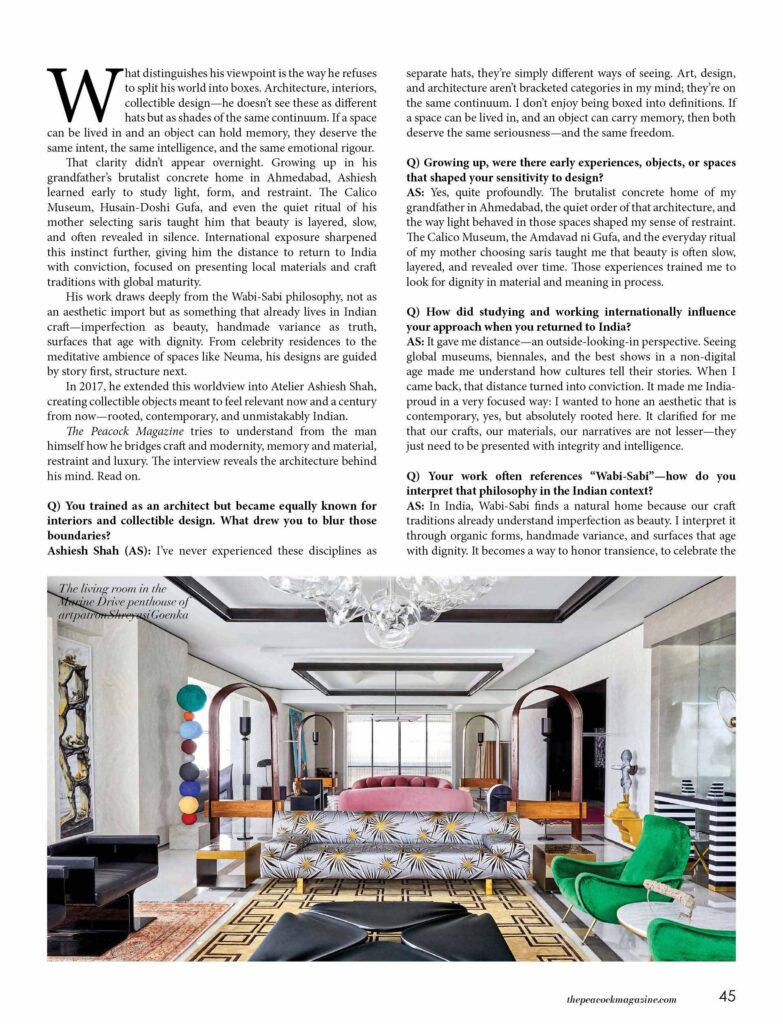
What distinguishes his viewpoint is the way he refuses to split his world into boxes. Architecture, interiors, collectible design—he doesn’t see these as different hats but as shades of the same continuum. If a space can be lived in and an object can hold memory, they deserve the same intent, the same intelligence, and the same emotional rigour.
That clarity didn’t appear overnight. Growing up in his grandfather’s brutalist concrete home in Ahmedabad, Ashiesh learned early to study light, form, and restraint. The Calico Museum, Husain-Doshi Gufa, and even the quiet ritual of his mother selecting saris taught him that beauty is layered, slow, and often revealed in silence. International exposure sharpened this instinct further, giving him the distance to return to India with conviction, focused on presenting local materials and craft traditions with global maturity.
His work draws deeply from the Wabi-Sabi philosophy, not as an aesthetic import but as something that already lives in Indian craft—imperfection as beauty, handmade variance as truth, surfaces that age with dignity. From celebrity residences to the meditative ambience of spaces like Neuma, his designs are guided by story first, structure next.
In 2017, he extended this worldview into Atelier Ashiesh Shah, creating collectible objects meant to feel relevant now and a century from now—rooted, contemporary, and unmistakably Indian.
The Peacock Magazine tries to understand from the man himself how he bridges craft and modernity, memory and material, restraint and luxury. The interview reveals the architecture behind his mind. Read on.
Q) You trained as an architect but became equally known for interiors and collectible design. What drew you to blur those boundaries?
Ashiesh Shah (AS): I’ve never experienced these disciplines as separate hats, they’re simply different ways of seeing. Art, design, and architecture aren’t bracketed categories in my mind; they’re on the same continuum. I don’t enjoy being boxed into definitions. If a space can be lived in, and an object can carry memory, then both deserve the same seriousness—and the same freedom.
Q) Growing up, were there early experiences, objects, or spaces that shaped your sensitivity to design?
AS: Yes, quite profoundly. The brutalist concrete home of my grandfather in Ahmedabad, the quiet order of that architecture, and the way light behaved in those spaces shaped my sense of restraint. The Calico Museum, the Amdavad ni Gufa, and the everyday ritual of my mother choosing saris taught me that beauty is often slow, layered, and revealed over time. Those experiences trained me to look for dignity in material and meaning in process.
Q) How did studying and working internationally influence your approach when you returned to India?
AS: It gave me distance—an outside-looking-in perspective. Seeing global museums, biennales, and the best shows in a non-digital age made me understand how cultures tell their stories. When I came back, that distance turned into conviction. It made me India-proud in a very focused way: I wanted to hone an aesthetic that is contemporary, yes, but absolutely rooted here. It clarified for me that our crafts, our materials, our narratives are not lesser—they just need to be presented with integrity and intelligence.
Q) Your work often references “Wabi-Sabi”—how do you interpret that philosophy in the Indian context?
AS: In India, Wabi-Sabi finds a natural home because our craft traditions already understand imperfection as beauty. I interpret it through organic forms, handmade variance, and surfaces that age with dignity. It becomes a way to honor transience, to celebrate the incomplete and the evolving. In the Indian context, it means letting local processes lead the form, and allowing the hand to remain visible rather than erased.
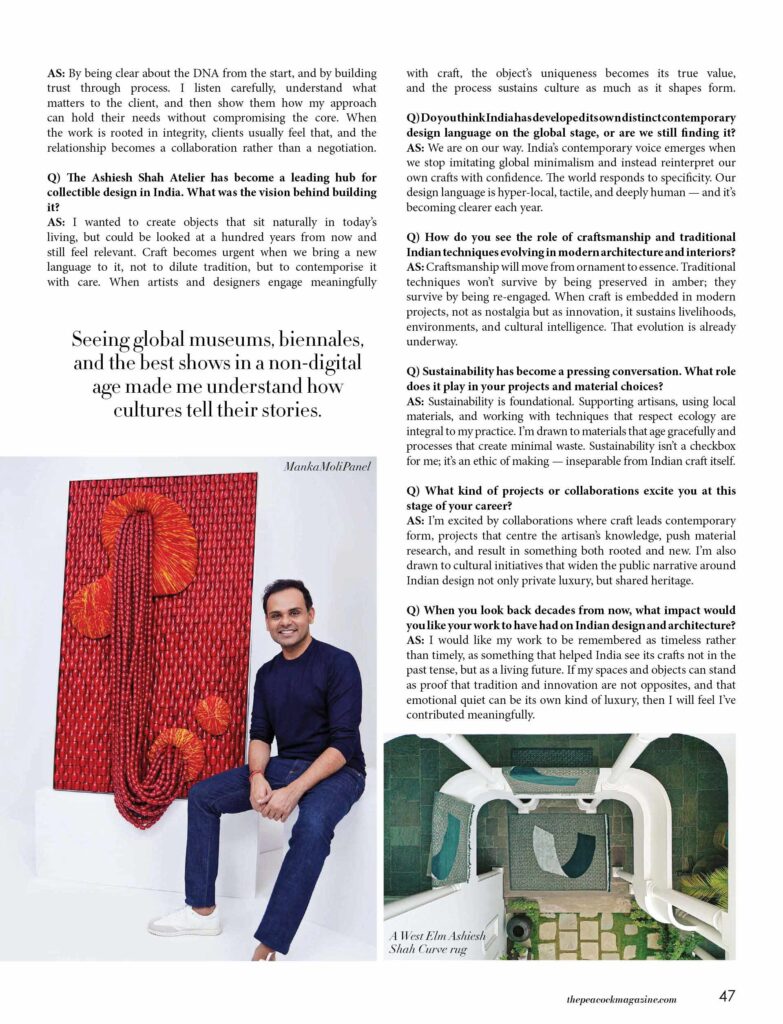
Q) When you walk into a new project, what’s the first thing you look for—the bones of the space, light, or the story it wants to tell? AS: The story. The bones and the light are part of it, but they only become meaningful once you understand what the space wants to be. I try to listen first, to context, to people, to culture, to what already exists. Then the light and structure tell you how to shape that story with restraint.
Q) How do you balance function with aesthetic restraint, especially in luxury spaces where clients often want “more”? AS: Restraint is not the absence of luxury, it’s the presence of clarity. Today, clients understand the artist’s view more than they used to. When someone pushes too hard for “more,” I step back, let it breathe, and revisit the conversation. Time helps. You don’t need to fight a client; you need to bring them along. Often, once the idea settles, they see why less can feel far more powerful.
Q) Which project in your career has felt the most personal or transformative for you?
AS: The (G20 work). It was personal because it wasn’t only about design, it was about representing India, its craft legacy, and its contemporary confidence on a global stage. It pushed the practice to think beyond object and space, into cultural meaning.
Q) You’ve worked with celebrities, collectors, and global brands. How do you navigate client expectations while keeping your design DNA intact?
AS: By being clear about the DNA from the start, and by building trust through process. I listen carefully, understand what matters to the client, and then show them how my approach can hold their needs without compromising the core. When the work is rooted in integrity, clients usually feel that, and the relationship becomes a collaboration rather than a negotiation.
Q) The Ashiesh Shah Atelier has become a leading hub for collectible design in India. What was the vision behind building it?
AS: I wanted to create objects that sit naturally in today’s living, but could be looked at a hundred years from now and still feel relevant. Craft becomes urgent when we bring a new language to it, not to dilute tradition, but to contemporise it with care. When artists and designers engage meaningfully with craft, the object’s uniqueness becomes its true value, and the process sustains culture as much as it shapes form.
Q) Do you think India has developed its own distinct contemporary design language on the global stage, or are we still finding it?
AS: We are on our way. India’s contemporary voice emerges when we stop imitating global minimalism and instead reinterpret our own crafts with confidence. The world responds to specificity. Our design language is hyper-local, tactile, and deeply human — and it’s becoming clearer each year.
Q) How do you see the role of craftsmanship and traditional Indian techniques evolving in modern architecture and interiors? AS: Craftsmanship will move from ornament to essence. Traditional techniques won’t survive by being preserved in amber; they survive by being re-engaged. When craft is embedded in modern projects, not as nostalgia but as innovation, it sustains livelihoods, environments, and cultural intelligence. That evolution is already underway.
Q) Sustainability has become a pressing conversation. What role does it play in your projects and material choices?
AS: Sustainability is foundational. Supporting artisans, using local materials, and working with techniques that respect ecology are integral to my practice. I’m drawn to materials that age gracefully and processes that create minimal waste. Sustainability isn’t a checkbox for me; it’s an ethic of making — inseparable from Indian craft itself.
Q) What kind of projects or collaborations excite you at this stage of your career?
AS: I’m excited by collaborations where craft leads contemporary form, projects that centre the artisan’s knowledge, push material research, and result in something both rooted and new. I’m also drawn to cultural initiatives that widen the public narrative around Indian design not only private luxury, but shared heritage.
Q) When you look back decades from now, what impact would you like your work to have had on Indian design and architecture?
AS: I would like my work to be remembered as timeless rather than timely, as something that helped India see its crafts not in the past tense, but as a living future. If my spaces and objects can stand as proof that tradition and innovation are not opposites, and that emotional quiet can be its own kind of luxury, then I will feel I’ve contributed meaningfully.