
The Peacock Magazine traces the evolution of iconic luxury bags and puts together some of the most sought-after accessories which continue to fly off the shelves even today…
By Manish Mishra
“It’s not a bag… it’s a Birkin.” Any Sex and the City series fan would vouch that this line has been so iconic, it practically recalibrated pop culture. Birkin price points may have gone up astronomically since the series aired and it’s comparatively easy to procure them now yet the obsession for this ageless symbol of unabashed luxe hasn’t faded. When one carries a Birkin, especially one which is limited edition and crafted in an exotic animal skin, one’s making a strong statement – wealth, power, style and status. Let’s circle back to the Season 3 of SATC when a mugger demanded that Carrie give him her bag. ‘It’s not a bag,’ she replies. ‘It’s a Baguette.’ A pop cultural icon was born – and sales exploded.
Sparking off the ‘It bag’ era, Fendi’s value increased, in doing so accelerating its acquisition, in 2001, by LVMH. As one’s on the topic of cult luxury bags, it’s worth mentioning the much talked about first Chanel collection designed by the current artistic director Matthieu Blazy hit stores in March, wreaking a frenzy of purchases by brand loyalists, editors and luxury world insiders. The reimagined 2.55 Handbag had bags aficionados smitten after its runway debut, and the Large Tote also has been in great demand and seen on the likes of Hailey Bieber, Kylie Jenner, and Blackpink’s Jennie. Every season sees a new bag being touted as the next ‘it’ bag but there are some cult bags in luxury history which continue to stay in demand and get reinvented and relaunched in new animal skins, colours and textures. Here’s looking at some epoch-defining luxe bags in fashion history which have had clients like Lady Diana, Jackie Kennedy and Jane Birkin. Read on…
Chanel 2.55
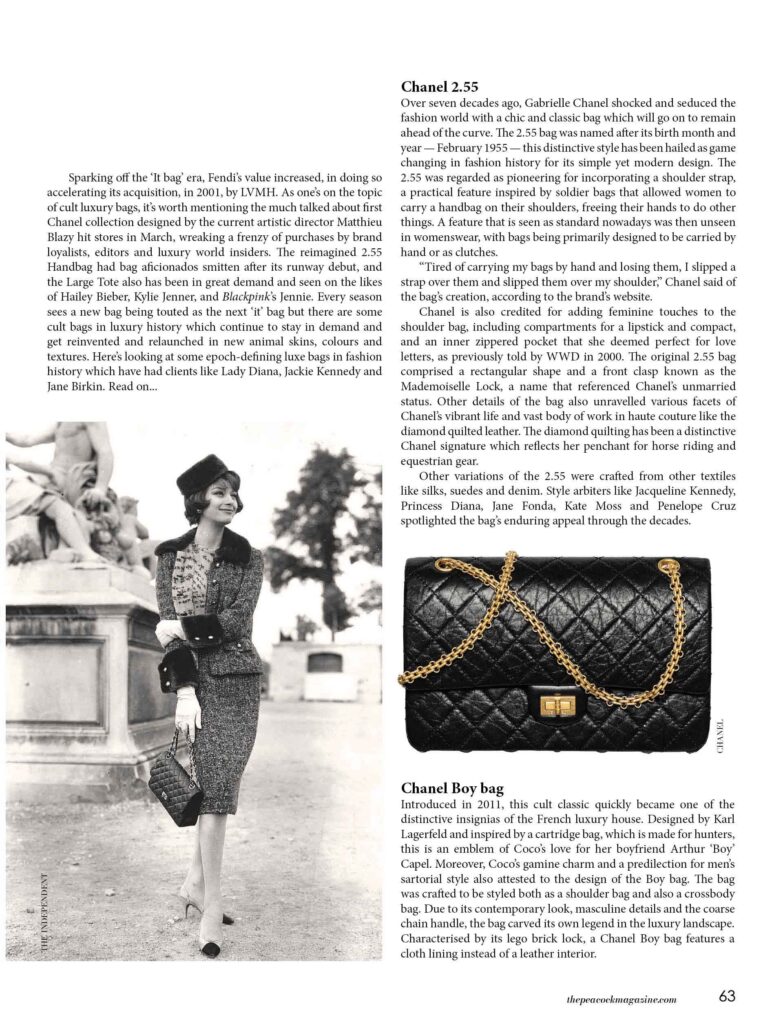
Over seven decades ago, Gabrielle Chanel shocked and seduced the fashion world with a chic and classic bag which will go on to remain ahead of the curve. The 2.55 bag was named after its birth month and year — February 1955 — this distinctive style has been hailed as game changing in fashion history for its simple yet modern design. The 2.55 was regarded as pioneering for incorporating a shoulder strap, a practical feature inspired by soldiers’ bags that allowed women to carry a handbag on their shoulders, freeing their hands to do other things. A feature that is seen as standard nowadays was then unseen in women’s wear, with bags being primarily designed to be carried by hand or as clutches.
“Tired of carrying my bags by hand and losing them, I slipped a strap over them and slipped them over my shoulder,” Chanel said of the bag’s creation, according to the brand’s website.
Chanel is also credited for adding feminine touches to the shoulder bag, including compartments for a lipstick and compact, and an inner zippered pocket that she deemed perfect for love letters, as previously told by WWD in 2000. The original 2.55 bag comprised a rectangular shape and a front clasp known as the Mademoiselle Lock, a name that referenced Chanel’s unmarried status. Other details of the bag also unravelled various facets of Chanel’s vibrant life and vast body of work in haute couture like the diamond quilted leather. The diamond quilting has been a distinctive Chanel signature which reflects her penchant for horse riding and equestrian gear.
Other variations of the 2.55 were crafted from other textiles like silks, suedes and denim. Style arbiters like Jacqueline Kennedy, Princess Diana, Jane Fonda, Kate Moss and Penelope Cruz spotlighted the bag’s enduring appeal through the decades.
Chanel Boy bag
Introduced in 2011, this cult classic quickly became one of the distinctive insignias of the French luxury house. Designed by Karl Lagerfeld and inspired by a cartridge bag, which is made for hunters, this emblem of Coco’s love for her boyfriend Arthur ‘Boy’ Capel. Moreover, Coco’s gamine charm and a predilection for men’s sartorial style also attested to the design of the Boy bag. The bag was crafted to be styled both as a shoulder bag and also a crossbody bag. Due to its contemporary look, masculine details and the coarse chain handle, the bag carved its own legend in the luxury landscape. Characterised by its lego brick lock, a Chanel Boy bag features a cloth lining instead of a leather interior.
Available in three sizes: small, medium and large, the small bag can be used as a purse, the medium size is good for everyday use and the large model is for everyone who likes to carry their life with them. Besides the different sizes, the Boy bag is available in many different materials and colours. Chanel also introduced a Boy collection, reimagining different models with the recognisable logo brick lock, sturdy chains and use of padding on the leather.
Chanel 11.12
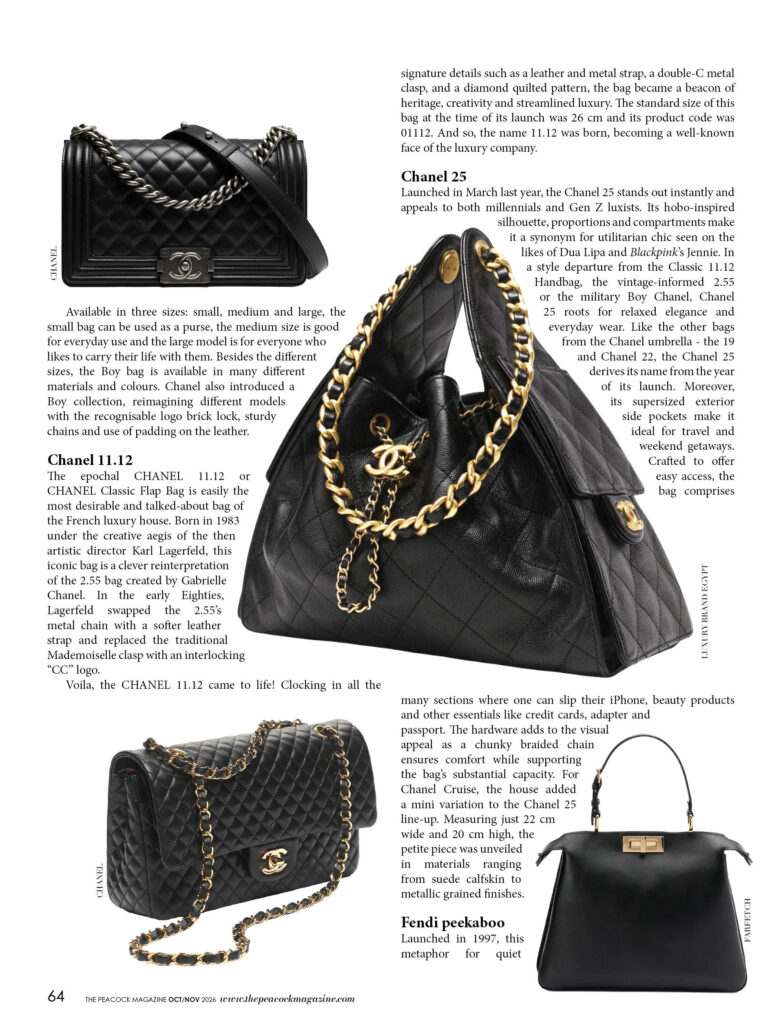
The epochal CHANEL 11.12 or CHANEL Classic Flap Bag is easily the most desirable and talked-about bag line of the French luxury house. Born in 1983 under the creative aegis of the then artistic director Karl Lagerfeld, this iconic bag is a clever reinterpretation of the 2.55 bag created by Gabrielle Chanel. In the early eighties, Lagerfeld swapped the 2.55’s metal chain with a softer leather strap and replaced the traditional Mademoiselle clasp with an interlocking “CC” logo.
Voila, the CHANEL 11.12 came to life! Clocking in all the signature details such as a leather and metal strap, a double-C metal clasp, and a diamond quilted pattern, the bag became a beacon of heritage, creativity and streamlined luxury. The standard size of this bag at the time of its launch was 26 cm and its product code was 01112. And so, the name 11.12 was born, becoming a well-known face of the luxury company.
Chanel 25
Launched in March last year, the Chanel 25 stands out instantly and appeals to both millennials and Gen Z luxists. Its hobo-inspired silhouette, proportions and compartments make it a synonym for utilitarian chic seen on the likes of Dua Lipa and Blackpink’s Jennie. In a style departure from the Classic 11.12 Handbag, the vintage-informed 2.55 or the military Boy Chanel, Chanel 25 roots for relaxed elegance and everyday wear. Like the other bags from Chanel umbrella – the 19 and Chanel 22, the Chanel 25 derives its name from the year of its launch. Moreover, its supersized exterior side pockets make it ideal for travel and weekend getaways. Crafted to offer easy access, the bag comprises many sections where one can slip their iPhone, beauty products and other essentials like credit cards, adapter and passport. The hardware adds to the visual appeal as a chunky braided chain ensures comfort while supporting the bag’s substantial capacity. For Chanel Cruise, the house added a mini variation to the Chanel 25 line-up. Measuring just 22 cm wide and 20 cm high, the petite piece was unveiled in materials ranging from suede calfskin to metallic grained finishes.
Fendi peekaboo
Launched in 1997, this metaphor for quiet luxury from the Fendi dynasty offered a pleasant surprise in an era of unapologetic logo mania and unabashed ‘it’ bag flashing. A rather discreet and practically logo-less option, the bag’s comparatively minimal design entrenched it as a new classic. It first made its presence felt in raw cotton toile, glossy patent leather and perforated suede at Fendi’s spring/summer 2009 show, as the accessory to Karl Lagerfeld’s ready-to-wear collection. The name referred to the traditional children’s game, ‘Peekaboo, I see you’. Initially, the bag was called the ‘Hide and Seek’ but Venturini Fendi felt that Peekaboo was a better fit for the way the interior compartments of the bag are revealed.
The bag’s top handle and trapezium-shaped form offered a thoughtful tribute to mid-century styles but with a contemporary spin. The utilitarian bag redefined stealth chic with its clever construction and weighted keyhole hardware. An easy swivel of the turn lock clasp creates a drape (or ‘smile’) that unfolds a stunningly crafted interior – a contrasting hue, precious material, or, in the case of 2013’s ‘Monster’ Peekaboo, a pair of piercing yellow eyes.
“Carrying a Peekaboo says something about a very strong, powerful and empowered person who is not afraid to hide,” shared Venturini Fendi in an interview. The bag remains popular today and has been launched and relaunched for both men and women in various textiles and colours.
Fendi baguette
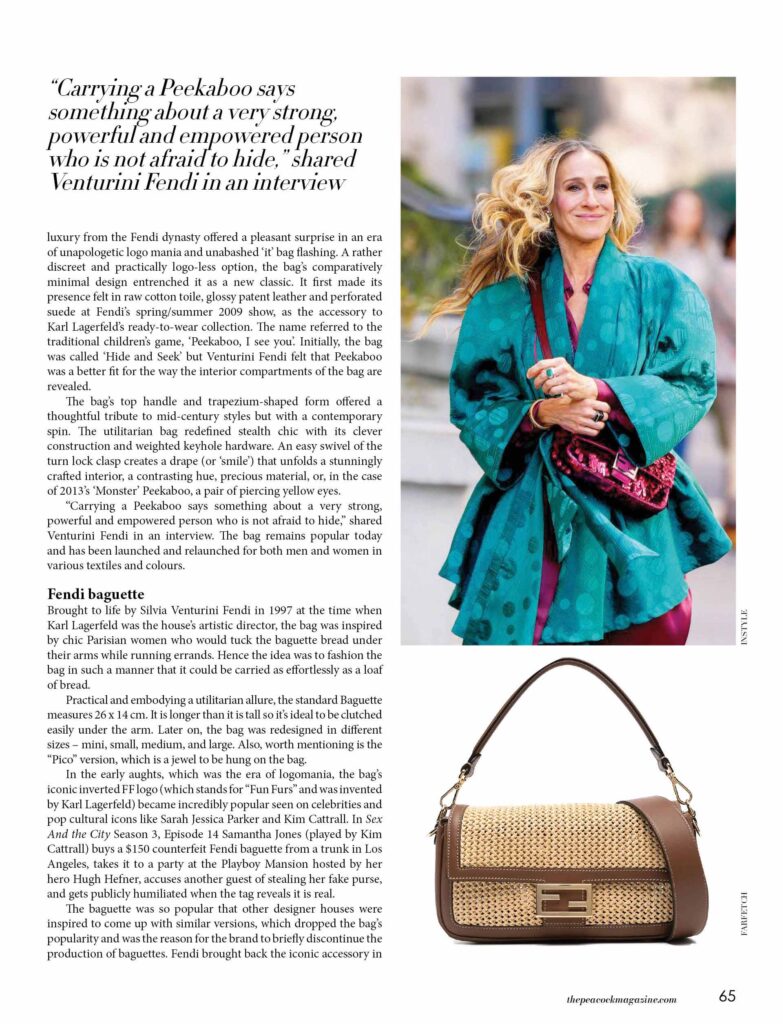
Brought to life by Silvia Venturini Fendi in 1997 at the time when Karl Lagerfeld was the house’s artistic director, the bag was inspired by chic Parisian women who would tuck the baguette bread under their arms while running errands. Hence the idea was to fashion the bag in such a manner that it could be carried as effortlessly as a loaf of bread.
Practical and embodying a utilitarian allure, the standard Baguette measures 26 x 14 centimetres. It is longer than it is tall so it’s ideal to be clutched easily under the arm. Later on, the bag has been redesigned into different sizes – mini, small, medium, and large. Also, worth mentioning is the “Pico” version, which is a jewel to be hung on the bag.
The early aughts, which was the era of logomania, the bag’s iconic inverted FF logo (which stands for “Fun Furs” and was invented by Karl Lagerfeld) became incredibly popular seen on celebrities and pop cultural icons like Sarah Jessica Parker and Kim Catrall. In Sex And the City Season 3, Episode 14 Samantha Jones (played by Kim Cattrall) buys a $150 counterfeit Fendi baguette from a trunk in Los Angeles, takes it to a party at the Playboy Mansion hosted by her hero Hugh Hefner, accuses another guest of stealing her fake purse, and gets publicly humiliated when the tag reveals it is real.
The baguette was so popular that other designer houses were inspired to come up with similar versions, which dropped the bag’s popularity and was the reason for the brand to briefly discontinue the production of Baguettes. Fendi brought back the iconic accessory in 2019 with a campaign entitled #BaguetteFriendsForever, a series of three short movies that recount the urban adventures of best friends, featuring the iconic Baguette bag.
Gucci Diana
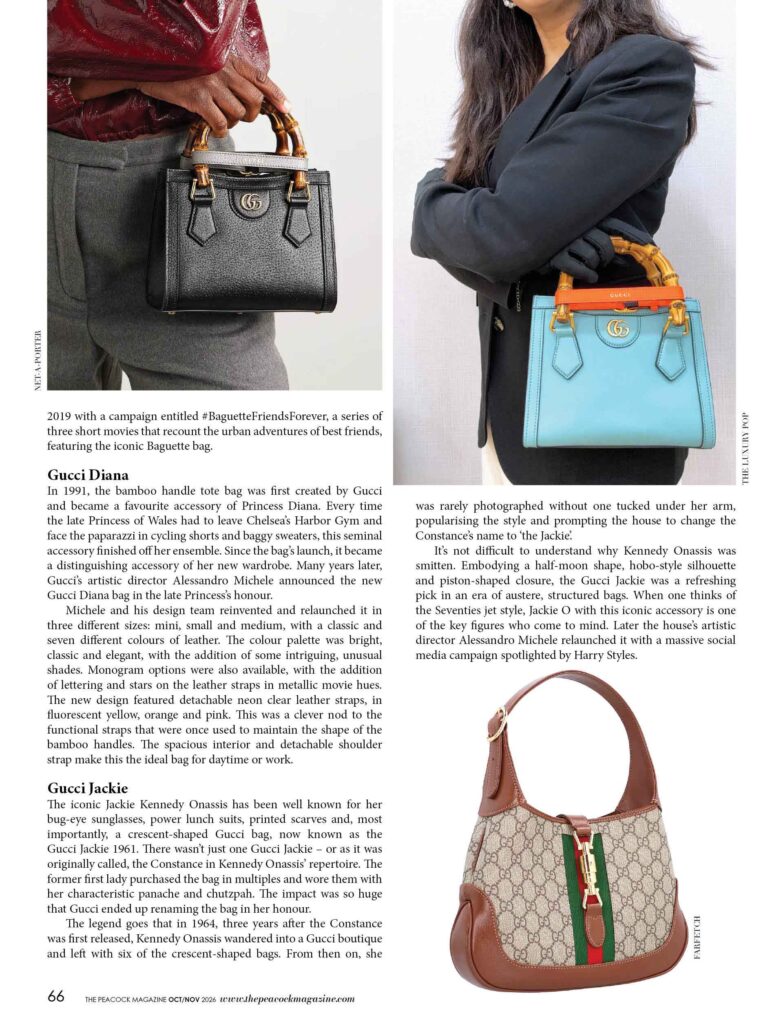
In 1991, the bamboo handle tote bag was first created by the fashion house and became a favourite accessory of Princess Diana. Every time the late Princess of Wales had to leave Chelsea’s Harbor Gym and face the paparazzi in cycling shorts and baggy sweaters, this seminal accessory finished off her ensemble. Since the bag’s launch, it became a distinguishing accessory of her new wardrobe. Many years later, Gucci’s artistic director Alessandro Michele announced the new Gucci Diana bag in the late Princess’s honour.
Michele and his design team reinvented it and relaunched in three different sizes: mini, small and medium, with a classic and seven different colours of leather. The colour palette was bright, classic and elegant, with the addition of some intriguing, unusual shades. Monogram options were also available, with the addition of lettering and stars on the leather straps in metallic movie hues. The new design featured detachable neon clear leather straps, in fluorescent yellow, orange and pink. This was a clever nod to the functional straps that were once used to maintain the shape of the bamboo handles. The spacious interior and detachable shoulder strap make this the ideal bag for daytime or work.
Gucci Jackie
The iconic Jackie Kennedy Onassis has been well known for her bug-eye sunglasses, power lunch suits, printed scarves and, most importantly, a crescent-shaped Gucci bag, now known as the Gucci Jackie 1961. There wasn’t just one Gucci Jackie – or as it was originally called, the Constance – in Kennedy Onassis’ repertoire. The former first lady purchased the bag in multiples and wore them with her characteristic panache and chutzpah. The impact was so huge that Gucci ended up renaming the bag in her honour.
The legend goes that in 1964, three years after the Constance was first released, Kennedy Onassis wandered into a Gucci boutique and left with six of the crescent-shaped bags. From then on, she was rarely photographed without one tucked under her arm, popularising the style and prompting the house to change the Constance’s name to ‘the Jackie’.
It’s not difficult to understand why Kennedy Onassis was smitten. Embodying a half-moon shape, hobo-style silhouette and piston-shaped closure, the Gucci Jackie was a refreshing pick in an era of austere, structured bags. When one thinks of seventies jet style, Jackie O with this iconic accessory is one of the key figures who come to mind. Later the house’s artistic director Alessandro Michele relaunched it with a massive social media campaign spotlighted by Harry Styles.
Lady Dior
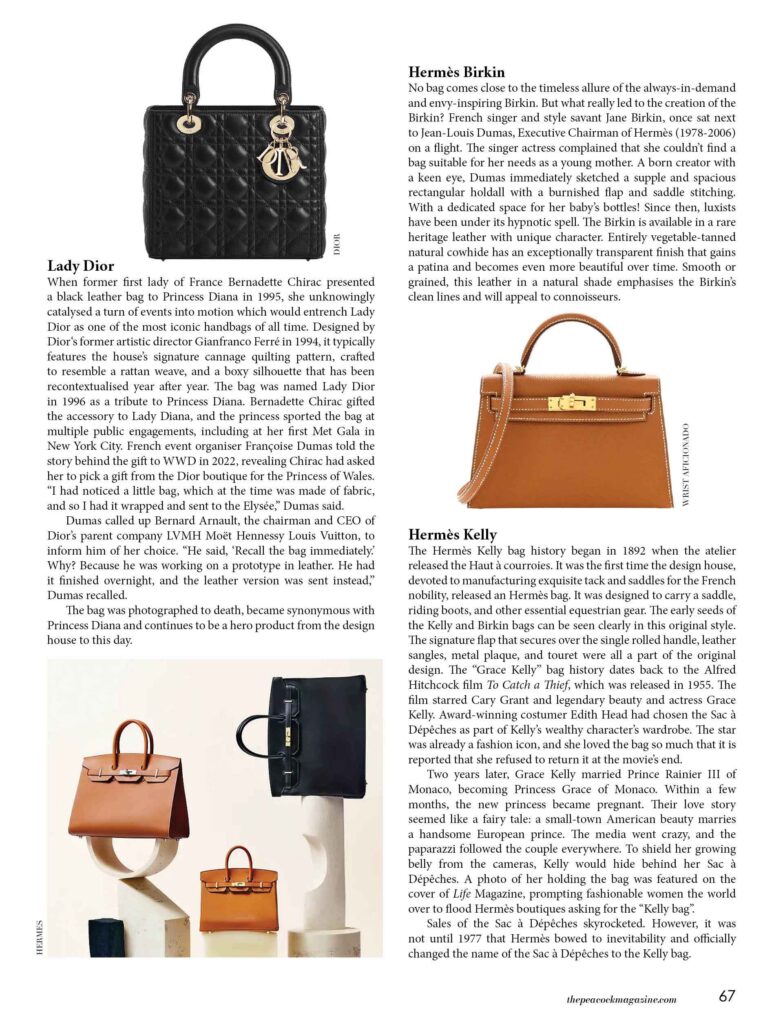
When former first lady of France Bernadette Chirac presented a black leather bag to Princess Diana in 1995, she unknowingly catalysed a turn of events into motion which will entrench Lady Dior as one of the most iconic handbags of all time. Designed by Dior‘s former artistic director Gianfranco Ferré in 1994, it typically features the house’s signature cannage quilting pattern, crafted to resemble a rattan weave, and a boxy silhouette that has been recontextualised year after year. The bag was named Lady Dior in 1996 as a tribute to Princess Diana. Bernadette Chirac gifted the accessory to Lady Diana, and the royal sported the bag at multiple public engagements, including at her first Met Gala in New York City. French event organiser Françoise Dumas told the story behind the gift to WWD in 2022, revealing Chirac had asked her to pick a gift from the Dior boutique for the Princess of Wales. “I had noticed a little bag, which at the time was made of fabric, and so I had it wrapped and sent to the Elysée,” Dumas said.
Dumas called up Bernard Arnault, the chairman and CEO of Dior’s parent company LVMH Moët Hennessy Louis Vuitton, to inform him of her choice. “He said, ‘Recall the bag immediately.’ Why? Because he was working on a prototype in leather. He had it finished overnight, and the leather version was sent instead,” Dumas recalled.
The bag was photographed to death, became synonymous with Princess Diana and continues to be a hero product from the design house to this day.
Hermès Birkin
No bag comes close to the timeless allure of the always-in-demand and envy-inspiring Birkin. But what really led to the creation of the Birkin? French singer and style savant Jane Birkin, once sat next to Jean-Louis Dumas, Executive Chairman of Hermès (1978-2006) on a flight. The singer actress complained that she couldn’t find a bag suitable for her needs as a young mother. A born creator with a keen eye, Dumas immediately sketched a supple and spacious rectangular holdall with a burnished flap and saddle stitching. With a dedicated space for her baby’s bottles! Since then, luxists have been under its hypnotic spell. The Birkin is available in a rare heritage leather with unique character. Entirely vegetable-tanned natural cowhide has an exceptionally transparent finish that gains a patina and becomes even more beautiful over time. Smooth or grained, this leather in a natural shade emphasises the Birkin’s clean lines and will appeal to connoisseurs.
Hermès Kelly
The Hermès Kelly bag history began in 1892 when the atelier released the Haut à courroies. It was the first time the design house, devoted to manufacturing exquisite tack and saddles for the French nobility, released an Hermès bag. It was designed to carry a saddle, riding boots, and other essential equestrian gear. The early seeds of the Kelly and Birkin bags can be seen clearly in this original style. The signature flap that secures over the single rolled handle, leather sangles, metal plaque, and touret were all a part of the original design. The “Grace Kelly” bag history dates back to the Alfred Hitchcock film To Catch a Thief, which was released in 1955. The film starred Cary Grant and legendary beauty and actress Grace Kelly. Award-winning costumer Edith Head had chosen the Sac à Dépêches as part of Kelly’s wealthy character’s wardrobe. The star was already a fashion icon, and she loved the bag so much that it is reported that she refused to return it at the movie’s end.
Two years later, Grace Kelly married Prince Rainier III of Monaco, becoming Princess Grace of Monaco. Within a few months, the new princess became pregnant. Their love story seemed like a fairy tale: a small-town American beauty marries a handsome European prince. The media went crazy, and the paparazzi followed the couple everywhere. To shield her growing belly from the cameras, Kelly would hide behind her Sac à Dépêches. A photo of her holding the bag was featured on the cover of Life Magazine, prompting fashionable women the world over to flood Hermès boutiques asking for the “Kelly bag.”
Sales of the Sac à Dépêches skyrocketed. However, it was not until 1977 that Hermès bowed to inevitability and officially changed the name of the Sac à Dépêches to the Kelly bag.