
Once synonymous with power, status, and identity, men’s baubles are making a comeback, embodying a new-age masculinity.
By Manish Mishra
India has always been a treasure trove of precious stones, and Indian men have traditionally been sartorial peacocks who never shied away from sporting exquisite jewellery. Masculine jewellery in ancient times played a key role in society and conveyed a lot about a culture’s core values and heritage.
Moreover, jewellery has always symbolised the wearer’s role in their society’s social, political and economic structure. During the 17th century, Emperor Jahangir, an avid jewellery collector, is said to have owned more than five million carats of rough diamonds. A Flemish stone dealer even stated that he possessed more jewellery than all the European monarchs combined. In fact, India is believed to be the first to identify and mine diamonds in the world from Antiquity until the 18th century.
Among the many stones of the Maharajas, the Golconda diamonds have been the most noteworthy. It was in the 19th and during the first half of the 20th century that the Maharajas’ taste for high jewellery came to the forefront. In 1905, Maharaja Jagatjit Singh of Kapurthala visited the acclaimed Parisian jeweller Mellerio dits Meller and acquired an articulated peacock in enamel entirely set with rose-cut diamonds. In 1927, Maharaja Jagatjit Singh commissioned an exceptional turban crown with his own emerald collection from the legendary house of Cartier. It is courtesy of this very unique creation that many Maharajas decided to entrust their jewels to the houses of the Place Vendôme in Paris.
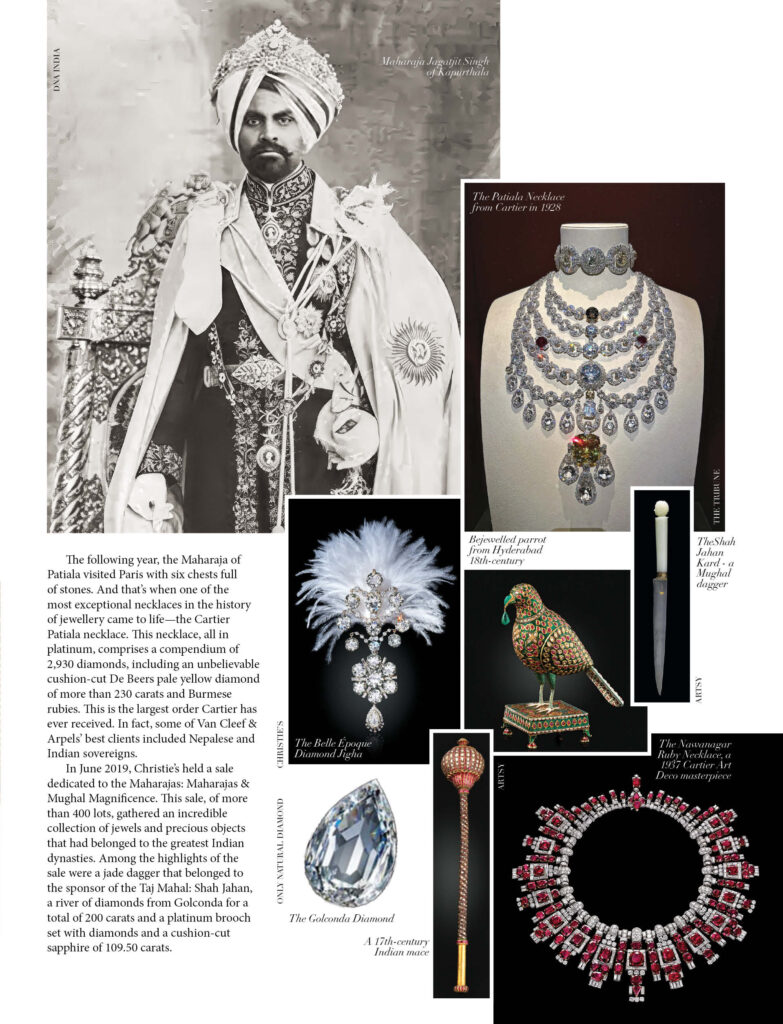
The following year, the Maharaja of Patiala visited Paris with six chests full of stones. And that’s when one of the most exceptional necklaces in the history of jewellery came to life—the Cartier Patiala necklace. This necklace, all in platinum, comprises a compendium of 2,930 diamonds, including an unbelievable cushion-cut De Beers pale yellow diamond of more than 230 carats and Burmese rubies. This is the largest order Cartier has ever received. In fact, some of Van Cleef & Arpels’ best clients included Nepalese and Indian sovereigns.
In June 2019, Christie’s held a sale dedicated to the Maharajas: Maharajas & Mughal Magnificence. This sale, of more than 400 lots, gathered an incredible collection of jewels and precious objects that had belonged to the greatest Indian dynasties. Among the highlights of the sale were a jade dagger that belonged to the sponsor of the Taj Mahal: Shah Jahan, a river of diamonds from Golconda for a total of 200 carats and a platinum brooch set with diamonds and a cushion-cut sapphire of 109.50 carats.
Besides India, other cultures have also celebrated men’s jewellery. In ancient Egypt, pharaohs adorned themselves with intricate gold and precious stone jewellery, which symbolised their divine authority and preeminent status. In ancient Rome, military commanders and officials were rarely seen without gold signet rings, which were used to stamp important documents, indicating their rank and importance. In ancient Greece, jewellery was synonymous with warriors and athletes as a beacon of victory and achievement.
The cultural meaning of masculine jewellery back then went way beyond mere aesthetics. It was steeped in symbolism and also had practical purposes. It even served as a form of currency, religious symbolism and protective talismans. In fact, donning jewellery was also a mark of masculinity, with men adorning themselves with symbols of strength and power.
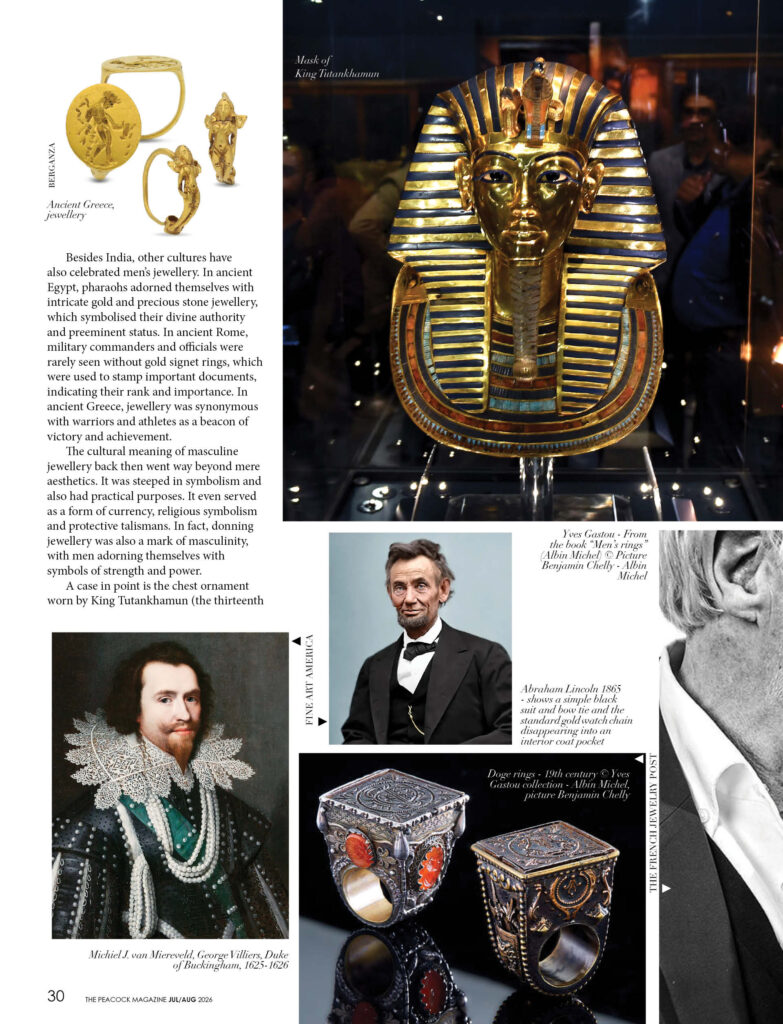
A case in point is the chest ornament worn by King Tutankhamun (the thirteenth) pharaoh of the Eighteenth Dynasty of ancient Egypt, who ruled (1333 – 1323 BC), for important ceremonial occasions, such as his coronation. Not only did this astonishing piece of jewellery baffle all the archaeologists during the tomb’s famous 1922 excavation, but it also continues to fascinate modern admirers. Male members of Royal families regularly sported ornate gemstone and diamond pins on their lapels, hats, belts and coats. From collars to earrings to hats, the noteworthy men of the Renaissance approached their ensembles with both creativity and importance.
In the 19th century, the Industrial Revolution led to the mass production of jewellery, making it more approachable to a diverse range of jewellery enthusiasts. As the price barrier between jewellery goods began to diminish, along with the slow rise of a middle class, men began to wear more modest and understated jewellery, such as cufflinks, tie pins and pocket watches, as a sign of their social status and refinement.
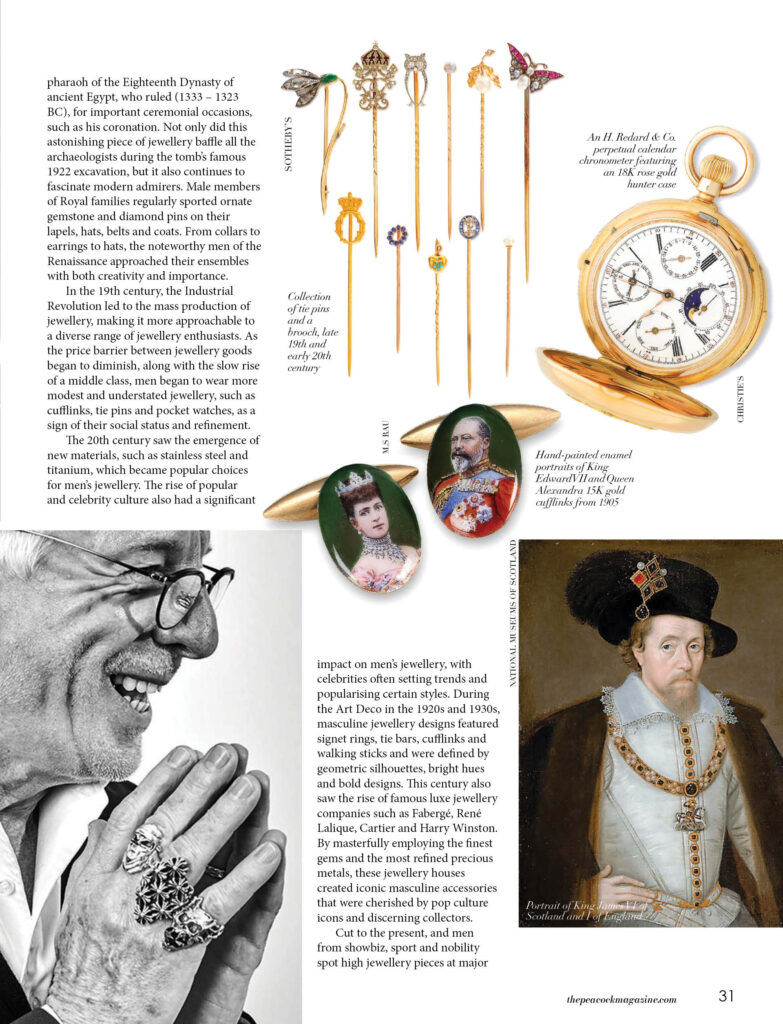
The 20th century saw the emergence of new materials, such as stainless steel and titanium, which became popular choices for men’s jewellery. The rise of popular and celebrity culture also had a significant impact on men’s jewellery, with celebrities often setting trends and popularising certain styles. During the Art Deco in the 1920s and 1930s, masculine jewellery designs featured signet rings, tie bars, cufflinks and walking sticks and were defined by geometric silhouettes, bright hues and bold designs. This century also saw the rise of famous luxe jewellery companies such as Fabergé, René Lalique, Cartier and Harry Winston. By masterfully employing the finest gems and the most refined precious metals, these jewellery houses created iconic masculine accessories that were cherished by pop culture icons and discerning collectors.
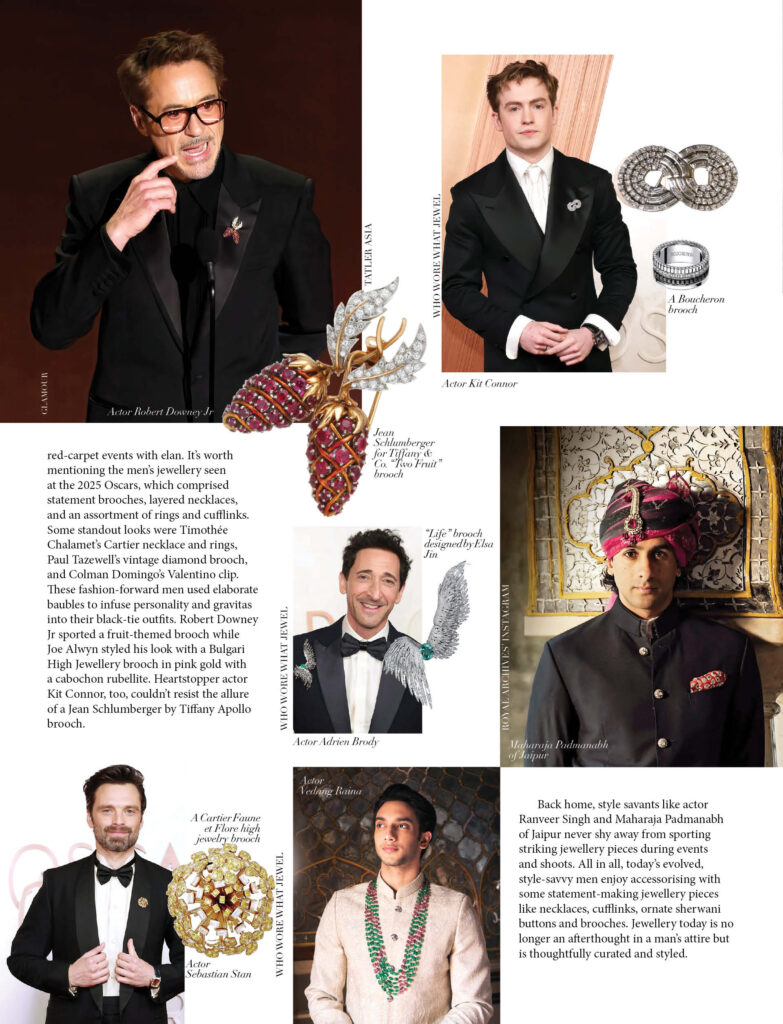
Cut to the present, and men from showbiz, sport and nobility spot high jewellery pieces at major red-carpet events with elan. It’s worth mentioning the men’s jewellery seen at the 2025 Oscars, which comprised statement brooches, layered necklaces, and an assortment of rings and cufflinks. Some standout looks were Timothée Chalamet’s Cartier necklace and rings, Paul Tazewell’s vintage diamond brooch, and Colman Domingo’s Valentino clip. These fashion-forward men used elaborate baubles to infuse personality and gravitas into their black-tie outfits. Robert Downey Jr sported a fruit-themed brooch while Joe Alwyn styled his look with a Bulgari High Jewellery brooch in pink gold with a cabochon rubellite. Heartstopper actor Kit Connor, too, couldn’t resist the allure of a Jean Schlumberger by Tiffany Apollo brooch.
Back home, style savants like actor Ranveer Singh and Maharaja Padmanabh of Jaipur never shy away from sporting striking jewellery pieces during events and shoots. All in all, today’s evolved, style-savvy men enjoy accessorising with some statement-making jewellery pieces like necklaces, cufflinks, ornate sherwani buttons and brooches. Jewellery today is no longer an afterthought in a man’s attire but is thoughtfully curated and styled.
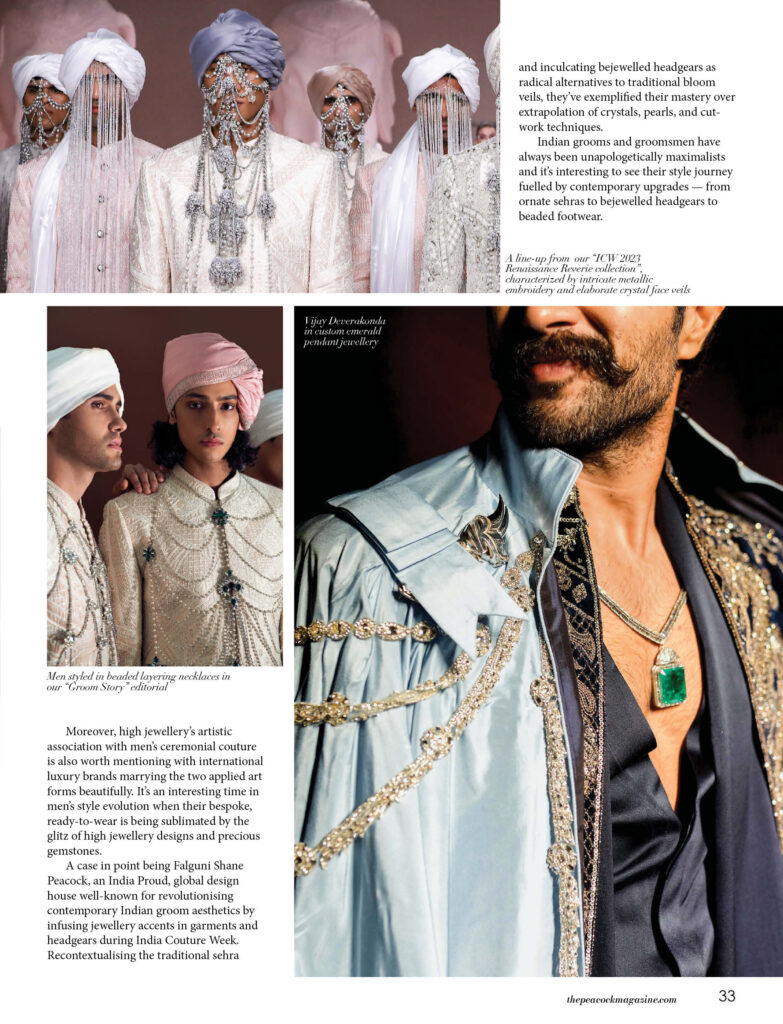
Moreover, high jewellery’s artistic association with men’s ceremonial couture is also worth mentioning with international luxury brands marrying the two applied art forms beautifully. It’s an interesting time in men’s style evolution when their bespoke, ready-to-wear is being sublimated by the glitz of high jewellery designs and precious gemstones.
A case in point being Falguni Shane Peacock, an India Proud, global design house well-known for revolutionising contemporary Indian groom aesthetics by infusing jewellery accents in garments and headgears during India Couture Week.
Recontextualising the traditional sehra and inculcating bejewelled headgears as radical alternatives to traditional bloom veils, they’ve exemplified their mastery over extrapolation of crystals, pearls, and cut-work techniques. Indian grooms and groomsmen have always been unapologetically maximalists and it’s interesting to see their style journey fuelled by contemporary upgrades — from ornate sehras to bejewelled headgears to beaded footwear.