
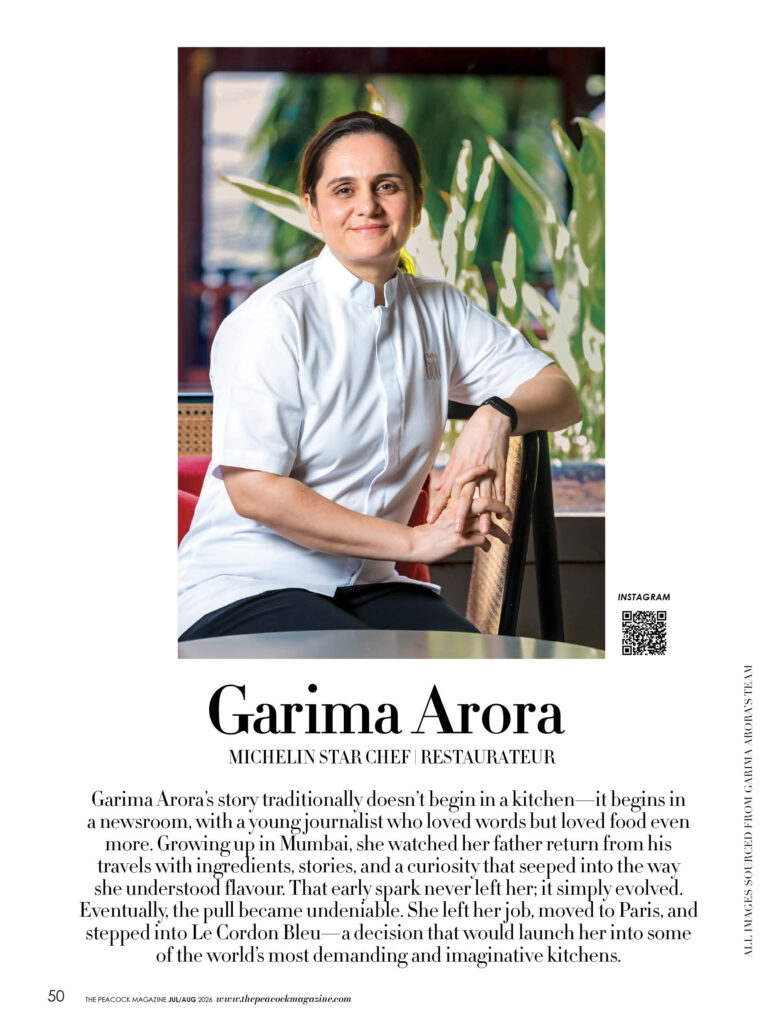
Garima Arora’s path to becoming one of the world’s most celebrated chefs did not begin in a professional kitchen. Before pursuing a culinary career, she worked as a journalist, where storytelling was her profession. Raised in Mumbai, she developed a deep appreciation for food through her father, who often returned from his travels with unique ingredients, new flavours, and stories from different cultures. Those experiences sparked a lasting curiosity about cooking and global cuisines. As her passion for food grew stronger, she decided to change careers, moving to Paris to study at Le Cordon Bleu. That bold step marked the beginning of a remarkable journey through some of the world’s most prestigious and innovative kitchens.
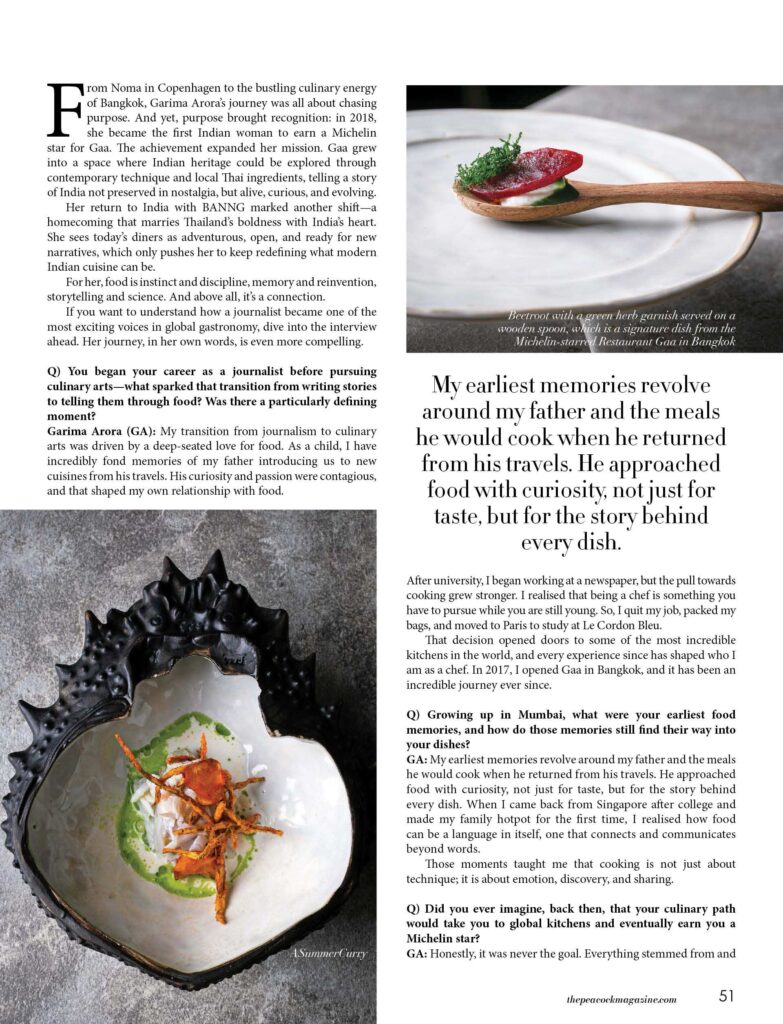
From Noma in Copenhagen to the bustling culinary energy of Bangkok, Garima Arora’s journey was all about chasing purpose. And yet, purpose brought recognition: in 2018, she became the first Indian woman to earn a Michelin star for Gaa. The achievement expanded her mission. Gaa grew into a space where Indian heritage could be explored through contemporary technique and local Thai ingredients, telling a story of India not preserved in nostalgia, but alive, curious, and evolving.
Her return to India with BANNG marked another shift—a homecoming that marries Thailand’s boldness with India’s heart. She sees today’s diners as adventurous, open, and ready for new narratives, which only pushes her to keep redefining what modern Indian cuisine can be.
For her, food is instinct and discipline, memory and reinvention, storytelling and science. And above all, it’s a connection.
If you want to understand how a journalist became one of the most exciting voices in global gastronomy, dive into the interview ahead. Her journey, in her own words, is even more compelling.
Q) You began your career as a journalist before pursuing culinary arts—what sparked that transition from writing stories to telling them through food? Was there a particularly defining moment?
Garima Arora (GA): My transition from journalism to culinary arts was driven by a deep-seated love for food. As a child, I have incredibly fond memories of my father introducing us to new cuisines from his travels. His curiosity and passion were contagious, and that shaped my own relationship with food.
After university, I began working at a newspaper, but the pull towards cooking grew stronger. I realised that being a chef is something you have to pursue while you are still young. So, I quit my job, packed my bags, and moved to Paris to study at Le Cordon Bleu.
That decision opened doors to some of the most incredible kitchens in the world, and every experience since has shaped who I am as a chef. In 2017, I opened Gaa in Bangkok, and it has been an incredible journey ever since.
Q) Growing up in Mumbai, what were your earliest food memories, and how do those memories still find their way into your dishes?
GA: My earliest memories revolve around my father and the meals he would cook when he returned from his travels. He approached food with curiosity, not just for taste, but for the story behind every dish. When I came back from Singapore after college and made my family hotpot for the first time, I realised how food can be a language in itself, one that connects and communicates beyond words.
Those moments taught me that cooking is not just about technique; it is about emotion, discovery, and sharing.
Q) Did you ever imagine, back then, that your culinary path would take you to global kitchens and eventually earn you a Michelin star?
GA: Honestly, it was never the goal. Everything stemmed from and Working at Noma was transformative. I watched chefs create extraordinary dishes from limited ingredients, which taught me that the food is always bigger than the chef. was a result of pure passion. I didn’t go into this with the accolades or recognition in mind. I just wanted to share my food with others, just as my dad did with us.
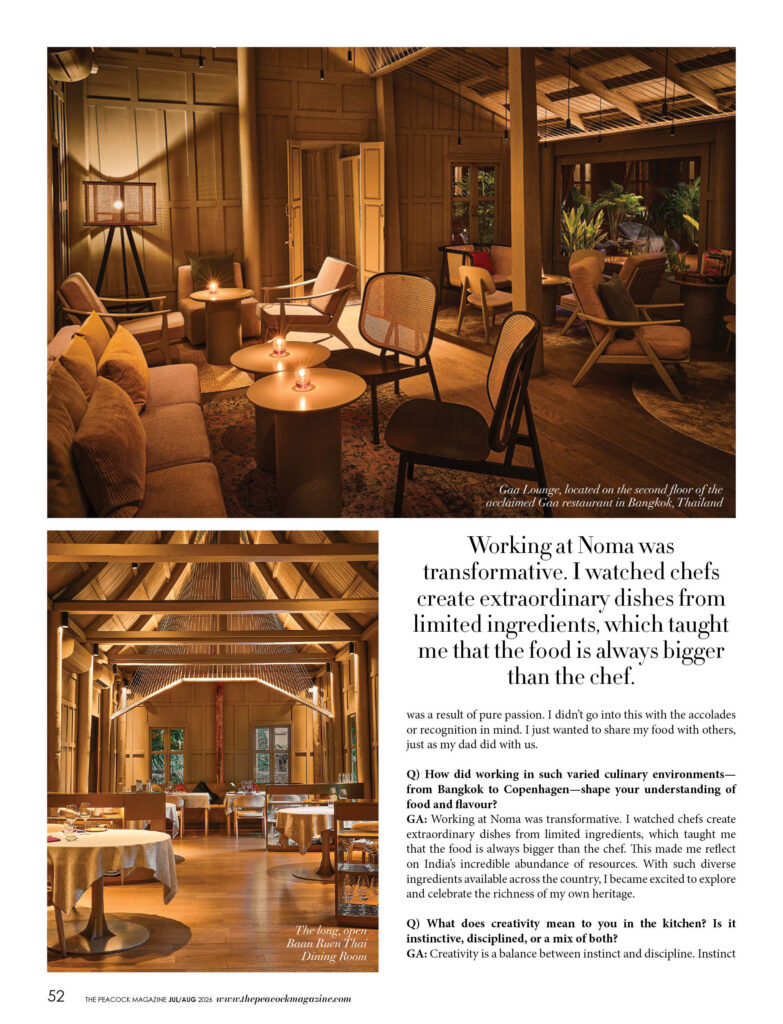
Q) How did working in such varied culinary environments—from Bangkok to Copenhagen—shape your understanding of food and flavour?
GA: Working at Noma was transformative. I watched chefs create extraordinary dishes from limited ingredients, which taught me that the food is always bigger than the chef. This made me reflect on India’s incredible abundance of resources. With such diverse ingredients available across the country, I became excited to explore and celebrate the richness of my own heritage.
Q) What does creativity mean to you in the kitchen? Is it instinctive, disciplined, or a mix of both?
GA: Creativity is a balance between instinct and discipline. Instinct helps you explore, while discipline ensures you do it with precision. It is that tension between freedom and control that keeps the kitchen alive and the food meaningful.
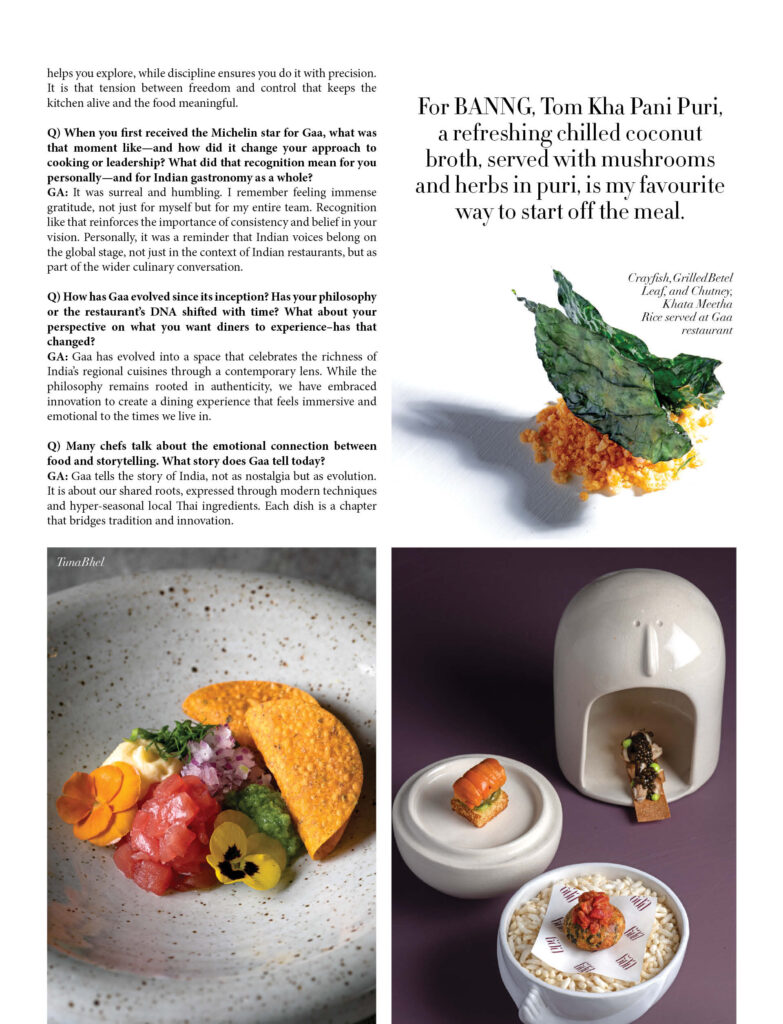
Q) When you first received the Michelin star for Gaa, what was that moment like—and how did it change your approach to cooking or leadership? What did that recognition mean for you personally—and for Indian gastronomy as a whole?
GA: It was surreal and humbling. I remember feeling immense gratitude, not just for myself but for my entire team. Recognition like that reinforces the importance of consistency and belief in your vision. Personally, it was a reminder that Indian voices belong on the global stage, not just in the context of Indian restaurants, but as part of the wider culinary conversation.
Q) How has Gaa evolved since its inception? Has your philosophy or the restaurant’s DNA shifted with time? What about your perspective on what you want diners to experience–has that changed?
GA: Gaa has evolved into a space that celebrates the richness of India’s regional cuisines through a contemporary lens. While the philosophy remains rooted in authenticity, we have embraced innovation to create a dining experience that feels immersive and emotional to the times we live in.
Q) Many chefs talk about the emotional connection between food and storytelling. What story does Gaa tell today?
GA: Gaa tells the story of India, not as nostalgia but as evolution. It is about our shared roots, expressed through modern techniques and hyper-seasonal local Thai ingredients. Each dish is a chapter that bridges tradition and innovation.
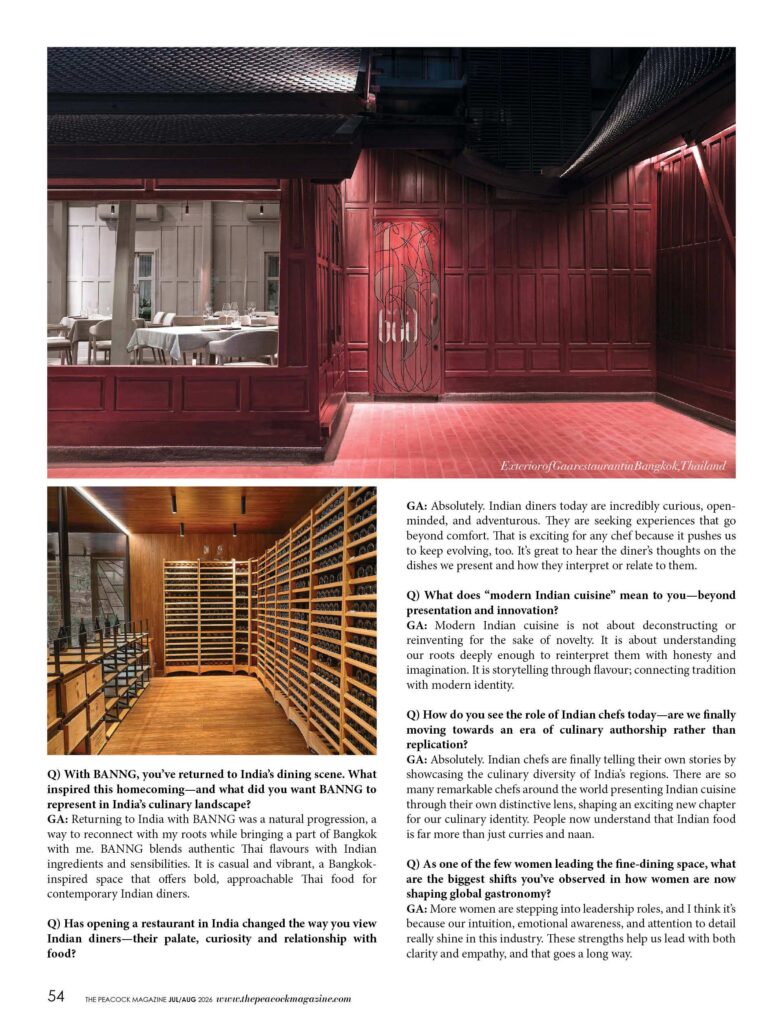
Q) With BANNG, you’ve returned to India’s dining scene. What inspired this homecoming—and what did you want BANNG to represent in India’s culinary landscape?
GA: Returning to India with BANNG was a natural progression, a way to reconnect with my roots while bringing a part of Bangkok with me. BANNG blends authentic Thai flavours with Indian ingredients and sensibilities. It is casual and vibrant, a Bangkok-inspired space that offers bold, approachable Thai food for contemporary Indian diners.
Q) Has opening a restaurant in India changed the way you view Indian diners—their palate, curiosity and relationship with food?
GA: Absolutely. Indian diners today are incredibly curious, open-minded, and adventurous. They are seeking experiences that go beyond comfort. That is exciting for any chef because it pushes us to keep evolving, too. It’s great to hear the diner’s thoughts on the dishes we present and how they interpret or relate to them.
Q) What does “modern Indian cuisine” mean to you—beyond
GA: Modern Indian cuisine is not about deconstructing or reinventing for the sake of novelty. It is about understanding our roots deeply enough to reinterpret them with honesty and imagination. It is storytelling through flavour; connecting tradition with modern identity.
Q) How do you see the role of Indian chefs today—are we finally moving towards an era of culinary authorship rather than replication?
GA: Absolutely. Indian chefs are finally telling their own stories by showcasing the culinary diversity of India’s regions. There are so many remarkable chefs around the world presenting Indian cuisine through their own distinctive lens, shaping an exciting new chapter for our culinary identity. People now understand that Indian food is far more than just curries and naan.
Q) As one of the few women leading the fine-dining space, what are the biggest shifts you’ve observed in how women are now shaping global gastronomy?
GA: More women are stepping into leadership roles, and I think it’s because our intuition, emotional awareness, and attention to detail really shine in this industry. These strengths help us lead with both clarity and empathy, and that goes a long way.
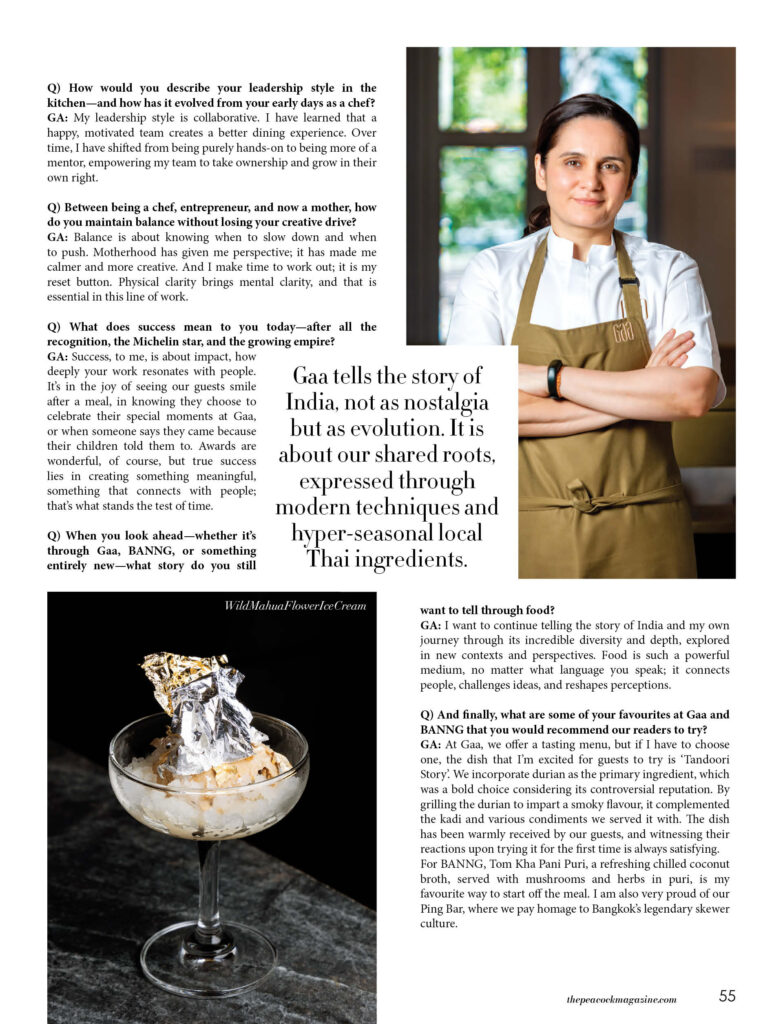
Q) How would you describe your leadership style in the kitchen—and how has it evolved from your early days as a chef?
GA: My leadership style is collaborative. I have learned that a happy, motivated team creates a better dining experience. Over time, I have shifted from being purely hands-on to being more of a mentor, empowering my team to take ownership and grow in their own right.
Q) Between being a chef, entrepreneur, and now a mother, how do you maintain balance without losing your creative drive?
GA: Balance is about knowing when to slow down and when to push. Motherhood has given me perspective; it has made me calmer and more creative. And I make time to work out; it is my reset button. Physical clarity brings mental clarity, and that is essential in this line of work.
Q) What does success mean to you today—after all the recognition, the Michelin star, and the growing empire?
GA: Success, to me, is about impact, how deeply your work resonates with people. It’s in the joy of seeing our guests smile after a meal, in knowing they choose to celebrate their special moments at Gaa, or when someone says they came because their children told them to. Awards are wonderful, of course, but true success lies in creating something meaningful, something that connects with people; that’s what stands the test of time.
Q) When you look ahead—whether it’s through Gaa, BANNG, or something entirely new—what story do you still want to tell through food?
GA: I want to continue telling the story of India and my own journey through its incredible diversity and depth, explored in new contexts and perspectives. Food is such a powerful medium, no matter what language you speak; it connects people, challenges ideas, and reshapes perceptions.
Q) And finally, what are some of your favourites at Gaa and BANNG that you would recommend our readers to try?
GA: At Gaa, we offer a tasting menu, but if I have to choose one, the dish that I’m excited for guests to try is ‘Tandoori Story’.
We incorporate durian as the primary ingredient, which was a bold choice considering its controversial reputation. By grilling the durian to impart a smoky flavour, it complemented the kadi and various condiments we served it with.
The dish has been warmly received by our guests, and witnessing their reactions upon trying it for the first time is always satisfying.
For BANNG, Tom Kha Pani Puri, a refreshing chilled coconut broth, served with mushrooms and herbs in puri, is my favourite way to start off the meal.
I am also very proud of our Ping Bar, where we pay homage to Bangkok’s legendary skewer culture.